Manipur Political Standstill and Ethnic Conflict Resolution
Source:Indian Express ↗
Why It Matters
The enduring crisis in Manipur serves as a critical case study for UPSC aspirants on the complexities of managing ethnic conflicts, the importance of disarmament, and the limitations of President's Rule in resolving deeply entrenched socio-political divides in North-East India.
Summary
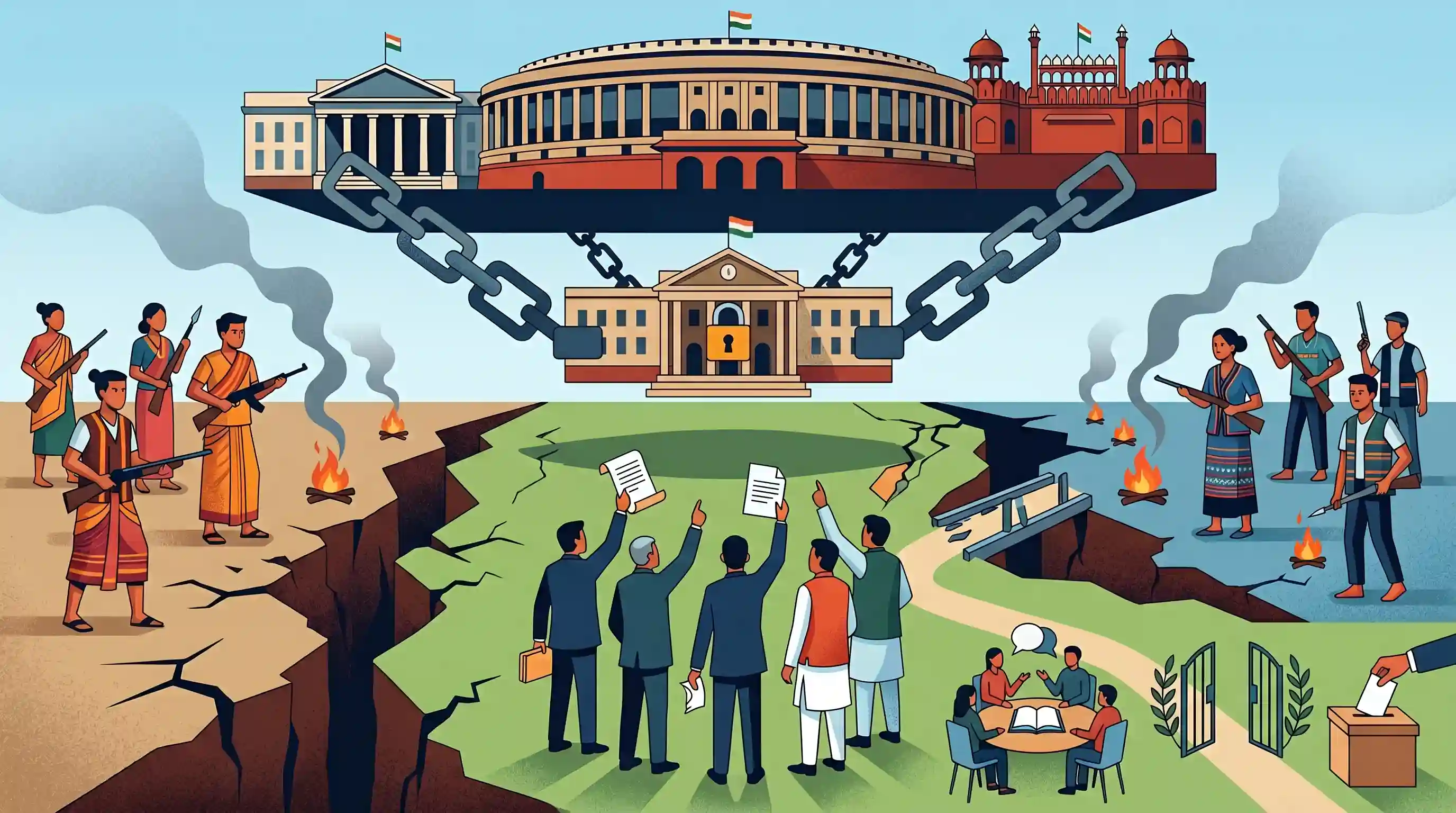
Twenty-one NDA MLAs from Manipur have petitioned the Central leadership to restore a popular government, ending the President's Rule imposed in mid-February. While an uneasy peace has settled over the state since December, the deep ethnic divide between Meiteis and Kukis remains unhealed, with no substantive political dialogue or disarmament taking place. The editorial underscores that reliance on administrative measures and central rule is insufficient to resolve the crisis. Instead, genuine confidence-building measures, the restoration of democratic processes, and engagement with civil society are urgently needed to build lasting peace and trust between the communities.
Key Points
- 21 NDA MLAs from Manipur have written to the Prime Minister and Home Minister urging the restoration of a popular government and the end of President's Rule, which was imposed on February 13.
- The state has been deeply fractured by a nearly two-year-long ethnic conflict between the Meiteis and Kukis, resulting in over 250 deaths and mass displacement.
- Despite an uneasy calm prevailing since December, no meaningful political dialogue has been initiated, and deep divisions persist.
- Armed groups on both sides of the ethnic divide remain fully armed, keeping the environment volatile and hindering true normalcy.
- The editorial argues that an administrative standstill under President's Rule is insufficient; the Centre must restart political processes and engage with civil society to foster trust and long-term peace.
Important Terms
Article 356 (President's Rule)

Constitutional provision allowing the Union to take direct control of a state's administration if the constitutional machinery fails, suspending or dissolving the state government.
UPSC context
GS Paper II (Polity); tests understanding of emergency provisions, Centre-State relations, and judicial review (S.R. Bommai case).
Article 355
A constitutional duty requiring the Union to protect states from external aggression and internal disturbance, and ensure governance follows the Constitution.
UPSC context
GS Paper II & III; crucial for the Union's security obligations and federal balance during state-level crises.
Federalism
A system dividing powers between the Centre and states; in India, it is often termed "quasi-federal" due to a strong central bias in emergencies.
UPSC context
GS Paper II (Polity); foundational concept for Centre-State legislative, executive, and financial relations.
Ethnic Conflict
Protracted struggle between ethnic groups over political power, land, or identity rights, frequently driven by historical grievances and perceived marginalization.
UPSC context
GS Paper III (Internal Security); examines threats to national integrity and challenges in managing multi-ethnic societies.
NDA (National Democratic Alliance)
A centre-right political coalition in India led by the Bharatiya Janata Party (BJP), including various national and regional parties.
UPSC context
GS Paper II (Polity); relates to coalition politics, executive stability, and party-system dynamics in a federal setup.
Popular Government
An elected government consisting of representatives who hold a majority in the legislature, as opposed to executive rule by the Governor or Centre.
UPSC context
GS Paper II (Polity); tests the transition from central intervention to democratic accountability and parliamentary governance.
Confidence-Building Measures (CBMs)
Strategic actions including dialogue and transparency designed to reduce suspicion and prevent the escalation of conflict between opposing groups.
UPSC context
GS Paper III (Internal Security); focuses on conflict resolution, peace-building frameworks, and post-violence stabilization.
Disarmament
The act of reducing or withdrawing weapons from a conflict zone, often a prerequisite for a permanent ceasefire and political dialogue.
UPSC context
GS Paper III (Internal Security); key to insurgency management and the "Suspension of Operations" (SoO) peace process.
Prelims Trap
"Article 371C grants constitutional protection and special land rights to the entire state of Manipur."
Article 371C provides special administrative safeguards and a dedicated legislative committee exclusively for the 'Hill Areas' of Manipur, not the state's valley regions.
Static Concepts Connected
What is the constitutional mandate of Article 371C for Manipur?
- 27th Amendment: Enacted via the 27th Amendment Act, 1971, to provide special constitutional provisions for the governance of Manipur.
- Hill Areas Committee: Mandates the creation of a legislative committee comprising Members of the Legislative Assembly (MLAs) elected specifically from the Hill Areas.
- Governor's Responsibility: The Governor holds a special responsibility to ensure the proper functioning of this committee and must submit annual reports to the President.
What happens to the state legislature under Article 356 (President's Rule)?
- Suspension or Dissolution: The state legislative assembly is either kept in suspended animation or dissolved; it is not automatically dissolved upon the immediate imposition of the rule.
- Parliamentary Lawmaking: The Parliament assumes the power to legislate on items in the State List and pass the state budget until popular government is restored.
- No Rights Impact: Unlike a National Emergency (Article 352), the imposition of President's Rule does not affect the Fundamental Rights of citizens.
Cross-Topic Patterns
Geography driving internal security
Manipur's topography—where the Meitei majority occupies 10% of the land (valley) and Kuki-Zomi occupy 90% (hills)—demonstrates how physical geography directly fuels ethnic polarization and internal security crises.
DDR frameworks in Northeast peace accords
The persistent threat from armed Meitei and Kuki militias contrasts with recent successful Northeast peace accords (like Bodo and Karbi Anglong) that hinged on strict Disarmament, Demobilization, and Reintegration (DDR) protocols.

Expect a comparative Prelims question testing Article 371C (Manipur) against 371A (Nagaland) and 371G (Mizoram) regarding tribal land rights.
Linked PYQs · 4
Linked PYQs · 4
- 2025MainsGS3
What are the major challenges to internal security and peace process in the North-Eastern States? Map the various peace accords and agreements initiated by the government in the past decade.
- 2017MainsGS3
The North-East region of India has been infested with insurgency for a very long time. Analyze the major reasons for the survival of armed insurgency in this region.
- 2019MainsGS3
Cross-border movement of insurgents is only one of the several security challenges facing the policing of the border in North-East India. Examine the various challenges currently emanating across the India-Myanmar border. Also, discuss the steps to counter the challenges.
- 2023MainsGS2
Account for the legal and political factors responsible for the reduced frequency of using Article 356 by the Union Governments since mid 1990s.
