Finance Commission chairman views on rupee depreciation and RBI
Source:The Hindu ↗
Why It Matters
Understanding the dynamics of currency depreciation and RBI intervention is crucial for UPSC aspirants. It highlights the trade-offs between defending the exchange rate, preserving foreign exchange reserves, and managing imported inflation. Questions on monetary policy responses to external shocks and exchange rate mechanisms appear frequently in both Prelims and Mains GS-3 (Economy).
Summary
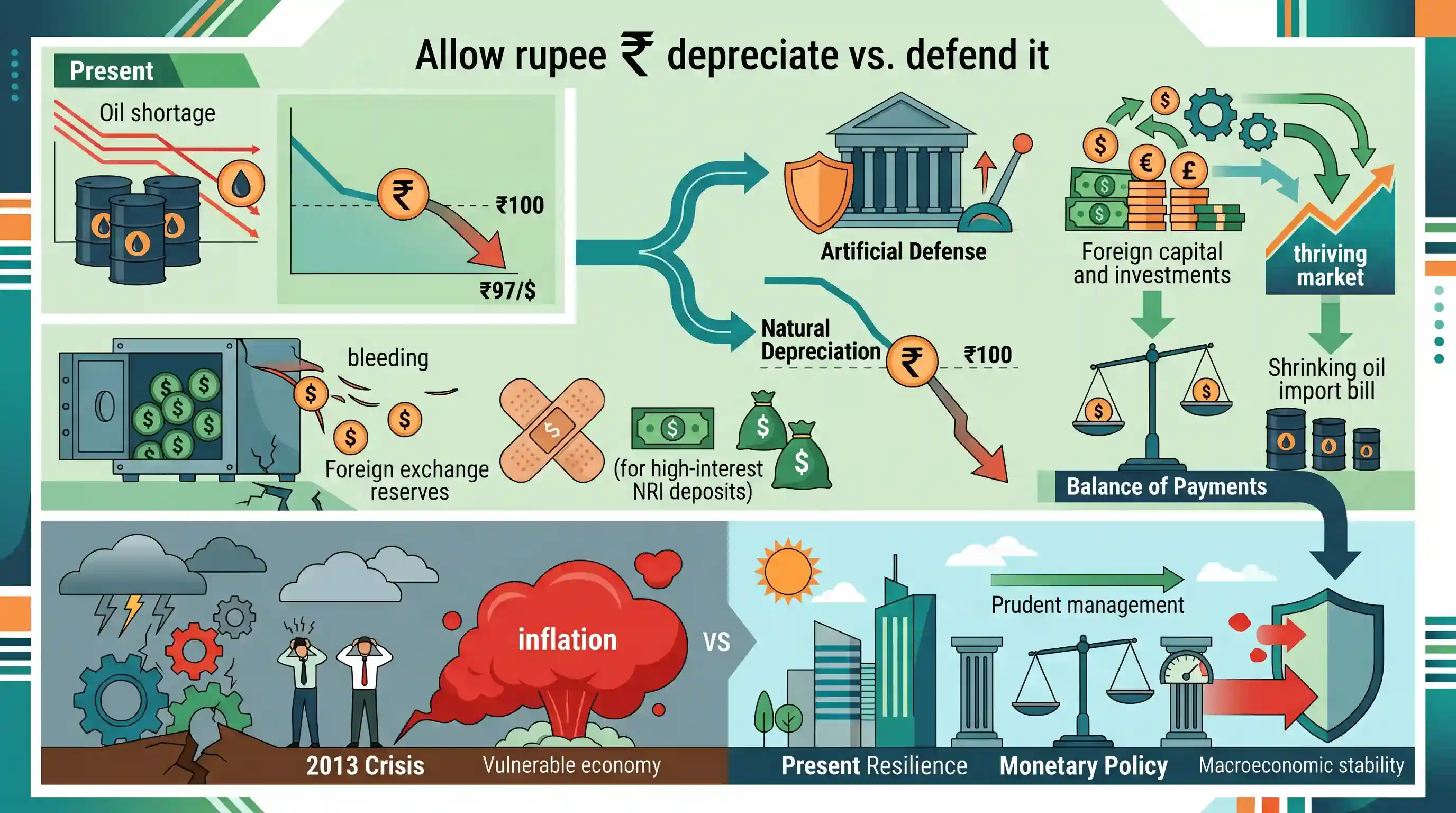
16th Finance Commission Chairman Arvind Panagariya has advised the Reserve Bank of India (RBI) to allow the rupee to depreciate past the ₹100 per dollar mark rather than artificially defending it amidst an oil shortage. The rupee recently neared ₹97 to a dollar, leading to RBI intervention to halt its 7% slide in CY26. Panagariya cautioned that defending the currency would bleed foreign exchange reserves, and issuing costly dollar-denominated bonds or high-interest NRI deposits would act as mere band-aids. He argued that natural depreciation is a better strategy, as a cheaper rupee would eventually attract foreign capital once the oil import bill shrinks. Highlighting the stark contrast with the 2013 currency crisis, Panagariya noted that India's current macroeconomic stability and prudent monetary management make the economy resilient enough to absorb the inflationary pressures of a weaker rupee.
Key Points
- 16th Finance Commission Chairman Arvind Panagariya advised the RBI not to artificially defend the rupee from crossing the psychological ₹100 per dollar mark amidst the current oil shortage.
- The Indian rupee has fallen 7% in CY26, recently nearing ₹97 to a dollar, prompting RBI intervention to prevent further depreciation.
- Panagariya argued that defending the currency risks exhausting foreign exchange reserves, and utilizing high-interest NRI dollar deposits or dollar-denominated bonds are costly measures that primarily benefit wealthy NRIs.
- He emphasized that allowing the rupee to depreciate naturally would help the currency recover later by attracting foreign capital seeking cheaper Indian investments.
- Unlike the 2013 crisis, India's current inflation is manageable due to prudent monetary policy, positioning the economy to absorb the inflationary pressures accompanying rupee depreciation.
Important Terms
16th Finance Commission

A constitutional body (Article 280) chaired by Arvind Panagariya. It recommends the formula for distributing tax revenues between the Union and States for the 2026–2031 period.
UPSC context
GS-II (Constitutional Bodies), GS-III (Fiscal Federalism). Critical for understanding fiscal transfers and Centre-State relations.
Reserve Bank of India (RBI)
India's central bank and regulatory body responsible for monetary policy, maintaining price stability, and managing the country's foreign exchange reserves and currency volatility.
UPSC context
GS-III (Economy). Core for questions on inflation, banking regulation, and external sector management.
Currency Depreciation
A market-driven decrease in the value of a currency relative to others in a floating exchange rate system, usually caused by factors like trade deficits or capital outflows.
UPSC context
GS-III (External Sector). Tested through impacts on exports, imports, inflation, and the J-curve effect.
Foreign Exchange Reserves (Forex)
Assets held by the central bank (FCA, gold, SDRs, and RTP) to buffer against external shocks, maintain currency confidence, and ensure payment of external obligations.
UPSC context
GS-III (External Sector). Important for "Import Cover" and RBI’s market intervention strategies.
Balance of Payments (BoP)
A systematic record of all economic transactions between a country's residents and the rest of the world, comprising the current account (trade) and capital account (investments).
UPSC context
GS-III (Economy - BoP). Essential for analyzing India's external health, trade deficits, and currency stability.
Exchange Rate Management
A policy framework (like India's "managed float") where the central bank intervenes in the forex market to curb excessive volatility without targeting a specific rate.
UPSC context
GS-III (Economy). Evaluates the balance between market forces and central bank stability measures.
Prelims Trap
"The RBI targets a specific nominal exchange rate value under India's exchange rate regime."
India uses a managed float system. The RBI intervenes in the forex market solely to curb excessive volatility, not to defend or target a specific fixed value (like ₹100 per dollar).
Static Concepts Connected
How does India's 'managed float' exchange rate system function?
- Market-determined: The rupee's value is primarily decided by the market forces of demand and supply for foreign exchange in the international market.
- RBI Intervention: The RBI buys or sells US dollars from its forex reserves to smooth out disruptive volatility, not to defend a fixed price.
- Depreciation vs. Devaluation: A market-driven fall is called "depreciation," whereas "devaluation" refers to a deliberate downward adjustment in a fixed exchange rate regime.
What are the macroeconomic consequences of severe Rupee depreciation?
- Imported Inflation: Essential, inelastic imports like crude oil and edible oils become costlier, directly pushing up domestic inflation rates.
- Export Competitiveness: Indian goods become cheaper in foreign markets, which can theoretically boost export competitiveness and volumes over time.
- External Debt Burden: A rapidly falling currency increases the debt servicing burden for Indian corporates holding external commercial borrowings (ECBs).
Cross-Topic Patterns
Imported Inflation + Flexible Inflation Targeting
Supply-side oil shocks cause imported inflation via a weaker rupee. This tests the RBI's Monetary Policy Committee's ability to maintain its 4% inflation target without choking economic growth.
Rupee Depreciation + 2013 Taper Tantrum
The 2013 'Taper Tantrum' saw severe rupee depreciation driven by high twin deficits. Current economic resilience is directly linked to stronger forex reserves and strict inflation targeting frameworks.

Expect a 2026 Prelims question linking RBI's managed float, NEER/REER dynamics, and how imported inflation affects the CAD.
Linked PYQs · 3
Linked PYQs · 3
- 2022PrelimsGS1
With reference to the Indian economy, consider the following statements: 1. If the inflation is too high, Reserve Bank of India (RBI) is likely to buy government securities. 2. If the rupee is rapidly depreciating, RBI is likely to sell dollars in the market. 3. If interest rates in the USA or European Union were to fall, that is likely to induce RBI to buy dollars. Which of the statements given above are correct?
- 2019PrelimsGS1
Which one of the following is not the most likely measure the Government/RBI takes to stop the slide of Indian rupee?
- 2018MainsGS3
How would the recent phenomena of protectionism and currency manipulations in world trade affect macroeconomic stability of India?
