Finance Commission chief advises RBI against defending rupee
Source:The Hindu ↗
Why It Matters
This article provides an excellent real-world policy debate on exchange rate management. It highlights the trade-offs the RBI faces between defending the rupee (using forex reserves and NRI deposits) versus letting it depreciate to act as a shock absorber for the current account. This is highly relevant for GS3 Economy questions on macroeconomic stability, imported inflation, and currency manipulation.
Summary
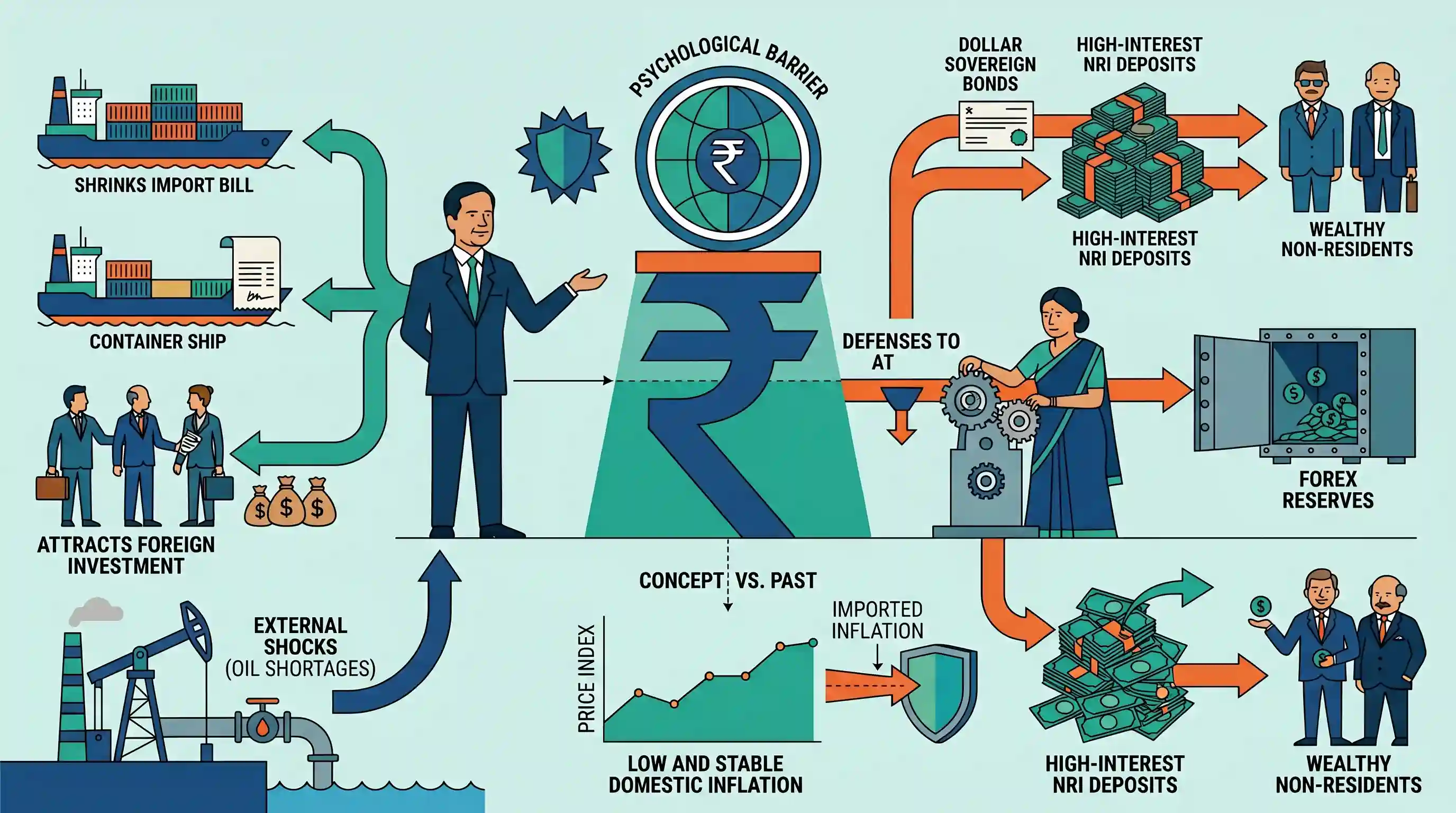
The Chairman of the 16th Finance Commission, Arvind Panagariya, has advised the Reserve Bank of India (RBI) not to excessively intervene to prevent the Indian rupee from depreciating past the psychological mark of ₹100 against the US dollar. Countering the RBI's recent interventions to defend the currency at ₹97, Panagariya argued that letting the rupee depreciate naturally is the optimal response to external shocks like oil shortages, as it shrinks the import bill and attracts foreign investment. He warned against depleting foreign exchange reserves or relying on costly instruments like dollar-denominated sovereign bonds and high-interest NRI deposits, which he argued essentially transfer wealth to wealthy non-residents. Furthermore, he noted that unlike the 2013 crisis, India currently has low and stable domestic inflation, giving the economy ample buffer to absorb any imported inflation caused by a weaker rupee.
Key Points
- 16th Finance Commission Chairman Arvind Panagariya advised the RBI not to defend the rupee if it breaches the psychological mark of ₹100 against the US dollar.
- The RBI recently intervened heavily in intraday trading to prevent the rupee from falling past the ₹97 per dollar mark.
- Panagariya argued that allowing the currency to depreciate naturally helps self-correct the economy by shrinking the import bill and subsequently attracting foreign capital.
- He criticized the strategy of defending the currency by bleeding foreign exchange reserves or by issuing costly dollar-denominated bonds and high-interest NRI deposits.
- India's current low domestic inflation provides the economy with a sufficient buffer to absorb any imported inflation resulting from a weaker rupee, unlike the 2013 'taper tantrum' crisis.
Important Terms
16th Finance Commission

A constitutional body under Article 280 that recommends the formula for tax revenue sharing between the Union and States and among States.
UPSC context
GS Paper II (Constitutional Bodies) and GS Paper III (Fiscal Federalism/Economic Development).
Reserve Bank of India (RBI)
India's central bank and custodian of foreign exchange reserves, responsible for maintaining monetary stability and managing the "managed float" exchange rate system.
UPSC context
GS Paper III (Indian Economy); tests knowledge of monetary policy and currency management.
Rupee Depreciation
A market-driven decrease in the value of the Indian rupee against foreign currencies (like the USD) due to higher demand for foreign currency.
UPSC context
GS Paper III (External Sector); tests impact on trade, CAD, and exports.
Foreign Exchange (Forex) Reserves
External assets held by the RBI, including foreign currency, gold, and SDRs, used to back liabilities and influence the exchange rate.
UPSC context
GS Paper III (Economic Development); critical for understanding Balance of Payments stability.
Imported Inflation
Domestic price increases caused by a rise in the cost of imported goods (e.g., crude oil) due to a weaker domestic currency.
UPSC context
GS Paper III (Inflation); focuses on external linkages to domestic price stability.
Sovereign Bonds (Dollar-Denominated)
Debt securities issued by the national government in foreign currency, shifting the exchange rate risk from the investor to the government.
UPSC context
GS Paper III (Budgeting/External Debt); tests knowledge of alternative funding and its risks.
Prelims Trap
A depreciating rupee unconditionally worsens India's Balance of Payments by permanently increasing the import bill.
While the import bill initially spikes (J-curve effect), depreciation eventually acts as an automatic stabilizer by making exports cheaper and imports costlier, which helps narrow the CAD.
Static Concepts Connected
How does India's managed floating exchange rate operate?
- Market Determined: The Rupee's value is fundamentally determined by market forces of supply and demand for foreign exchange.
- Volatility Checks: The RBI intervenes (buying/selling dollars) strictly to curb excessive speculative volatility, not to defend a pre-determined or fixed target rate.
What are the primary channels of imported inflation in India?
- Direct Channel: Immediate rise in the rupee price of final imported consumer goods.
- Indirect Channel: Higher costs of imported raw materials (crude oil, critical minerals) cascading into domestic manufacturing and logistics costs, subsequently raising headline inflation.
Cross-Topic Patterns
Currency Dynamics + Current Account Deficit
UPSC frequently tests the "automatic stabilizer" concept, where a weakening currency naturally corrects trade deficits by making exports competitive and suppressing import demand.
Sovereign Debt + Exchange Rate Risk
Issuing dollar-denominated bonds to defend the rupee shifts currency risk to the sovereign, an issue heavily debated during the 2019 Union Budget's overseas borrowing proposal.

A 2026 prelims question linking RBI's managed float, imported inflation mechanics, and FCNR deposit impacts is highly probable.
Linked PYQs · 5
Linked PYQs · 5
- 2022PrelimsGS1
With reference to the Indian economy, consider the following statements: 1. If the inflation is too high, Reserve Bank of India (RBI) is likely to buy government securities. 2. If the rupee is rapidly depreciating, RBI is likely to sell dollars in the market. 3. If interest rates in the USA or European Union were to fall, that is likely to induce RBI to buy dollars. Which of the statements given above are correct?
- 2019PrelimsGS1
Which one of the following is not the most likely measure the Government/RBI takes to stop the slide of Indian rupee?
- 2022PrelimsGS1
With reference to the Indian economy, consider the following statements: 1. An increase in Nominal Effective Exchange Rate (NEER) indicates the appreciation of rupee. 2. An increase in the Real Effective Exchange Rate (REER) indicates an improvement in trade competitiveness. 3. An increasing trend in domestic inflation relative to inflation in other countries is likely to cause an increasing divergence between NEER and REER. Which of the above statements are correct?
- 2013PrelimsGS1
Which one of the following groups of items is included in India's foreign-exchange reserves?
- 2018MainsGS3
How would the recent phenomena of protectionism and currency manipulations in world trade affect macroeconomic stability of India?
