Constitutional Jurisprudence on the Right to Freedom of Assembly
Source:The Hindu ↗
Why It Matters
The right to assembly is foundational to Indian democracy. Understanding its scope, global comparative practices, and the balance between public order and fundamental freedoms is essential for GS Paper II.
Summary
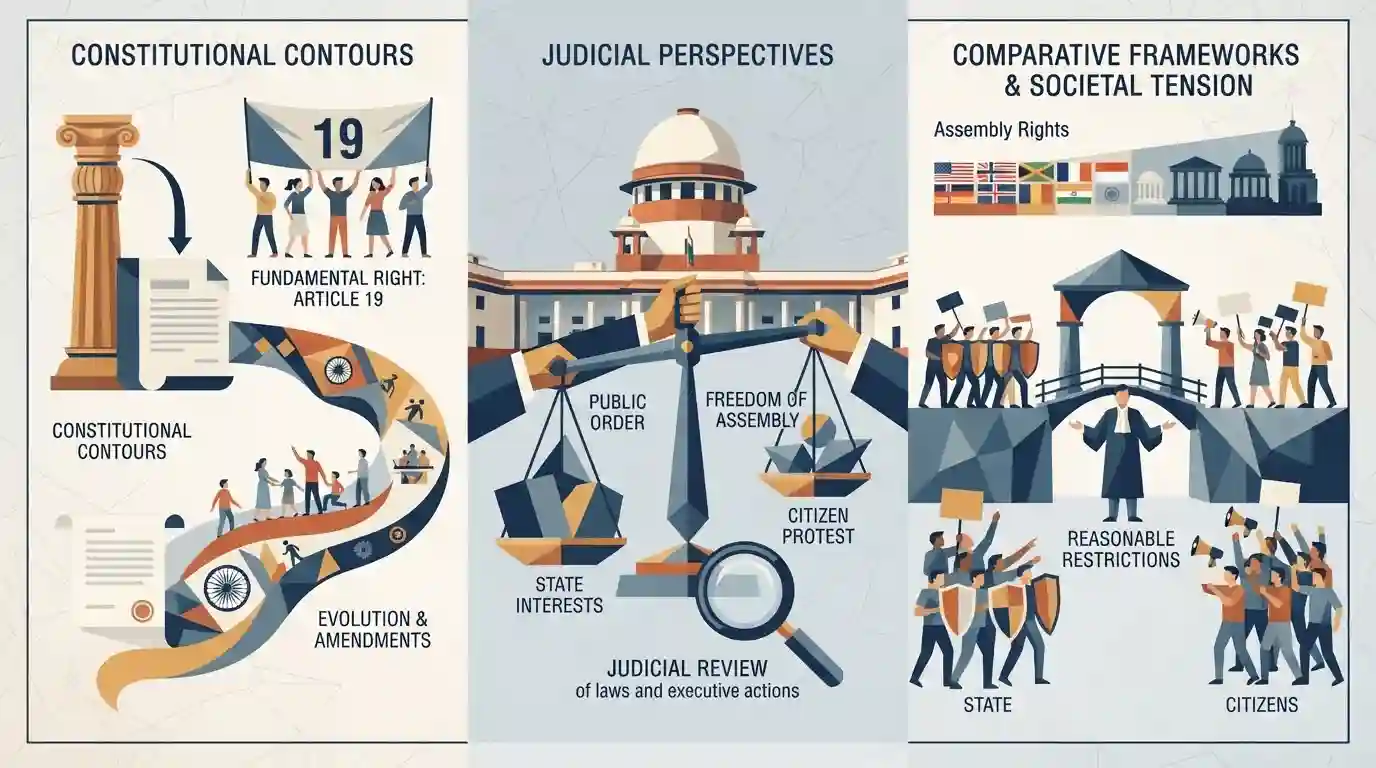
The article explores the constitutional contours, judicial perspectives, and comparative frameworks governing the right to freedom of assembly. It analyzes how democratic societies navigate the tension between maintaining public order and protecting the fundamental right of citizens to protest and assemble peacefully.
Key Points
- The right to assemble peaceably and without arms is guaranteed under Article 19(1)(b) of the Indian Constitution, subject to reasonable restrictions in the interest of public order and sovereignty.
- Comparative jurisprudence reveals varying approaches across global democracies regarding public assemblies, balancing free expression with public order and safety.
- State responses to protests often grapple with administrative overreach, arbitrary bans, and the misuse of prohibitory orders under criminal procedure codes.
- Judicial oversight plays a crucial role in safeguarding democratic space by ensuring that restrictions on assembly are proportionate, non-discriminatory, and necessary.
Important Terms
Article 19(1)(b)

Guarantees Indian citizens the right to assemble peacefully and without arms, subject to reasonable restrictions in the interest of public order and sovereignty.
UPSC context
UPSC GS Paper II: Indian Constitution—historical underpinnings, evolution, features, amendments, and Fundamental Rights (Article 19).
European Convention on Human Rights
An international treaty protecting human rights and fundamental freedoms in Europe, including the explicit right to freedom of peaceful assembly and association under Article 11.
UPSC context
UPSC GS Paper II: Comparison of the Indian constitutional scheme with that of other major democratic countries.
First Amendment to the U.S. Constitution
Protects freedom of speech, press, assembly, and petition in the United States, providing a comparative benchmark for constitutional protections of public protest.
UPSC context
UPSC GS Paper II: Comparative constitutional frameworks and judicial doctrines across democracies.
Prelims Trap
the right to assemble peaceably and without arms is absolute once granted permission by local police authorities
The right to assemble is not absolute and can be regulated, but the State cannot impose a total or blanket prohibition on public meetings under the guise of regulation.
Static Concepts Connected
What are the constitutional dimensions and reasonable restrictions under Article 19(1)(b) and Article 19(3)?
- Scope: Guaranteed right: Article 19(1)(b) grants all citizens the right to assemble peaceably and without arms.
- Restrictions: Conditional: The right is subject to reasonable restrictions imposed by the State under Article 19(3).
- Grounds: Grounds: Restrictions can only be made in the interests of the sovereignty and integrity of India or public order.
- Citizenship: Non-citizens: This fundamental right is exclusively available to Indian citizens and not to foreign nationals.
Cross-Topic Patterns
Proportionality test in rights vs public order
Proportionality tests and administrative overreach in public order management connect fundamental rights enforcement with police reforms and bureaucratic accountability under administrative law.
Public thoroughfares, protests, and urban governance
The tension between indefinite occupation of public spaces and citizen convenience links constitutional jurisprudence with urban planning and municipal governance issues.

Expect a multi-statement prelims question combining Article 19(1)(b) reasonable restrictions, proportionality tests, and Supreme Court rulings.
Linked PYQs · 3
Linked PYQs · 3
- 2022MainsGS2
“Right of movement and residence throughout the territory of India are freely available to the Indian citizens, but these rights are not absolute.” Comment.
- 2017MainsGS2
Examine the scope of Fundamental Rights in the light of the latest judgement of the Supreme Court on Right to Privacy.
- 2014MainsGS2
What do you understand by the concept "freedom of speech and expression"? Does it cover hate speech also ? Why do the films in India stand on a slightly different plane from other forms of expression ? Discuss.
