Crowd Management Lessons from Independent India's First Kumbh
Source:Indian Express ↗
Why It Matters
Crowd management at religious festivals is a highly relevant subset of Disaster Management (GS3). Understanding the administrative failures of the 1954 Kumbh Mela and the subsequent structural reforms provides excellent historical context for essays or answers on India's evolution from reactive to proactive disaster preparedness.
Summary
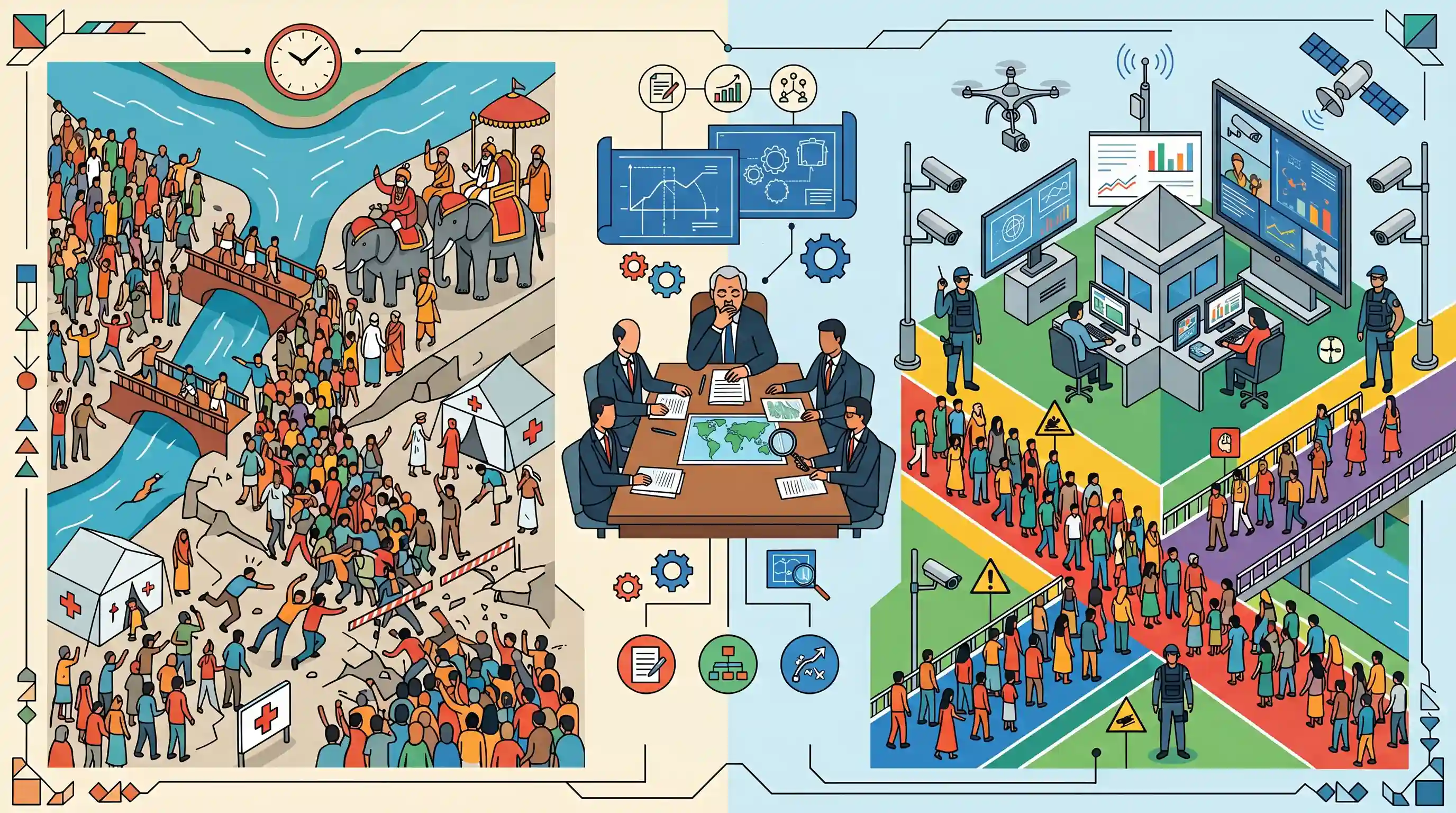
The article reflects on the devastating stampede at the 1954 Kumbh Mela in Allahabad (now Prayagraj), independent India's first Maha Kumbh, which claimed over 800 lives. It explores the systemic failures—such as inadequate infrastructure, poor crowd control, and disruptive VIP movements—that precipitated the tragedy. The piece highlights how the resultant Justice Kamala Kant Verma Committee recommendations laid the groundwork for modern crowd management protocols. Comparing 1954 with contemporary mass gatherings, the article underscores the evolution from reactive administration to proactive disaster preparedness using modern technology, emphasizing the vital historical and administrative lessons learned for managing mass events.
Key Points
- The 1954 Maha Kumbh in Prayagraj was independent India's first, but it became infamous for a tragic stampede on Mauni Amavasya that killed over 800 people.
- The disaster was primarily caused by infrastructural unpreparedness, sudden crowd surges, and the disruptive impact of VIP movements on general crowd flow.
- The Justice Kamala Kant Verma Committee was established in the aftermath; its report laid the foundational standard operating procedures (SOPs) for crowd control and traffic management at large religious gatherings.
- The tragedy catalyzed a long-term administrative shift. Today's mass gatherings, including recent Kumbh Melas, rely on predictive planning, AI, drone surveillance, and strict NDMA guidelines to proactively manage millions of pilgrims.
Important Terms
Justice Kamala Kant Verma Committee

A judicial inquiry commission established after the 1954 Kumbh Mela tragedy to investigate systemic failures and recommend improvements for managing mass religious gatherings.
UPSC context
Relevant for GS Paper 1 (Post-Independence History) and Paper 3 (Disaster Management) as a landmark in crowd-control policy evolution.
National Disaster Management Authority (NDMA)
The apex statutory body for disaster management in India, headed by the Prime Minister, mandated to formulate policies and coordinate responses to natural or man-made disasters.
UPSC context
Core topic for GS Paper 3 (Disaster Management); tests knowledge of institutional frameworks for disaster mitigation and crisis response.
NDMA Guidelines on Crowd Management
A set of protocols focusing on capacity planning, crowd profiling, risk assessment, and real-time monitoring to prevent stampedes and ensure safety at mass gatherings.
UPSC context
Critical for GS Paper 3 (Disaster Management) and GS Paper 4 (Case Studies) for implementing practical safety measures in public administration.
Disaster Management Act, 2005
The primary legislation in India providing the legal framework for disaster management, including the creation of NDMA, SDMAs, and DDMAs.
UPSC context
Fundamental for GS Paper 2 (Governance) and GS Paper 3 (Disaster Management); defines the statutory powers of the government during emergencies.
Uttar Pradesh Police
The primary law enforcement agency responsible for executing on-ground crowd control, traffic management, and security protocols during the Kumbh Mela in Prayagraj.
UPSC context
Relevant for GS Paper 3 (Internal Security) and Public Administration, focusing on the tactical execution of public order during mega-events.
Prelims Trap
"NDMA directly assumes control of crowd management and security during national-level religious gatherings like the Maha Kumbh."
Public order and police are State List subjects (Schedule VII). NDMA only issues advisory guidelines; operational control and execution remain strictly with state and local authorities.
Static Concepts Connected
What are the core NDMA guidelines for crowd management at mass gatherings?
- Infrastructure Design: Mandates structural measures like multiple wide exits, outward-opening gates, and snake-line barricades to regulate flow.
- VIP Protocols: Strict regulation and restriction of VIP movements during peak gathering hours to prevent the creation of lethal bottlenecks.
- Tech Integration: Utilization of AI, drone surveillance, and CCTV networks for real-time crowd density tracking and early warning alerts.
- Emergency Response: Ensuring robust medical preparedness, emergency evacuation routes, and clear public address systems to mitigate panic during surges.
What is the institutional framework for Disaster Management in India?
- NDMA (National Level): Headed by the Prime Minister, it is the apex body that lays down overarching policies, plans, and guidelines for disaster management.
- SDMA (State Level): Headed by the Chief Minister, responsible for coordinating implementation and ensuring state-level disaster preparedness.
- DDMA (District Level): Headed by the District Magistrate/Collector, acting as the primary execution and planning body at the grassroots level.
Cross-Topic Patterns
Post-Independence history meets disaster management
The 1954 Kumbh stampede is a vital GS1 case study showing the shift from reactive colonial policing to welfare-oriented, proactive crowd management in early independent India.
Tech integration in public order
Connects GS3 Disaster Management with E-governance. The shift from manual barricading to AI predictive crowd-density monitoring highlights tech's growing role in internal security and public administration.

Expect a GS3 Mains question linking traditional mass-gathering challenges with AI/tech-driven disaster risk reduction (DRR) strategies.
Linked PYQs · 3
Linked PYQs · 3
- 2020MainsGS3
Discuss the recent measures initiated in disaster management by the Government of India departing from the earlier reactive approach.
- 2019MainsGS3
Vulnerability is an essential element for defining disaster impacts and its threat to people. How and in what ways can vulnerability to disasters be characterized? Discuss different types of vulnerability with reference to disasters.
- 2025MainsGS1
Trace India's consolidation process during early phase of independence in terms of polity, economy, education and international relations.
