Chola Administration Local Governance and Water Management Lessons
Source:The Hindu ↗
Why It Matters
Directly addresses the historical legacy of the Cholas (a highly recurring UPSC theme in Prelims and GS1 Mains) and links it to modern governance issues (GS2), providing excellent fodder for comparative analysis in Mains answers.
Summary
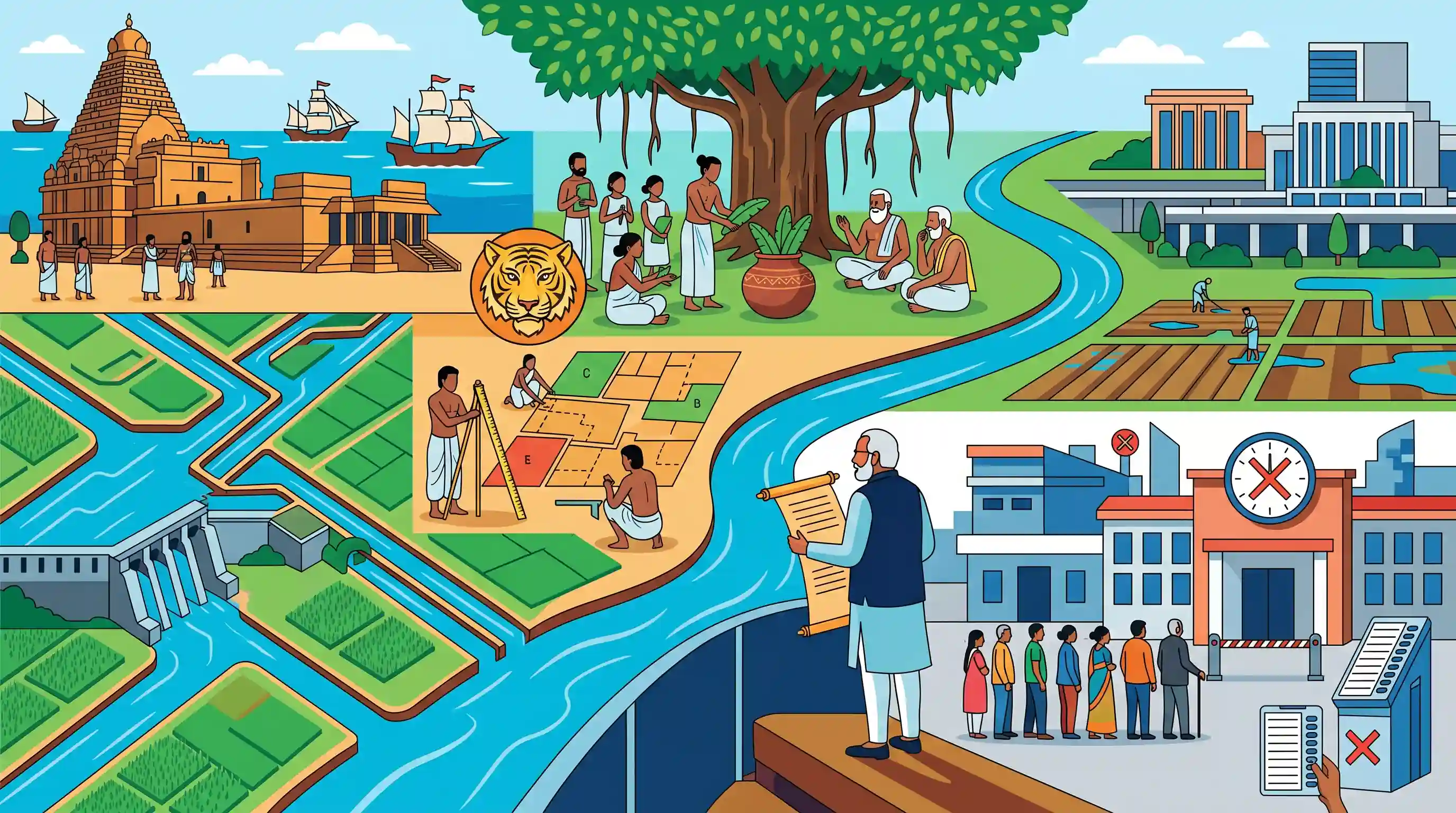
A reflection on the Chola dynasty’s legacy, triggered by the Prime Minister’s visit to Gangaikonda Cholapuram. While their monumental temples and maritime expeditions under Rajaraja I and Rajendra I are widely celebrated, the article emphasizes their significant achievements in governance. The Cholas developed sophisticated systems for land revenue, water management in the Cauvery delta, and early forms of democratic decentralization through village assemblies. The editorial contrasts these historical successes with modern challenges, particularly the delayed elections for local bodies in contemporary India, urging policymakers to draw practical administrative lessons from the Chola era rather than merely glorifying their imperial past.
Key Points
- The Chola empire's legacy encompasses not only grand architecture and maritime conquests but also sophisticated local administration and water management.
- Temples like the Brihadisvara showcase advanced architectural techniques, such as interlocking stones without mortar, providing seismic resilience.
- The Cholas established an early form of democratic decentralization with elected local assemblies, contrasting with modern delays in holding local body elections in India.
- Their efficient water management system, utilizing interconnected tanks in the Cauvery delta, prevented both floods and droughts, offering lessons for contemporary conservation.
Important Terms
Village Assemblies (Chola)

Autonomous local governing bodies in medieval South India, specifically the 'Sabha' (Brahmin villages) and 'Ur' (non-Brahmin villages), known for sophisticated committee-based administration and electoral processes.
UPSC context
GS Paper I (Ancient History) & GS Paper II (Local Governance). Tests knowledge of historical roots of Indian democracy.
73rd Constitutional Amendment Act
A landmark 1992 legislation that granted constitutional status to rural local self-governments (Panchayati Raj Institutions), adding Part IX and the Eleventh Schedule to the Constitution.
UPSC context
GS Paper II (Polity). Essential for understanding democratic decentralization and mandatory provisions for rural local bodies.
74th Constitutional Amendment Act
A 1992 legislation providing constitutional status to urban local bodies (Municipalities), introducing Part IXA and the Twelfth Schedule to govern towns and cities.
UPSC context
GS Paper II (Governance). Crucial for urban administration, ward committees, and urban planning topics.
Finance Commission
A constitutional body (Article 280) appointed every five years to recommend the distribution of financial resources between the Union and States, including grants for local bodies.
UPSC context
GS Paper II (Polity) & GS Paper III (Economy). Key for fiscal federalism and financial health of local governments.
Panchayati Raj
The system of local self-government in rural India, organized into a three-tier structure: Gram Panchayat (village), Panchayat Samiti (block), and Zila Parishad (district).
UPSC context
GS Paper II (Polity & Governance). Fundamental topic regarding grassroots democracy and rural development.
Local Bodies
Collectively refers to Panchayati Raj Institutions (rural) and Municipalities (urban), acting as the third tier of government to manage community affairs.
UPSC context
GS Paper II (Governance). Tests understanding of decentralized administration and the implementation of social justice at the local level.
Prelims Trap
The Chola Kudavolai system was an early democratic process based on universal adult franchise.
The system was not universal. It had strict eligibility criteria: candidates had to own tax-paying land, fall within the 35–70 age bracket, and possess specific educational qualifications.
Static Concepts Connected
What were the three primary types of village assemblies in the Chola administration?
- Ur: The general assembly of the village consisting of all tax-paying residents.
- Sabha or Mahasabha: An exclusive assembly of Brahmin landholders, specifically functioning in entirely Brahmin villages (Brahmadeya).
- Nagaram: Assemblies of merchants, traders, and artisans, typically found in prominent commercial and trading centers.
What are the distinguishing engineering features of imperial Chola temple architecture?
- Vimana dominance: Massive, towering step-pyramid structures built over the garbhagriha (sanctum), overshadowing the gopurams (gateways).
- Mortarless interlocking: Extensive use of granitic stones cut to interlock precisely without mortar, providing incredible seismic resilience.
- Dvarapalas: Fierce, monumental guardian figures placed at the entrance of the sanctum or the temple itself.
Cross-Topic Patterns
Historical roots of the 73rd Amendment
Linking the Chola 'Kudavolai' system with modern Panchayati Raj highlights India's deep historical tradition of decentralized, participatory local governance.
Kudimaramath and modern climate resilience
The Chola community-driven interconnected tank system (Kudimaramath) in the Cauvery delta offers a historical blueprint for contemporary participatory irrigation and flood management.

Expect a multi-statement question contrasting the restrictive eligibility of the Chola Kudavolai system with modern Panchayati Raj.
Linked PYQs · 5
Linked PYQs · 5
- 2013MainsGS1
Chola architecture represents a high watermark in the evolution of temple architecture. Discuss.
- 2022MainsGS1
Discuss the main contributions of Gupta period and Chola period to Indian heritage and culture.
- 2024MainsGS1
Though the great Cholas are no more yet their name is still remembered with great pride because of their highest achievements in the domain of art and architecture. Comment.
- 2024MainsGS2
Analyse the role of local bodies in providing good governance at local level and bring out the pros and cons merging the rural local bodies with the urban local bodies.
- 2017MainsGS2
The local self-government system in India has not proved to be effective instrument of governance." Critically examine the statement and give your views to improve the situation.
