Structural Vulnerabilities in Public Infrastructure and Transport
Source:The Hindu ↗
Why It Matters
Provides a critical economic perspective on public infrastructure delivery, contrasting the failures of underfunded state services with the risks of private monopolies. Highly relevant for GS3 answers on PPP models, infrastructure development, and inclusive growth.
Summary
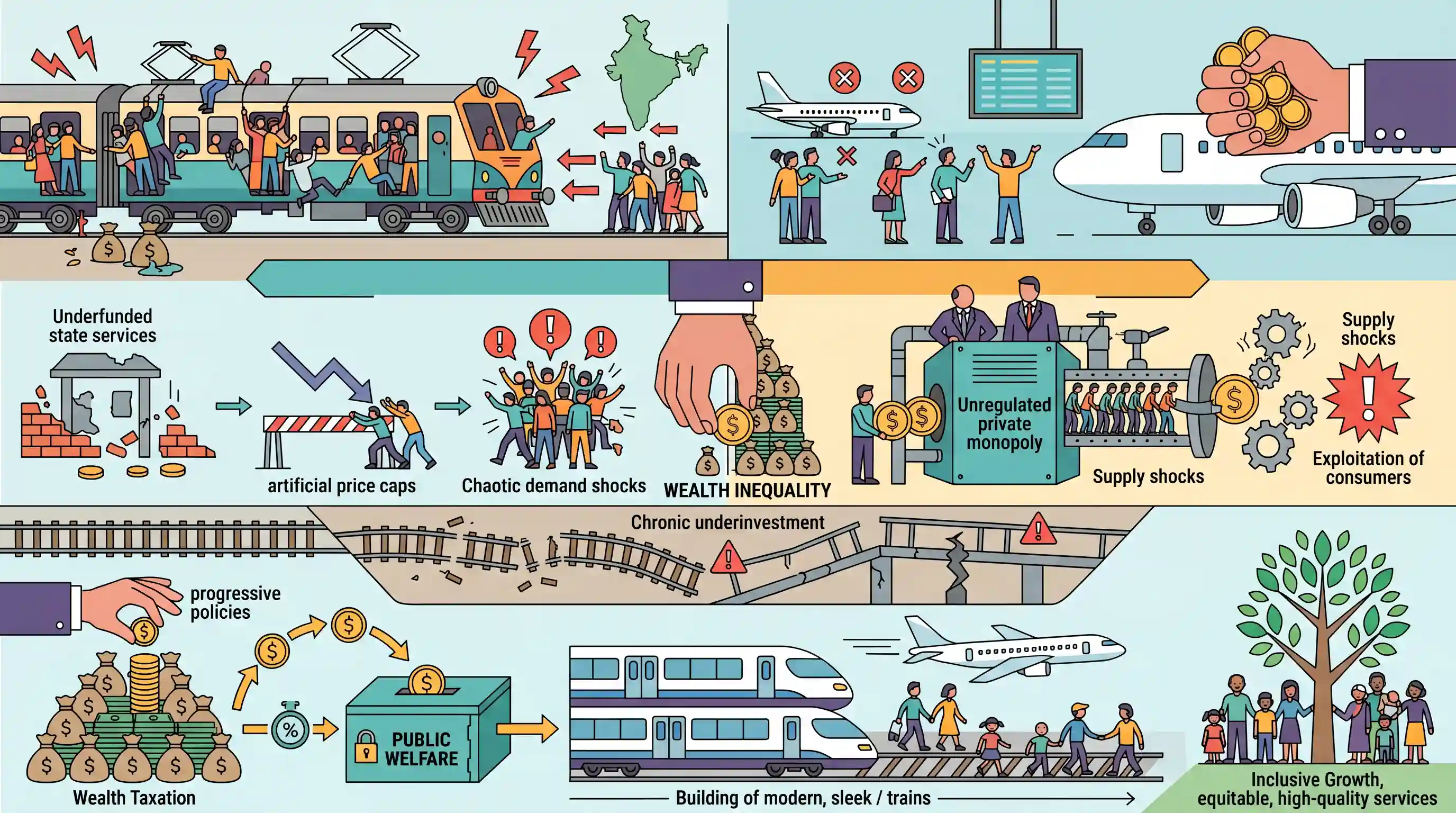
An analysis of recent transport crises in India, including railway overcrowding and mass flight cancellations by IndiGo, reveals significant weaknesses in the neo-liberal economic model. The article argues that underfunded state-run services with artificial price caps lead to chaotic demand shocks, while unregulated private monopolies create supply shocks and exploit consumers. To solve the chronic underinvestment in essential public infrastructure, the author suggests adopting progressive policies like wealth taxation to fund public welfare and ensure equitable, high-quality services.
Key Points
- Recent transport crises in India—overcrowding in railways during Chhath Puja and mass cancellation of IndiGo flights—highlight structural flaws in the current economic model.
- Artificial price caps in public transport like railways, without corresponding public investment, result in demand shocks, extreme overcrowding, and degraded service quality.
- Conversely, deregulation in the aviation sector has allowed near-monopolies to form, leading to supply shocks where private entities can exploit consumers with sudden price surges and poor service.
- These events expose the limitations of a neo-liberal framework, which struggles to balance public welfare against the interests of capital.
- Addressing underinvestment in public infrastructure requires systemic reforms, such as implementing wealth taxation (as suggested by Thomas Piketty), to ensure equitable and efficient public services.
Important Terms
Indian Railways

India's state-owned national carrier and the world's fourth-largest rail network. It serves as a critical "lifeline," providing affordable transport for millions while facing challenges of chronic underinvestment and extreme seasonal overcrowding.
UPSC context
GS Paper 3: Infrastructure. Tested on its role in inclusive growth, logistical efficiency, and the debate between privatization and public funding.
IndiGo
India’s largest private airline, holding over 60% of the domestic market. It recently faced a major crisis with mass flight cancellations, highlighting risks associated with private sector monopolies and "too-big-to-fail" infrastructure entities.
UPSC context
GS Paper 3: Infrastructure (Aviation). Examines market concentration, regulatory compliance, and the impact of private monopolies on consumer welfare.
Neo-liberalism
An economic model advocating for free markets, deregulation, privatization, and reduced government spending. Critics argue it leads to underfunded public services and increased wealth inequality in developing economies like India.
UPSC context
GS Paper 3: Indian Economy. Relevant for analyzing the shift from state-led development to market-driven policies and its social consequences.
Wealth Tax
A direct tax on an individual's net assets (property, cash, stocks). Abolished in India in 2015, its reintroduction is often proposed to fund public infrastructure and address extreme wealth concentration.
UPSC context
GS Paper 3: Government Budgeting & Inclusive Growth. Tested as a fiscal tool for redistribution and resource mobilization.
Flight Duty Time Limitation (FDTL)
Safety regulations issued by the DGCA that limit pilot flying hours and mandate rest periods to prevent fatigue. Non-compliance with revised FDTL norms recently triggered large-scale aviation disruptions in India.
UPSC context
GS Paper 3: Infrastructure/Aviation Safety. Important for understanding regulatory oversight and safety standards in the civil aviation sector.
Supply and Demand Shocks
Sudden events that significantly increase demand (e.g., festive travel surges) or decrease supply (e.g., mass cancellations). These shocks expose structural weaknesses in underfunded public services and unregulated private markets.
UPSC context
GS Paper 3: Indian Economy. Key for analyzing market volatility, infrastructure resilience, and the necessity of state intervention during crises.
Prelims Trap
India currently levies a direct Wealth Tax on ultra-high net worth individuals to fund infrastructure.
India abolished the Wealth Tax in 2015 due to high compliance costs and low yields, replacing it with an additional surcharge on the super-rich.
Static Concepts Connected
What does the Operating Ratio (OR) of Indian Railways signify?
- Definition: It is the ratio of working expenses to traffic earnings, indicating the financial efficiency of the organization.
- Interpretation: An OR above 100 indicates that the railways spends more than it earns, leaving zero internal surplus for capital investments.
- Structural Impact: Consistently high ORs directly cause chronic underinvestment in track additions, safety enhancements, and capacity expansion, exacerbating passenger overcrowding.
How are monopolistic practices regulated in India's deregulated sectors?
- Regulatory Authority: The Competition Commission of India (CCI), a statutory body established under the Competition Act, 2002.
- Core Mandate: It is mandated to prevent practices that have an appreciable adverse effect on competition, protecting consumer interests.
- Abuse of Dominance: CCI has the power to investigate entities with dominant market share (e.g., in aviation) for unfair pricing, restricting services, or exploiting supply shocks.
Cross-Topic Patterns
Wealth inequality and tax policy shifts
The debate links Piketty's findings on historic inequality to India's shift from direct wealth taxes (abolished 2015) to indirect taxation and surcharges.
Privatization vs. State capacity in infrastructure
Connects railway underinvestment to the push for PPP models and the National Monetisation Pipeline (NMP), questioning if unregulated private monopolies merely replace state inefficiencies.

Railway operating ratios, aviation market dominance, and wealth tax history could form a complex multi-statement economy question in 2026.
Linked PYQs · 4
Linked PYQs · 4
- 2017MainsGS3
Examine the development of Airports in India through joint ventures under Public-Private Partnership (PPP) model. What are the challenges faced by the authorities in this regard?
- 2022MainsGS3
Why is Public Private Partnership (PPP) required in infrastructural projects ? Examine the role of PPP model in the redevelopment of Railway Stations in India.
- 2014MainsGS3
Capitalism has guided the world economy to unprecedented prosperity. However, it often encourages short-sightedness and contributes to wide disparities between the rich and the poor. In this light, would it be correct to believe and adopt capitalism for bringing inclusive growth in India? Discuss.
- 2024MainsGS3
Examine the pattern and trend of public expenditure on social services in the post-reforms period in India. To what extent this has been in consonance with achieving the objective of inclusive growth?
