China pollution control offers airshed management lessons for India
Source:The Hindu ↗
Why It Matters
Urban air pollution, particularly the persistent winter smog in North India, is a severe public health crisis and a highly recurring UPSC theme. Analyzing successful international models like China's provides critical, actionable insights for Mains answers when evaluating the shortcomings of India's NCAP and proposing systemic governance reforms.
Summary
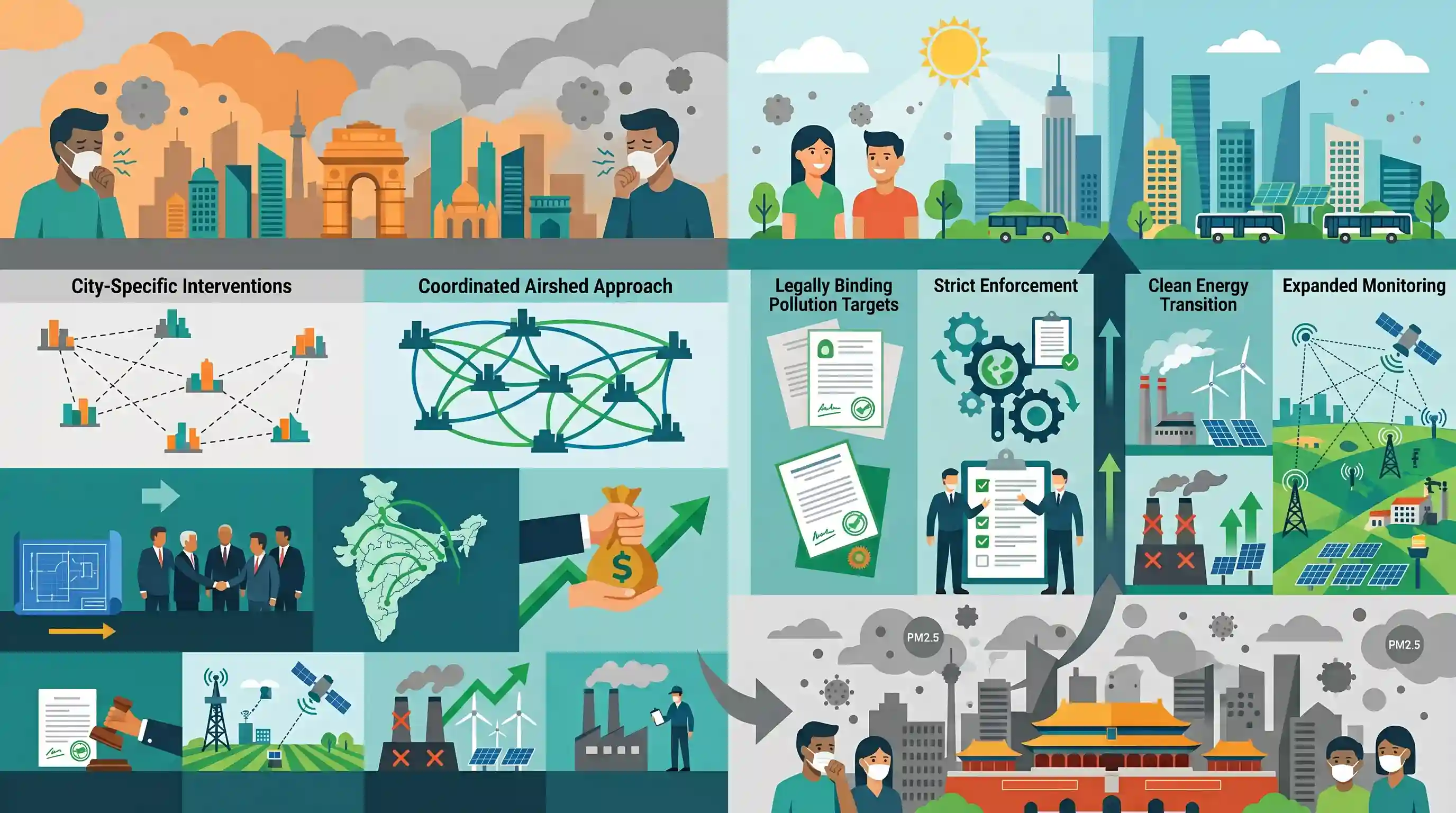
The article provides a comparative analysis of environmental governance, contrasting India's struggle with severe air pollution against China's successful mitigation of Beijing's smog over the past decade. It underscores the critical need for a coordinated 'airshed' approach rather than fragmented, city-specific interventions. Key lessons for India include the establishment of legally binding pollution reduction targets, scaling up monitoring infrastructure to rural areas, shifting aggressively from coal to cleaner energy sources, and enforcing strict compliance mechanisms. While India's National Clean Air Programme (NCAP) sets ambitious goals, the article argues that it requires stronger political will, enhanced inter-state coordination (especially across the Indo-Gangetic Plain), and robust financial backing to replicate China's success in drastically reducing PM2.5 levels.
Key Points
- Contrasts China's highly effective 'war on pollution' (launched in 2013) with India's current trajectory under the National Clean Air Programme (NCAP).
- Advocates for an 'airshed' management approach—treating entire geographical regions like the Indo-Gangetic Plain as a single unit rather than restricting efforts to city-level jurisdictions.
- Highlights China's success in enforcing legally binding emission targets, penalizing non-compliant local officials, and rapidly expanding its real-time air quality monitoring network.
- Points out the necessity for India to accelerate its phase-down of coal, improve crop stubble and biomass management, and adopt stringent emission standards for industries and vehicles.
- Concludes that ad-hoc technological fixes (e.g., smog towers) are ineffective without strong political will, massive funding, and comprehensive inter-state coordination.
Important Terms
National Clean Air Programme (NCAP)

India’s first national framework (2019) for time-bound air pollution reduction. It targets a 40% decrease in particulate matter concentrations by 2026 in 131 non-attainment cities through city-specific action plans and multi-sectoral coordination.
UPSC context
GS-III (Environment/Pollution); tests national policy implementation, city-specific strategies, and time-bound targets for clean air.
Central Pollution Control Board (CPCB)
A statutory organization (est. 1974) under the MoEFCC. It advises the Central Government, coordinates State Pollution Control Boards, and sets national standards for air and water quality to prevent and control pollution nationwide.
UPSC context
GS-II (Statutory Bodies) & GS-III (Environment); tests regulatory frameworks and roles of apex environmental authorities.
Commission for Air Quality Management (CAQM)
A powerful statutory body established in 2021 for the National Capital Region and adjoining areas. It coordinates regional air quality management and issues binding directions that override other authorities in its jurisdiction.
UPSC context
GS-III (Environment); tests institutional responses to regional crises and the powers of specialized commissions in inter-state coordination.
Airshed Management
A regional approach to pollution control based on shared geographical and meteorological conditions rather than administrative borders. It is critical for the Indo-Gangetic Plain, where pollution frequently transcends city and state boundaries.
UPSC context
GS-III (Environment); tests understanding of regional ecological dynamics and the shift towards trans-boundary environmental governance.
Air (Prevention and Control of Pollution) Act, 1981
A 1981 legislation enacted to prevent, control, and abate air pollution. It empowered pollution control boards to set emission standards and defines "air pollutant," which notably includes noise since a 1987 amendment.
UPSC context
GS-III (Environmental Legislation); tests the legal basis for pollution control and the evolution of environmental jurisprudence in India.
Ministry of Environment, Forest and Climate Change (MoEFCC)
The nodal agency in the Indian government for planning, promoting, and overseeing environmental and forestry programs, including pollution control, biodiversity conservation, and the implementation of international climate change commitments.
UPSC context
GS-II (Governance/Ministries); tests the administrative structure and executive role of the central ministry in environmental policy.
Prelims Trap
"The National Clean Air Programme (NCAP) sets legally binding PM2.5 reduction targets for non-attainment cities."
NCAP is a policy framework, not a statutory mandate. While it aims for a 40% reduction in particulate matter by 2026, these targets are voluntary and not legally binding on states or cities.
Static Concepts Connected
What is the 'Airshed' approach in air quality management?
- Geographic focus: Manages air quality across regions where topography and meteorology limit pollutant dispersion, overriding political and administrative boundaries.
- CAQM mandate: The Commission for Air Quality Management (CAQM) was specifically established in 2020 to manage the National Capital Region and adjoining areas using an airshed approach.
How do India's NAAQS compare to WHO's 2021 Air Quality Guidelines for PM2.5?
- WHO limits: Revised in 2021, WHO recommends stringent PM2.5 limits: an annual mean of 5 µg/m³ and a 24-hour mean of 15 µg/m³.
- Indian standards: India's National Ambient Air Quality Standards (NAAQS) are significantly more relaxed, setting the annual limit at 40 µg/m³ and the 24-hour limit at 60 µg/m³.
Cross-Topic Patterns
Federalism vs. Airshed Management
Managing the Indo-Gangetic airshed requires inter-state coordination, making air pollution a test case for cooperative federalism and highlighting the limits of state-specific policies.
Just Transition and Coal Phase-down
China's rapid coal phase-down contrasts with India's reliance on coal for energy security, linking clean air goals directly to GS3 energy economics and a 'just transition'.

Expect a 2026 multi-statement Prelims question testing the non-binding nature of NCAP targets alongside the 'airshed' management concept.
Linked PYQs · 3
Linked PYQs · 3
- 2021MainsGS3
Describe the key points of the revised Global Air Quality Guidelines (AQGs) recently released by the World Health Organisation (WHO). How are these different from its last update in 2005? What changes in India's National Clean Air Programme are required to achieve these revised standards?
- 2020MainsGS3
What are the key features of the National Clean Air Programme (NCAP) initiated by the Government of India?
- 2022PrelimsGS1
In the context of WHO Air Quality Guidelines, consider the following statements: 1. The 24-hour mean of PM2.5 should not exceed 15 µg/m³ and annual mean of PM2.5 should not exceed 5 µg/m³. 2. In a year, the highest levels of ozone pollution occur during the periods of inclement weather. 3. PM10 can penetrate the lung barrier and enter the bloodstream. 4. Excessive ozone in the air can trigger asthma. Which of the statements given above are correct?
