Maharashtra Relocates Leopards to Gujarat Facility Amid Conflict Surge
Source:Indian Express ↗
Why It Matters
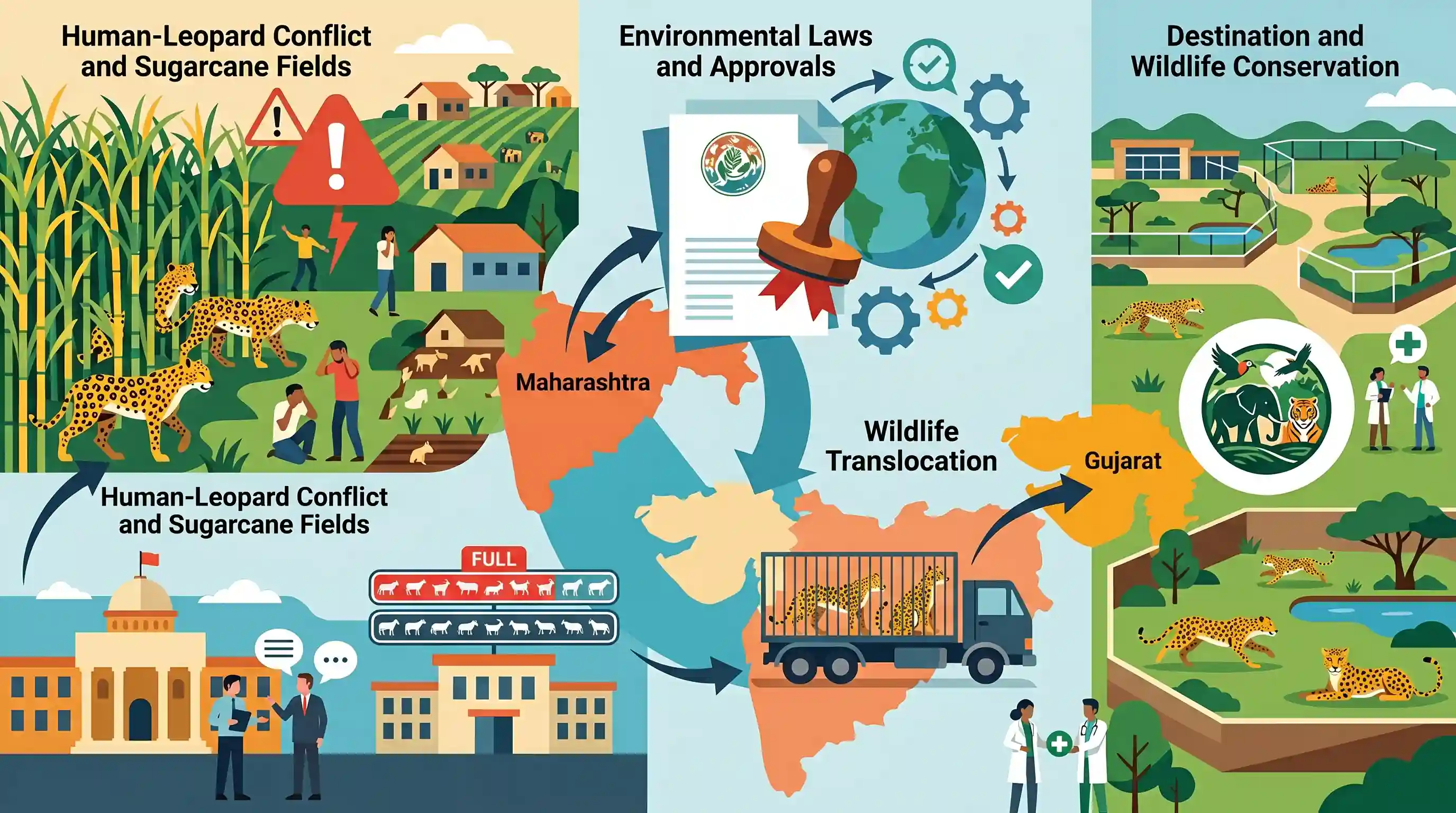
Highlights the growing issue of man-animal conflict driven by changes in agricultural land use (sugarcane acting as a habitat). It is highly relevant for GS-3 Environment and Biodiversity, emphasizing the legal procedure and jurisdictional boundaries (MoEFCC approval) required for the inter-state translocation of protected species under the Wildlife Protection Act.
Summary
In response to an alarming rise in human-leopard conflicts that resulted in nine deaths in the Junnar region, the Maharashtra government is relocating 50 leopards to the Vantara animal rescue facility in Gujarat. The inter-state transfer received mandatory clearance from the Ministry of Environment, Forest and Climate Change (MoEFCC) because local rescue centers reached full capacity. The surge in the leopard population is largely attributed to widespread sugarcane farming in Pune district, which provides ideal but unnatural cover and breeding grounds for the big cats close to human habitation.
Key Points
- Nine fatalities from leopard attacks in Maharashtra's Junnar region this year have escalated the human-wildlife conflict.
- To manage the crisis, the Maharashtra government is transferring 50 leopards from the over-capacity Manikdoh Leopard Rescue Centre to the Vantara facility in Jamnagar, Gujarat.
- Inter-state translocation of protected wildlife requires statutory approval from the central government, which was granted by the MoEFCC.
- The conflict is exacerbated by expansive sugarcane cultivation in the region, which provides a dense cover acting as an unnatural, safe breeding habitat for leopards near human settlements.
Important Terms
Wildlife (Protection) Act, 1972

The primary legal framework for wildlife conservation in India, providing schedules of protection for species and establishing the National Board for Wildlife and protected areas.
UPSC context
GS Paper III (Environment); vital for understanding legal safeguards, schedules, and the regulatory powers behind wildlife management and translocation.
Central Zoo Authority (CZA)
A statutory body under the MoEFCC, established under the Wildlife (Protection) Act, responsible for overseeing zoos and authorizing the inter-state transfer of captive or rescued animals.
UPSC context
GS Paper III; tests knowledge of statutory bodies involved in wildlife administration and conservation standards.
Vantara
A large-scale wildlife rescue and rehabilitation facility in Jamnagar, Gujarat, set up by Reliance Foundation, designed to house and treat animals from conflict zones.
UPSC context
GS Paper III; relevant for discussing private-sector participation in wildlife rehabilitation and its ethical/logistical implications.
Manikdoh Leopard Rescue Centre (MLRC)
A specialized facility in Junnar, Pune, operated by the Maharashtra Forest Department and Wildlife SOS to manage rescued and injured leopards from high-conflict areas.
UPSC context
GS Paper III; case study for Human-Wildlife Conflict (HWC) and challenges in state-managed rescue infrastructure.
Schedule I (Wildlife Protection Act)
The top-tier protection list under the Wildlife (Protection) Act; species here, like leopards, receive absolute legal protection and cannot be hunted except under strict conditions.
UPSC context
GS Paper III; crucial for identifying the conservation status of key species and the legal implications of their relocation.
Ministry of Environment, Forest and Climate Change (MoEFCC)
The nodal ministry for planning and overseeing India's environmental, forest, and climate policies, including the coordination of national conservation projects and wildlife approvals.
UPSC context
GS Paper II/III; central executive authority for environmental governance and international convention compliance.
Prelims Trap
State Governments have autonomous power to translocate Schedule I animals between states.
Wild animals are government property. Under the Wildlife Protection Act, 1972, inter-state translocation of Schedule I species requires prior approval from the Central Government.
Static Concepts Connected
What is the Central Zoo Authority (CZA)?
- Statutory Body: It is a statutory body established under the Wildlife (Protection) Act, 1972.
- Core Mandate: It regulates zoos and rescue centers across India, enforcing minimum standards for animal upkeep and veterinary care.
- Transfer Approvals: Central approval is mandatory for transferring Schedule I and Schedule II animals between recognized facilities.
Why does sugarcane cultivation exacerbate leopard-human conflict?
- Habitat Mimicry: Dense, tall sugarcane fields mimic the tall grass of natural forests, providing extensive, undisturbed cover.
- Breeding Ground: Leopards utilize these fields to safely hide and raise their cubs away from competing predators.
- Prey Availability: Proximity to villages offers easy access to a secondary prey base, such as livestock and feral dogs.
Cross-Topic Patterns
Cropping Patterns & Ecological Traps
UPSC often links agriculture to ecology. Sugarcane expansion in Maharashtra acts as an ecological trap, artificially shifting leopard populations and breeding grounds closer to human settlements.
Private Sector in Wildlife Conservation
The massive transfer to Vantara highlights the growing reliance on private, corporate-backed facilities to manage wildlife crises when state-run rescue centers reach capacity.

Expect a 2026 Prelims question combining cropping patterns (sugarcane as habitat) with the central approval rules for Schedule I translocations.
Linked PYQs · 1
Linked PYQs · 1
- 2022PrelimsGS1
With reference to Indian laws about wildlife protection, consider the following statements : 1. Wild animals are the sole property of the government. 2. When a wild animal is declared protected, such animal is entitled for equal protection whether it is found in protected areas or outside. 3. Apprehension of a protected wild animal becoming a danger to human life is sufficient ground for its capture or killing. Which of the statements given above is/are correct?
