Leopard Attack in Dudhwa Buffer Zone Highlights Wildlife Conflict
Source:The Hindu ↗
Why It Matters
Human-wildlife conflict in buffer zones of major reserves like Dudhwa is a recurring theme in environmental management and state-specific geography. Understanding the exact district location of Uttar Pradesh's national parks/sanctuaries and the chronological evolution of India's wildlife protection laws are highly scoring areas frequently targeted in UPPSC PCS Prelims.
Summary
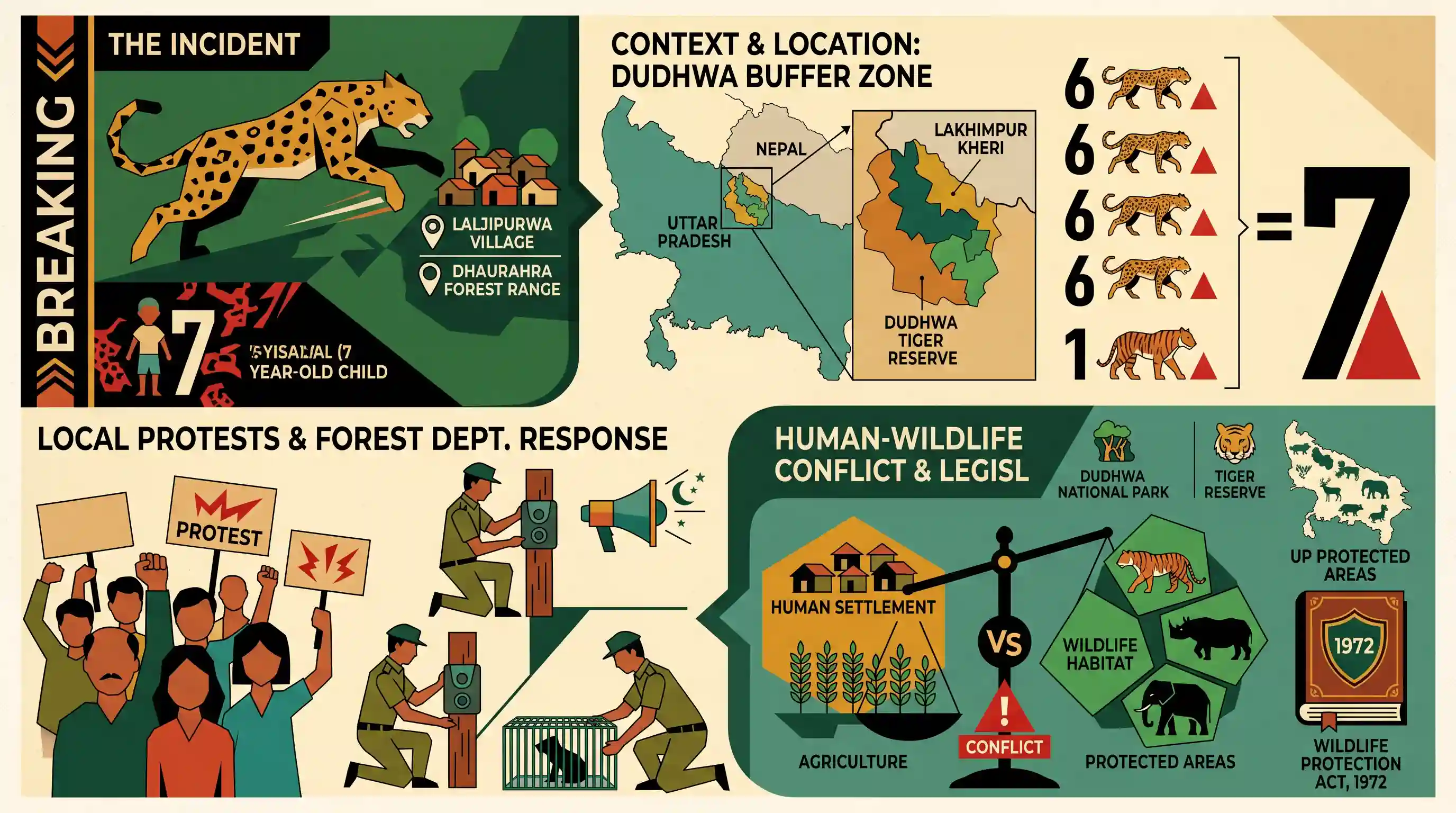
A leopard mauled a seven-year-old boy to death in Laljipurwa village under the Dhaurahra forest range in Uttar Pradesh's Dudhwa buffer zone (Lakhimpur Kheri district). The tragic incident marks the seventh human death caused by big-cat attacks in the Dudhwa buffer zone during the year (six leopard attacks and one tiger attack). Following local protests, forest department officials set up camera traps and cages to capture the animal and cautioned residents about outdoor movement during night hours. This event spotlights the persistent human-wildlife conflict in the ecologically sensitive Terai region of Uttar Pradesh.
Key Points
- A 7-year-old boy named Shubham was mauled to death by a leopard in the Dhaurahra forest range within the Dudhwa buffer zone of Uttar Pradesh's Lakhimpur Kheri district.
- The fatal incident highlights the escalating human-wildlife conflict in the Terai region, raising the total big-cat-related human fatalities in the Dudhwa buffer zone to seven within the year (six leopard attacks, one tiger attack).
- Following the attack and subsequent protests by villagers, forest officials deployed camera traps and cages to trace and capture the leopard, and issued advisories to local residents warning against solo movement during dusk and dawn.
- Dudhwa National Park, established in 1977 (initially a wildlife sanctuary in 1958 for Swamp Deer/Barasingha), is located along the Indo-Nepal border in Lakhimpur Kheri and is a major geographic focus of UPPSC Prelims questions.
- UPPSC frequently tests the chronology of environmental laws and conservation initiatives in India, such as the Wildlife Protection Act (1972), Project Tiger (1973), Project Elephant (1992), and the Biological Diversity Act (2002).
Important Terms
Dudhwa Tiger Reserve

A protected area in the Terai region of Uttar Pradesh consisting of Dudhwa National Park, Kishanpur, and Katarniaghat sanctuaries, known as a critical habitat for Bengal tigers and rhinos.
UPSC context
GS Paper 3 (Ecology & Environment). Tests geographic locations of protected areas, Terai ecosystems, and big-cat conservation initiatives in India.
Wildlife Protection Act 1972
India's principal legislation for conserving biodiversity and protecting wild species of plants and animals, featuring schedules with varying levels of legal protection.
UPSC context
GS Paper 3 (Biodiversity & Environment). Tests wildlife governance, animal protection schedules, and legislative provisions for hunting and trade control.
Project Tiger 1973
A centrally sponsored conservation programme launched to ensure a viable population of Bengal tigers in their natural habitats through a network of dedicated Tiger Reserves.
UPSC context
GS Paper 3 (Ecology & Environment). Tests flagship species conservation, institutional frameworks like NTCA, and the core-buffer strategy.
Biological Diversity Act 2002
India's statutory framework enacted to conserve biodiversity, regulate access to biological resources, and ensure fair and equitable benefit-sharing with local communities.
UPSC context
GS Paper 3 (Environment). Tests legislative measures for biodiversity conservation and three-tier regulatory authorities (NBA, SBBs, BMCs).
Project Elephant 1992
A centrally sponsored scheme launched to protect wild Asian elephants, safeguard their natural habitats and migration corridors, and mitigate human-elephant conflicts.
UPSC context
GS Paper 3 (Environment & Ecology). Tests keystone species conservation, corridor mapping, and conflict resolution management in protected landscapes.
Prelims Trap
The Great Indian One-Horned Rhinoceros has always had a continuous, undisturbed native population in the Dudhwa region.
Rhinos went extinct in this area by the early 20th century. The current population is the result of a highly successful reintroduction program started in 1984 from Kaziranga, Assam.
Static Concepts Connected
What are the geographic and ecological features of Dudhwa National Park?
- Eco-Zone: Located in the lowlands of the Himalayas (Terai-Duar savanna), characterized by tall elephant grass, clay-rich swamps, and clayey-silt soils.
- River Boundaries: Physical boundaries are defined by the Mohana River (north, bordering Nepal) and the Suheli River (south).
- Key Fauna: Hosts the nominate subspecies of northern swamp deer (Barasingha) and a reintroduced population of Great Indian One-Horned Rhinoceroses.
How does the Wildlife Protection Act (WPA) 1972 handle dangerous wild animals?
- CWLW Authority: Under Section 11 of the WPA, only the Chief Wildlife Warden (CWLW) can declare a wild animal dangerous to human life.
- Schedule I Protection: Leopards and tigers are Schedule I species; they cannot be captured or killed unless certified as a threat to human life.
- No Vermin Status: Schedule I animals cannot be declared vermin by the Central Government, ensuring high-level protection even during conflicts.
Cross-Topic Patterns
Linear Infrastructure vs. Terai Corridors
Infrastructure expansion, including border roads, intersects critical transboundary wildlife corridors, escalating human-wildlife encounters and causing habitat fragmentation in the Terai Arc.
Forest Rights vs. Buffer Management
FRA 2006 implementation in tiger reserve buffer zones often clashes with WPA restrictions over grazing rights and collection of minor forest produce.

Expect a multi-statement question linking Terai transboundary rivers (Mohana/Suheli) with rhino reintroduction history and WPA Schedule I rules.
Linked PYQs · 4
Linked PYQs · 4
- 2022UPPSC_PRELIMSGS1
Dudhwa National Park is located in which of the following districts of Uttar Pradesh?
- 2023UPPSC_PRELIMSGS1
Chandraprabha Wildlife Sanctuary is situated in which district of Uttar Pradesh?
- 2020UPPSC_PRELIMSGS1
Arrange the following events in chronological order of their commencement : I. Project Tiger II. Project Elephant III. Wildlife Protect Act IV. Biological Diversity Act Select the correct answer using the codes given below.
- 2019UPPSC_PRELIMSGS1
Arrange the following events in chronological order of their commencement and select correct answer from the codes given below: I. Wild Life (Protection) Act II. Biological Diversity Act III. Project Tiger IV. Project Elephant
