Lok Sabha Speaker Addresses Rajasthan Assembly Foundation
Source:The Hindu ↗
Why It Matters
This article covers key aspects of the working of state legislatures, legislative oversight over the executive, and the offices of the Speaker and the Leader of the Opposition, which are frequently asked topics under State Polity in the RPSC RAS Prelims exam.
Summary
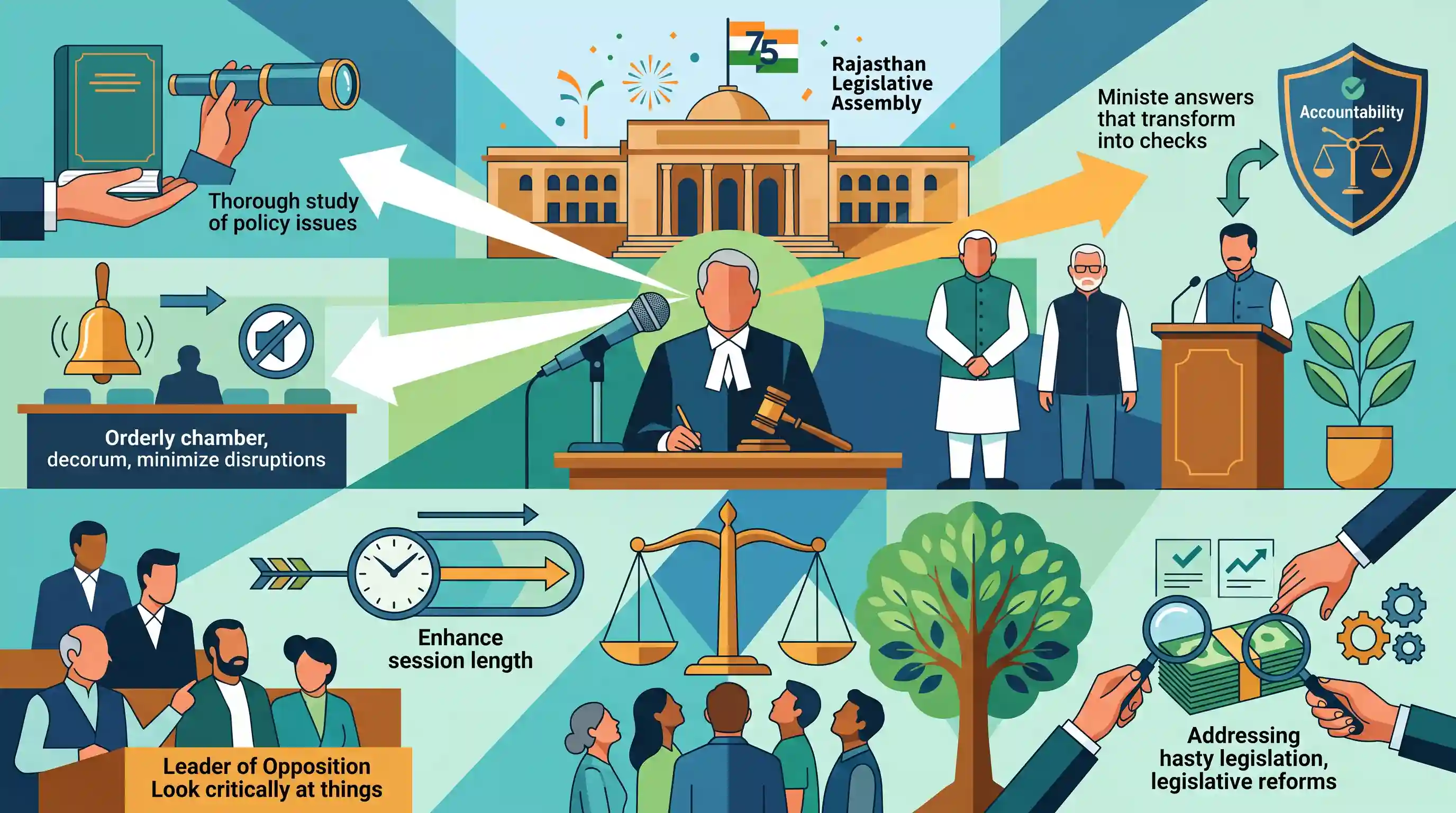
Addressing the 75th foundation year celebrations of the Rajasthan Legislative Assembly in Jaipur, Lok Sabha Speaker Om Birla highlighted that legislative houses serve as the ultimate training ground for leadership. He urged lawmakers to study policy issues thoroughly, maintain decorum, and minimize disruptions. He also advised ministers to deliver precise answers to ensure executive accountability. The celebration saw addresses from Chief Minister Bhajanlal Sharma, Speaker Vasudev Devnani, and Leader of Opposition Tikaram Jully, who critically observed the need to enhance the length of Assembly sessions and address issues of hasty legislation.
Key Points
- Lok Sabha Speaker Om Birla addressed the Rajasthan Legislative Assembly on its 75th foundation year celebrations in Jaipur, calling legislatures the 'training ground' for political leadership.
- Birla emphasized the need for constructive legislative debate, urging members to avoid unparliamentary disruptions, master public issues, and ensure precise executive replies to questions to foster administrative accountability.
- Assembly Speaker Vasudev Devnani highlighted the event as a symbol of development beyond partisan politics, characterizing democracy as a 'continuously flowing Ganga of ideas'.
- Chief Minister Bhajanlal Sharma reaffirmed commitment to democratic values, while Leader of Opposition Tikaram Jully highlighted challenges such as rapid passing of bills, the weakened role of individual legislators in lawmaking, and the need to increase Assembly sittings.
Important Terms
State Legislative Assembly

The lower house of a state legislature in India, consisting of directly elected representatives (MLAs), with a constitutional strength of 60 to 500 members under Article 170.
UPSC context
GS Paper II (Polity): Explores state legislative structure, functioning, and federal dynamics of lawmaking.
Lok Sabha
The lower house of India's bicameral Parliament, composed of directly elected representatives representing territorial constituencies, serving as the primary chamber for national legislation and financial decisions.
UPSC context
GS Paper II (Polity): Essential for understanding the Union legislature, democratic representation, and parliamentary operations.
Speaker of Lok Sabha
The presiding officer and supreme authority of the House of the People, elected under Article 93, responsible for maintaining decorum, certifying Money Bills, and deciding defections.
UPSC context
GS Paper II (Polity): Focuses on the constitutional role, powers, impartiality, and challenges of legislative presiding officers.
Leader of Opposition
A statutory post recognized under a 1977 Act, held by the leader of the largest opposition party securing at least ten percent of the house's total seats.
UPSC context
GS Paper II (Polity): Tests understanding of parliamentary democracy, checks and balances, and statutory appointment committees.
Executive Accountability
The constitutional requirement under Article 75(3) that the Council of Ministers remains collectively responsible and answerable to the elected legislature for its policies and actions.
UPSC context
GS Paper II (Polity): Critical for questions on parliamentary control, legislative devices, and the system of checks and balances.
Prelims Trap
A resolution passed by a State Assembly under Article 169 constitutionally obligates Parliament to create or abolish that Legislative Council.
While the Assembly's resolution requires a special majority (majority of total strength and 2/3rds of present and voting), Parliament can pass the final bill with a simple majority. Crucially, Parliament is not legally bound to act on the resolution.
Static Concepts Connected
How are Legislative Councils created or abolished under Article 169?
- Assembly Resolution: The State Legislative Assembly must pass a resolution by a special majority (majority of total membership and 2/3rds of members present and voting).
- Parliamentary Majority: Parliament can then approve the creation or abolition of the council by a simple majority, like any ordinary bill.
- Constitutional Status: The Act of Parliament is not deemed an amendment to the Constitution under Article 368, and the Union is not constitutionally bound to act on the state's request.
What limits does Article 164(1A) impose on a State Council of Ministers?
- Origin: Introduced by the 91st Constitutional Amendment Act, 2003, to curb jumbo cabinets and political defections.
- Ceiling Limit: The total number of ministers, including the Chief Minister, in a State Council of Ministers must not exceed 15% of the total strength of the Legislative Assembly.
- Floor Limit: The total number of ministers, including the Chief Minister, in a State must not be less than 12.
Cross-Topic Patterns
Fewer sittings and executive aggrandizement
Shorter legislative sessions and hasty passages of bills systematically weaken the legislature's oversight, resulting in increased reliance on ordinances and executive-led delegated legislation.
Delimitation freeze and presidential representation
Using 1971 census data for MLA vote values in presidential elections maintains federal balance but underscores the representation gap ahead of the post-2026 delimitation.

Parliament's non-binding power under Article 169 and legislative reform patterns will likely feature as a multi-statement MCQ in 2026.
Linked PYQs · 4
Linked PYQs · 4
- 2025RPSC_PRELIMSGS1
Which of the following statements regarding the powers of the Speaker of the Lok Sabha is correct? Select the correct answer from the code given below: (i) The Speaker of the Lok Sabha presides over the joint sitting of both houses of Parliament. (ii) When a Finance Bill is sent from the Lower House to the Upper House, the Speaker certifies it as a Finance Bill. (iii) When a motion to remove the Speaker is under consideration, the Speaker neither presides nor participates in the proceedings. (iv) Apart from equality of votes, the Speaker does not vote in the House. Code:
- 2018RPSC_PRELIMSGS1
Which of the following has NOT served as the Leader of the Opposition in the Rajasthan Legislative Assembly? (A) Haridev Joshi (B) Shivcharan Mathur (C) Ashok Gehlot (D) Vasundhara Raje Select the correct answer from the codes given below: Code:
- 2018RPSC_PRELIMSGS1
Who has been the Protem President, President and Vice President of the Rajasthan Legislative Assembly?
- 2025RPSC_PRELIMSGS1
Which of the following statements regarding subordinate legislation in the Rajasthan Legislative Assembly is not correct?
