Legendary Pandavani singer Teejan Bai passes away at sixty-nine
Source:Indian Express ↗
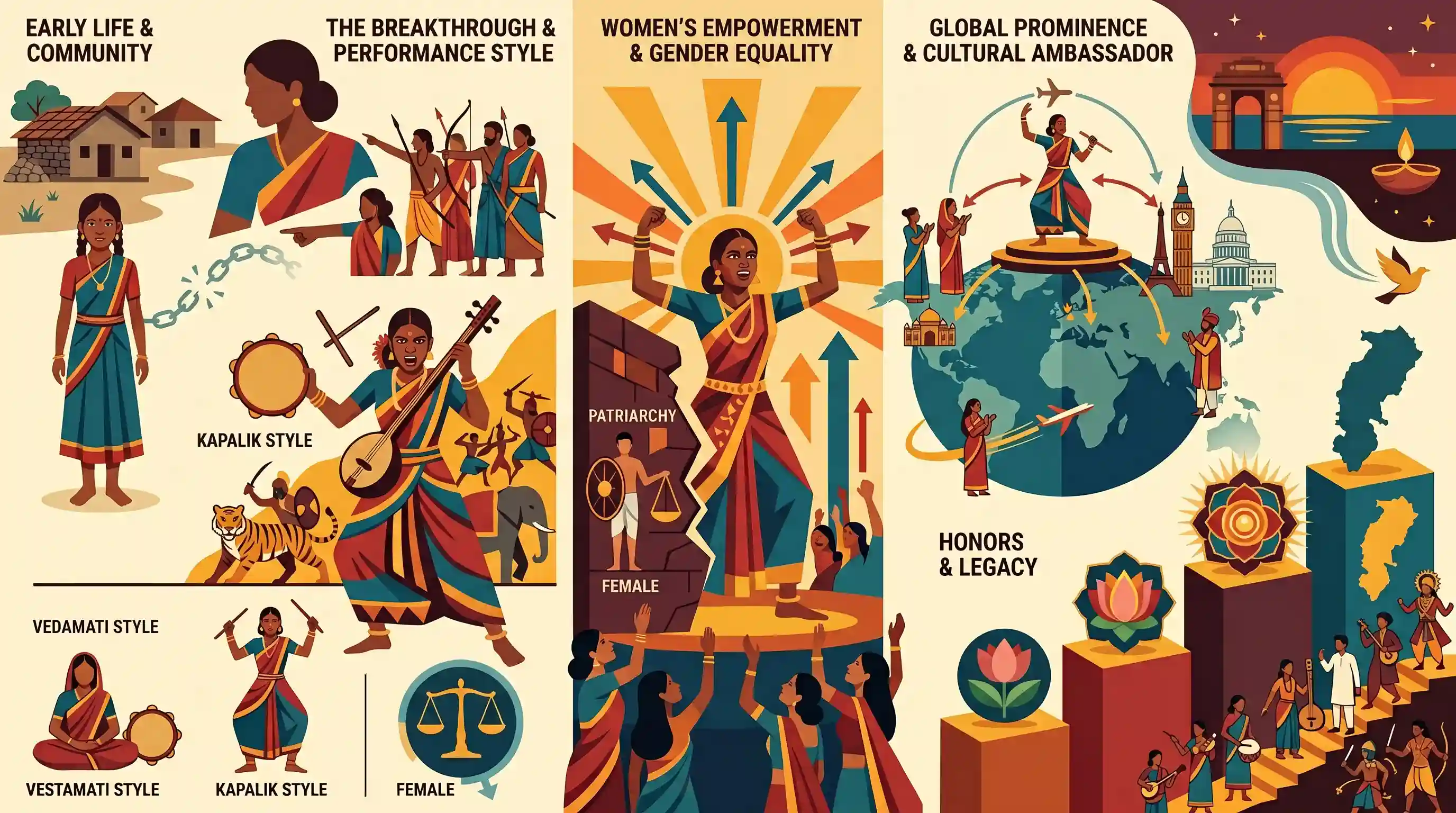
Why It Matters
This topic highlights the preservation of India's intangible cultural heritage, the distinction between folk narrative traditions (Kapalik vs. Vedamati styles of Pandavani), and how grassroots women and tribal artists overcome systemic discrimination to serve as international cultural ambassadors. It is highly relevant for both GS1 (Art & Culture and Social Issues) and Essay papers.
Summary
Legendary Pandavani folk singer and cultural icon Dr. Teejan Bai passed away on July 5, 2026, at the age of 69 in Raipur, Chhattisgarh. A pioneer of the Pandavani storytelling tradition—a narrative singing art form depicting the Mahabharata—she shattered patriarchal and tribal norms by performing in the dynamic Kapalik style. Despite facing social ostracization from her Pardhi community, she rose to global prominence, serving as a cultural ambassador for India. She was honored with multiple prestigious titles, including the Padma Shri, Padma Bhushan, and Padma Vibhushan, the latter of which she is Chhattisgarh's sole recipient.
Key Points
- Teejan Bai, the legendary Pandavani folk singer and Padma Vibhushan recipient, passed away on July 5, 2026, at the age of 69 in Raipur, Chhattisgarh.
- Pandavani is a traditional performing and narrative folk art form of Chhattisgarh that enacts and sings episodes from the ancient Indian epic Mahabharata.
- She shattered rigid gender and tribal barriers by performing in the energetic 'Kapalik' style (which involves singing and acting while standing), traditionally reserved for men, rather than the seated 'Vedamati' style traditionally assigned to women.
- Born into the marginalized Pardhi Scheduled Tribe, she faced severe social ostracization and expulsion from her community for pursuing the art form publicly, yet persevered to gain national and international acclaim.
- She served as India's prominent cultural ambassador, bringing indigenous folk art to international audiences in countries like France, Germany, England, and Switzerland, and performed in the iconic television series 'Bharat Ek Khoj'.
- She remains the only individual from Chhattisgarh to have been honored with the Padma Vibhushan (2019), and she also received the Padma Shri (1988), Sangeet Natak Akademi Award (1995), and Padma Bhushan (2003).
Important Terms
Padma Vibhushan

The second-highest civilian award of the Republic of India, instituted in 1954. It is awarded for "exceptional and distinguished service" without distinction of race, occupation, position, or sex.
UPSC context
GS Paper I (Art & Culture) / Prelims: Highlighting national civilian honors, criteria, and prominent cultural recipients.
Padma Bhushan
The third-highest civilian award of India, established in 1954. It is conferred by the President of India for "distinguished service of a high order" in any field, including the arts.
UPSC context
GS Paper I (Art & Culture) / Prelims: National awards recognizing exceptional contributions to Indian heritage and arts.
Padma Shri
The fourth-highest civilian award in India, established in 1954. It recognizes distinguished contributions of Indian citizens in various spheres, including arts, education, industry, literature, and sports.
UPSC context
GS Paper I (Art & Culture) / Prelims: Recognizing folk and grassroots artists under India's national award frameworks.
Sangeet Natak Akademi
India's national academy for music, dance, and drama, established in 1953. Operating under the Ministry of Culture, it preserves, promotes, and documents the country's diverse performing arts heritage.
UPSC context
GS Paper I (Art & Culture): Apex cultural bodies preserving India's intangible heritage and performing arts.
Fukuoka Prize
An award established in 1990 by Fukuoka City, Japan. It honors outstanding achievements of individuals or groups in preserving and fostering the unique and diverse cultures of Asia.
UPSC context
GS Paper I / Prelims: International awards honoring Asian cultural pioneers, showcasing global cultural exchange.
Adiwasi Lok Kala Parishad
A cultural council/academy dedicated to preserving, promoting, and documenting indigenous tribal performing arts, folk music, and oral storytelling traditions of Central India.
UPSC context
GS Paper I & II: State initiatives for preserving tribal heritage and supporting marginalized folk artists.
Prelims Trap
In Pandavani, the Kapalik style is the seated devotional rendition, while the Vedamati style features standing, energetic action with weapons.
UPSC often swaps the features of sub-genres or styles. Kapalik is the standing, theatrical style, while Vedamati is the seated, devotional style.
Static Concepts Connected
What are the defining styles and performance features of Pandavani folk art?
- Core Theme: Relates episodes of the Mahabharata, focusing primarily on the exploits of Bhima as the lead hero.
- Vedamati Style: A quiet, classical, and devotional form of narration where the performer remains seated throughout.
- Kapalik Style: An energetic, standing style where the performer moves, improvises, and acts out combat and characters.
- Signature Instrument: Uses a peacock-feathered Tambura serving as both a musical drone and a physical combat weapon prop.
Who are Denotified Tribes (DNTs) in the Indian administrative context?
- Historical Origin: Communities systematically classified as "born criminals" under the British colonial Criminal Tribes Act of 1871.
- Post-Independence Status: Formally "denotified" in 1952 after the repeal of the colonial act, replaced by State-level Habitual Offenders Acts.
- Modern Vulnerability: They often overlap with Scheduled Tribes, Scheduled Castes, or OBCs, yet face distinct socio-economic vulnerabilities.
Cross-Topic Patterns
Gender subversion in regional folk arts
Traditional folk performance barriers, such as restricting physical styles like Kapalik to men, show how artistic subversion serves as an active tool of gender reform in rural India.
Criminal Tribes Act and artistic survival
The social exclusion of Pardhi artists highlights how colonial-era criminalization under the 1871 Act continues to marginalize nomadic communities' cultural preservation efforts today.

UPSC may test Pandavani styles (Kapalik vs. Vedamati) and instrument roles alongside Central India's denotified tribal history in 2026.
Linked PYQs · 4
Linked PYQs · 4
- 2014PrelimsGS1
A community of people called Manganiyars is well-known for their
- 2021PrelimsGS1
With reference to India, the terms 'Halbi, Ho and Kui' pertain to
- 2018MainsGS1
Safeguarding the Indian art heritage is the need of the moment. Discuss.
- 2019MainsGS1
What makes the Indian society unique in sustaining its culture? Discuss.
