Writ Jurisdiction and Statutory Interpretation in Heritage Disputes
Source:Indian Express ↗
Why It Matters
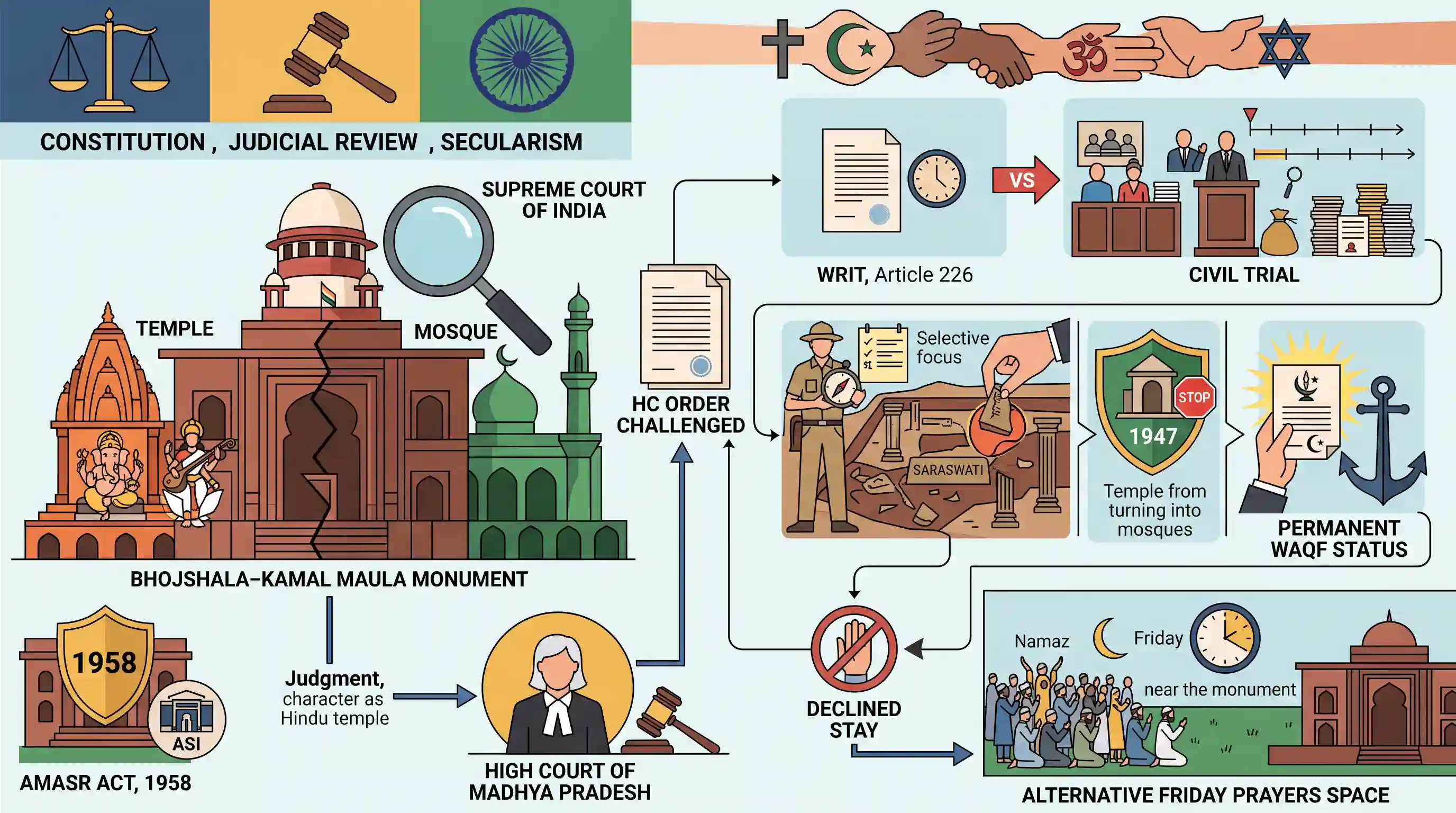
The dispute intersects constitutional law, statutory interpretation, and secular principles. It raises critical legal questions on the scope of Article 226 writ jurisdiction versus civil suits in determining historical facts, the boundary between the Places of Worship Act, 1991 and the AMASR Act, 1958, and the preservation of communal harmony.
Summary
The Supreme Court of India is examining legal challenges to a Madhya Pradesh High Court judgment that declared the religious character of the Bhojshala-Kamal Maula monument in Dhar as a Hindu temple. While declining to stay the order, the SC directed that alternative space be provided for Friday Muslim prayers. The petitioners argue that the HC exceeded its writ jurisdiction under Article 226 by deciding disputed historical facts without a civil trial, selectively relied on the ASI's archaeological report, misapplied the Places of Worship Act, 1991, and ignored the site's permanent Waqf status.
Key Points
- The Madhya Pradesh High Court declared the disputed Bhojshala-Kamal Maula complex's religious character to be a Hindu temple dedicated to Goddess Vagdevi (Saraswati), which has been appealed in the Supreme Court.
- While refusing a blanket stay on the High Court's ruling, the Supreme Court directed the administration to provide an adjacent, alternative space for Muslim worshippers to perform Friday prayers pending a final review.
- The appeal challenges the High Court's use of summary writ jurisdiction under Article 226 to resolve complex, disputed questions of historical fact and archaeological interpretation, arguing these require a full civil trial with cross-examination.
- The High Court interpreted Section 4(3)(a) of the Places of Worship (Special Provisions) Act, 1991 as exempting the Bhojshala complex because it is a protected monument under the Ancient Monuments and Archaeological Sites and Remains (AMASR) Act, 1958.
- Petitioners argue this exemption is meant solely for preservation and management and does not authorize courts to re-adjudicate historical-religious characters, especially when it infringes on freedom of religion (Article 25) and notified Waqf status.
- The plea claims the HC selectively read the ASI report, emphasizing 9th-10th century Paramara-period foundations while ignoring significant Arabic and Persian inscriptions and the historical syncretic character of the site.
Important Terms
Places of Worship (Special Provisions) Act, 1991

An Act of Parliament that freezes the religious character of any place of worship as it existed on August 15, 1947, prohibiting its conversion to safeguard India's secular fabric.
UPSC context
GS Paper II: Polity & Constitution. Tests understanding of secularism, communal harmony, and statutory limits on historical religious disputes.
Ancient Monuments and Archaeological Sites and Remains Act, 1958
A central legislation providing for the preservation of ancient monuments, archaeological sites, and historical remains of national importance, and regulating archaeological excavations.
UPSC context
GS Paper I: Art & Culture and GS II: Polity. Tests awareness of institutional mechanisms safeguarding heritage and ancient monument regulations.
Archaeological Survey of India
A premier organization under the Ministry of Culture responsible for archaeological research, excavation, and scientific conservation of protected monuments and historical sites of national importance.
UPSC context
GS Paper I: Indian Heritage and Culture. Tests knowledge of the central body executing archaeological surveys and resolving historical site disputes.
Article 226 of the Constitution of India
A constitutional provision empowering High Courts to issue writs for the enforcement of fundamental rights and for any other legal purpose within their territorial jurisdiction.
UPSC context
GS Paper II: Indian Polity & Judiciary. Tests understanding of judicial review, high courts' writ jurisdiction, and constitutional remedies.
Prelims Trap
The Places of Worship Act, 1991, freezes the religious character of all historical sites with no exceptions except the Ayodhya dispute.
Section 4(3)(a) of the Places of Worship Act explicitly exempts ancient/historical monuments covered by the AMASR Act, 1958, from the status-quo freeze.
Static Concepts Connected
What are the core provisions and exemptions of the Places of Worship (Special Provisions) Act, 1991?
- Section 3 Bar: Prohibits converting any place of worship of one religious denomination into another.
- Section 4(1) Freeze: Declares that the religious character of a place of worship existing on August 15, 1947, shall remain unchanged.
- AMASR Exemption: Explicitly excludes ancient monuments, archaeological sites, or remains covered under the AMASR Act, 1958.
Who was Raja Bhoja of the Paramara Dynasty and what were his contributions?
- Dynasty & Reign: Ruled Malwa (capital Dhar) in the 11th century; renowned scholar-king of the Paramara dynasty.
- Literary Works: Authored classical treatises like 'Samarangasutradhara' (architecture) and 'Sarasvatikanthabharana' (Sanskrit grammar).
- Architectural Legacy: Commissioned the Bhojeshwar Shiva Temple in Bhojpur and the Bhojtal (Upper Lake) in Bhopal.
Cross-Topic Patterns
Writ Jurisdiction vs Civil Suits
Explores how High Courts using Article 226 summary powers to decide complex historical-religious facts bypass standard civil procedures (CPC) requiring trials and witness cross-examination.
AMASR Act vs Places of Worship
Examines the tension between heritage preservation laws (exempting monuments for research) and secularism mandates designed to freeze communal ownership claims of public spaces.

The legal interaction between AMASR Act monument status and Places of Worship Act exemptions is ripe for a multi-statement Prelims MCQ.
Linked PYQs · 5
Linked PYQs · 5
- 2024MainsGS2
Discuss India as a secular state and compare with the secular principles of the US constitution.
- 2018MainsGS1
How the Indian concept of secularism is different from the western model of secularism? Discuss.
- 2022MainsGS1
Are tolerance, assimilation and pluralism the key elements in the making of an Indian form of secularism? Justify your answer.
- 2020MainsGS2
Judicial Legislation is antithetical to the doctrine of separation of powers as envisaged in the Indian Constitution. In this context justify the filing of large number of public interest petitions praying for issuing guidelines to executive authorities.
- 2018MainsGS1
Safeguarding the Indian art heritage is the need of the moment. Discuss.
