Geopolitical Implications of US Military Action in Venezuela
Source:The Hindu ↗
Why It Matters
This event highlights key issues in international relations such as the debate over national sovereignty, non-intervention, and the geopolitical implications of energy resources. It also sheds light on how domestic political parties in India shape the discourse around the country's foreign policy stances.
Summary
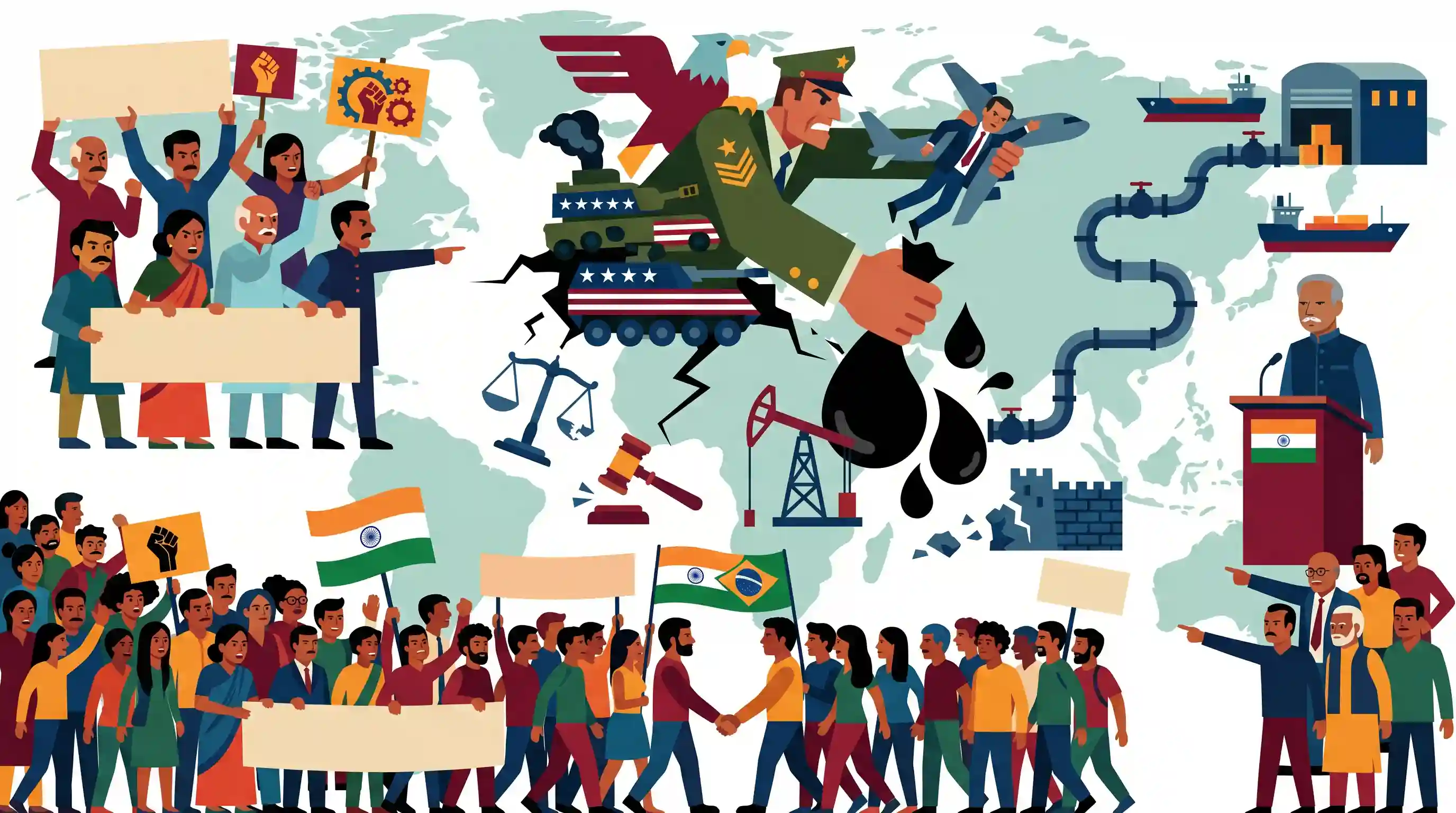
Left parties and the Congress party have strongly condemned the U.S. military action in Venezuela, which included the abduction of President Nicolas Maduro. Terming it an act of "naked imperialist aggression," the opposition argued that the move was aimed at capturing Venezuela's vast oil reserves and blatantly violated international law and national sovereignty. Furthermore, the parties criticized the Indian government for its silence on the issue and called for nationwide protests in solidarity with the people of Latin America.
Key Points
- Left parties and the Congress condemned the U.S. military attack on Venezuela and the abduction of President Nicolas Maduro.
- Opposition leaders termed the U.S. intervention an act of imperialist aggression aimed at capturing Venezuela's oil reserves.
- The political parties criticized the Indian Ministry of External Affairs for remaining silent on the violation of a sovereign nation's rights.
- A joint statement by five Left parties called for nationwide protests in solidarity with Latin America and against U.S. actions.
Important Terms
International Law

A body of rules and principles established by treaties, customs, and conventions that govern the conduct of sovereign states and international organizations in their mutual relations and global affairs.
UPSC context
GS Paper II: International Relations and Global Groupings. Tests understanding of sovereignty, multilateralism, and the legal framework of world politics.
Ministry of External Affairs
The primary government department responsible for formulating and implementing India's foreign policy, managing diplomatic relations, and representing the country in international forums like the United Nations.
UPSC context
GS Paper II: International Relations and Governance. Essential for studying the institutional mechanisms behind India’s strategic and diplomatic engagements.
National Sovereignty
The supreme and independent authority of a state to govern its territory and people without external interference, a fundamental principle of the modern international order.
UPSC context
GS Paper II: Constitution and International Relations. Core concept for analyzing state-led foreign policy and non-intervention principles.
Indian National Congress (INC)
India's oldest political party, which led the independence movement and historically advocates for a centrist, non-aligned foreign policy and secular, democratic governance.
UPSC context
GS Paper II: Political Parties. Relevant for understanding the evolution of India's foreign policy doctrine and the role of the opposition.
Communist Party of India (Marxist) [CPI(M)]
A national political party with a Marxist-Leninist ideology that split from the CPI in 1964; it frequently advocates for anti-imperialist and pro-peasantry foreign policy stances.
UPSC context
GS Paper II: Political Parties. Important for analyzing ideological influences on India’s diplomatic discourse and internal political alignments.
Communist Party of India (CPI)
Formed in 1925, this Marxist-Leninist party is one of India's oldest, historically influenced by Soviet socialism and advocating for labor rights and social justice.
UPSC context
GS Paper II: Political Parties. Relevant for studying the history of the Left movement and its stance on global geopolitical issues.
All India Forward Bloc
A left-wing nationalist political party founded by Subhas Chandra Bose in 1939, advocating for socialist principles and militant anti-imperialism within the Indian political spectrum.
UPSC context
GS Paper I: Modern Indian History; GS Paper II: Political Parties. Highlights the historical diversity of India's socialist and nationalist movements.
Prelims Trap
"Venezuela is the world's largest producer and exporter of crude oil."
Aspirants confuse "proven reserves" with "production." Venezuela holds the largest proven reserves (>300 billion barrels) but accounts for <1% of global output due to sanctions and poor infrastructure.
Static Concepts Connected
How does the 'Resource Curse' explain Venezuela's economic collapse?
- Paradox of Plenty: Countries with abundant natural resources often experience less economic growth and worse governance outcomes than resource-poor countries due to over-reliance on one commodity.
- Dutch Disease: An oil export boom causes the national currency to appreciate, making other sectors like agriculture and manufacturing structurally uncompetitive in the global market.
How does international law view unilateral military interventions?
- UN Charter 2(4): It explicitly prohibits the threat or use of force against the territorial integrity or political independence of any sovereign state, mandating peaceful dispute resolution.
- Panchsheel Principles: India's foundational foreign policy doctrine strictly mandates "mutual respect for territorial integrity and sovereignty" and "mutual non-interference in internal affairs."
Cross-Topic Patterns
Secondary Sanctions & Strategic Autonomy
U.S. sanctions on Venezuela mirror past constraints on Iranian oil, severely testing India's "Strategic Autonomy" and its ability to freely secure cheap energy imports.
OVL's Vulnerable Overseas Equity
Geopolitical interventions directly threaten Indian Public Sector investments abroad, such as ONGC Videsh Limited’s 40% stake in Venezuela's San Cristóbal oil field.

Expect a 2026 Prelims question mapping global oil fields (e.g., Orinoco Belt) to countries or linking them to India's OVL overseas assets.
Linked PYQs · 2
Linked PYQs · 2
- 2025MainsGS2
"With the waning of globalization, post-Cold War world is becoming a site of sovereign nationalism.” Elucidate.
- 2025MainsGS2
"Energy security constitutes the dominant kingpin of India's foreign policy, and is linked with India's overarching influence in Middle Eastern countries.” How would you integrate energy security with India's foreign policy trajectories in the coming years?
