Lebanon Seeks Ceasefire Extension in US Mediated Talks
Source:The Hindu ↗
Why It Matters
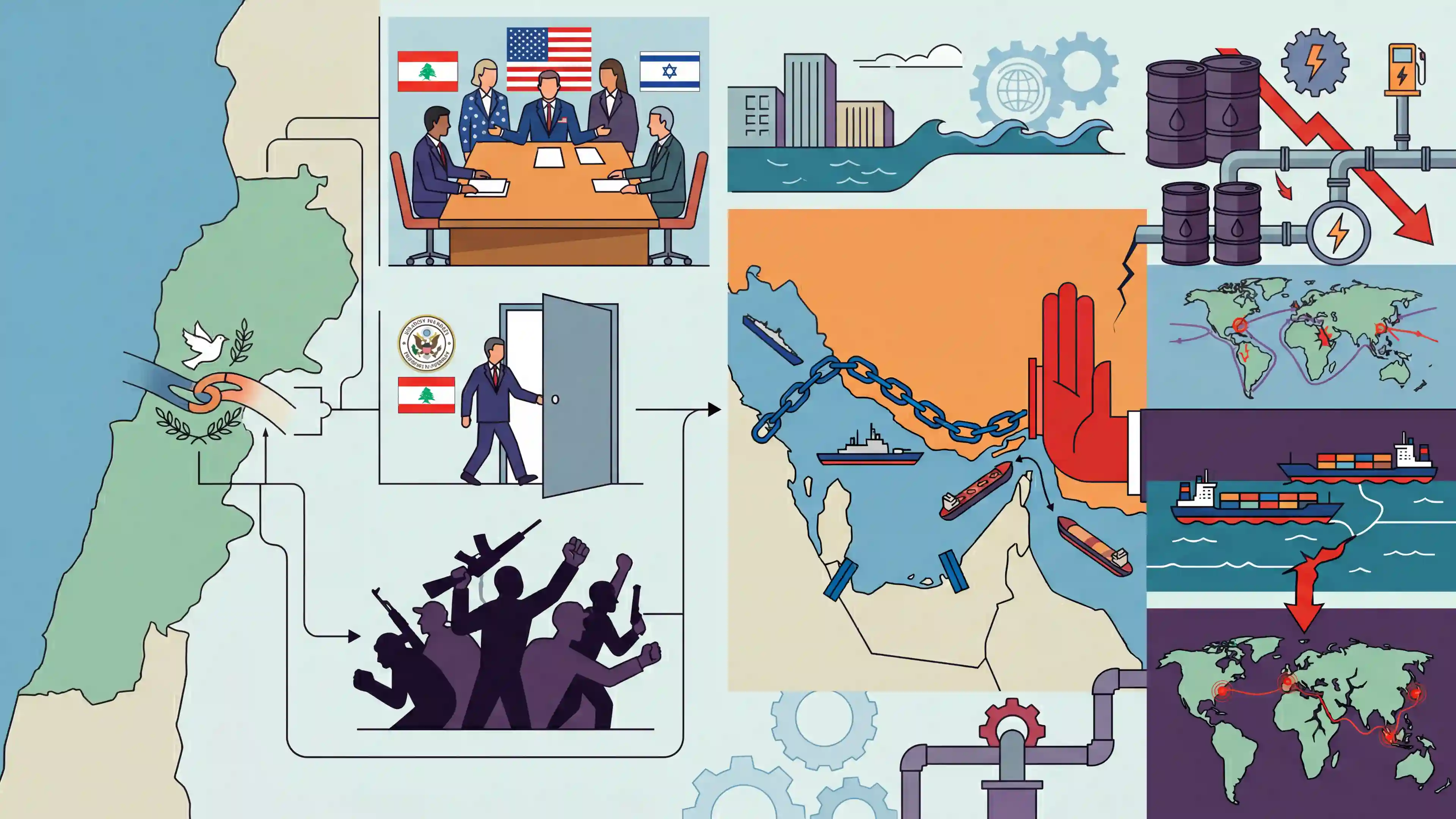
The Israel-Lebanon conflict and the associated closure of the Strait of Hormuz by Iran present critical case studies in Middle Eastern geopolitics. For UPSC aspirants, understanding these dynamics is vital for analyzing global energy security, the role of US diplomacy, and the impact of regional instability on India's strategic and economic interests.
Summary
Lebanon is pursuing an extension of its ceasefire with Israel through US-mediated negotiations, taking the significant step of opening direct diplomatic channels despite opposition from Hezbollah. While the ceasefire has reduced overall violence, tensions persist in southern Lebanon. The localized conflict is heavily intertwined with broader Middle East geopolitics, underscored by Iran's threat to close the Strait of Hormuz in retaliation for a US naval blockade. This links the Levant crisis directly to global energy security and international maritime trade routes.
Key Points
- Lebanon is seeking an extension to a US-brokered ceasefire with Israel amid continued low-level hostilities in southern Lebanon.
- The Lebanese government has initiated direct talks with Israel, bypassing objections from the Hezbollah militant group.
- The ceasefire negotiations involve key figures such as US Secretary of State Marco Rubio, Lebanese envoy Nada Moawad, and Israeli Ambassador Yechiel Leiter.
- The conflict is tied to broader regional tensions, highlighted by Iran's threat to keep the Strait of Hormuz closed unless the US lifts its naval blockade.
Important Terms
Hezbollah

A Lebanese Shia militant group and political party backed by Iran. It operates as a powerful non-state actor, often described as a "state within a state," with significant regional influence.
UPSC context
GS Paper II: International Relations. Tests knowledge of non-state actors, proxy warfare, and regional stability in West Asia.
Lebanese Armed Forces (LAF)
The official military of Lebanon, responsible for national defense. It is tasked with enforcing state sovereignty and implementing security arrangements, particularly in southern Lebanon, to prevent unauthorized armed group activity.
UPSC context
GS Paper II: International Relations. Focuses on the role of state institutions in conflict zones and implementation of UN mandates.
Strait of Hormuz
A vital maritime passage between Iran and Oman connecting the Persian Gulf to the Arabian Sea. It handles approximately 20-30% of global oil trade, making it a critical chokepoint.
UPSC context
GS Paper II & III: International Relations and Energy Security. Vital for India's oil imports and global supply chain stability.
UNSC Resolution 1701
A 2006 UN Security Council mandate intended to end the Israel-Hezbollah war. it calls for the disarmament of all armed groups in Lebanon and exclusive military presence of the state.
UPSC context
GS Paper II: International Relations. Tests understanding of international law, peacekeeping missions (UNIFIL), and diplomatic frameworks in West Asia.
Maritime Chokepoint
Narrow channels along global sea routes that are critical for international trade. Their closure can lead to significant economic disruption and spikes in global energy prices.
UPSC context
GS Paper I & II: Geography and International Relations. Relates to strategic sea lanes and freedom of navigation.
Energy Security
The continuous availability of energy sources at an affordable price. For India, it centers on securing oil/gas supplies from the Middle East through safe maritime routes.
UPSC context
GS Paper III: Indian Economy/Security. Tests vulnerabilities in India's energy supply chain and geopolitical impacts on the domestic economy.
Prelims Trap
"The 'Blue Line' is the officially recognized international border between Israel and Lebanon."
The Blue Line is merely a UN-demarcated temporary line of withdrawal established in 2000 for monitoring, not a legally recognized international boundary.
Static Concepts Connected
Which water bodies and nations does the Strait of Hormuz connect?
- Water bodies: It links the Persian Gulf to the Gulf of Oman and the broader Arabian Sea.
- Bordering states: It is flanked by Iran to the north, and the UAE and an exclave of Oman (Musandam Peninsula) to the south.
- Strategic value: It is a critical maritime chokepoint facilitating roughly 20% of the world's daily global oil trade.
What are the three basic principles of UN Peacekeeping missions like UNIFIL?
- Consent: Deployment requires the explicit consent of the main parties to the conflict.
- Impartiality: Peacekeepers must remain completely neutral and not favor any party involved in the dispute.
- Non-use of force: Force is strictly limited to self-defense and defense of the UN mandate, not for active combat.
Cross-Topic Patterns
Energy chokepoints & imported inflation
An Iranian blockade of Hormuz directly threatens India's macroeconomic stability by spiking crude prices, linking West Asian maritime security to the RBI's domestic inflation management strategies.
Non-State Actors vs Sovereign Diplomacy
Hezbollah’s opposition to Lebanon's direct talks illustrates the recurring UPSC theme of armed non-state actors complicating traditional state-to-state diplomacy and undermining national sovereignty.

A map-based Prelims question linking West Asian straits (Hormuz, Bab el-Mandeb) to bordering nations and conflict zones is highly likely.
Linked PYQs · 3
Linked PYQs · 3
- 2025MainsGS2
"Energy security constitutes the dominant kingpin of India's foreign policy, and is linked with India's overarching influence in Middle Eastern countries.” How would you integrate energy security with India's foreign policy trajectories in the coming years?
- 2018MainsGS2
“India’s relations with Israel have, of late, acquired a depth and diversity, which cannot be rolled back.” Discuss.
- 2024PrelimsGS1
Consider the following statements : Statement-I : Sumed pipeline is a strategic route for Persian Gulf oil and natural gas shipments to Europe. Statement-II : Sumed pipeline connects the Red Sea with the Mediterranean Sea. Which one of the following is correct in respect of the above statements?
