Israeli airstrike near Syrian border targets Palestinian faction
Source:The Hindu ↗
Why It Matters
The persistent volatility in the Middle East, particularly the interplay between sovereign states (Israel, Lebanon) and non-state armed groups (Hezbollah, Hamas, Islamic Jihad), is critical for understanding global security dynamics. Map locations related to the Levant (Lebanon, Syria, Israel, Mediterranean borders) are a staple for UPSC Prelims Geography questions, while the broader geopolitical implications are relevant for GS2 International Relations.
Summary
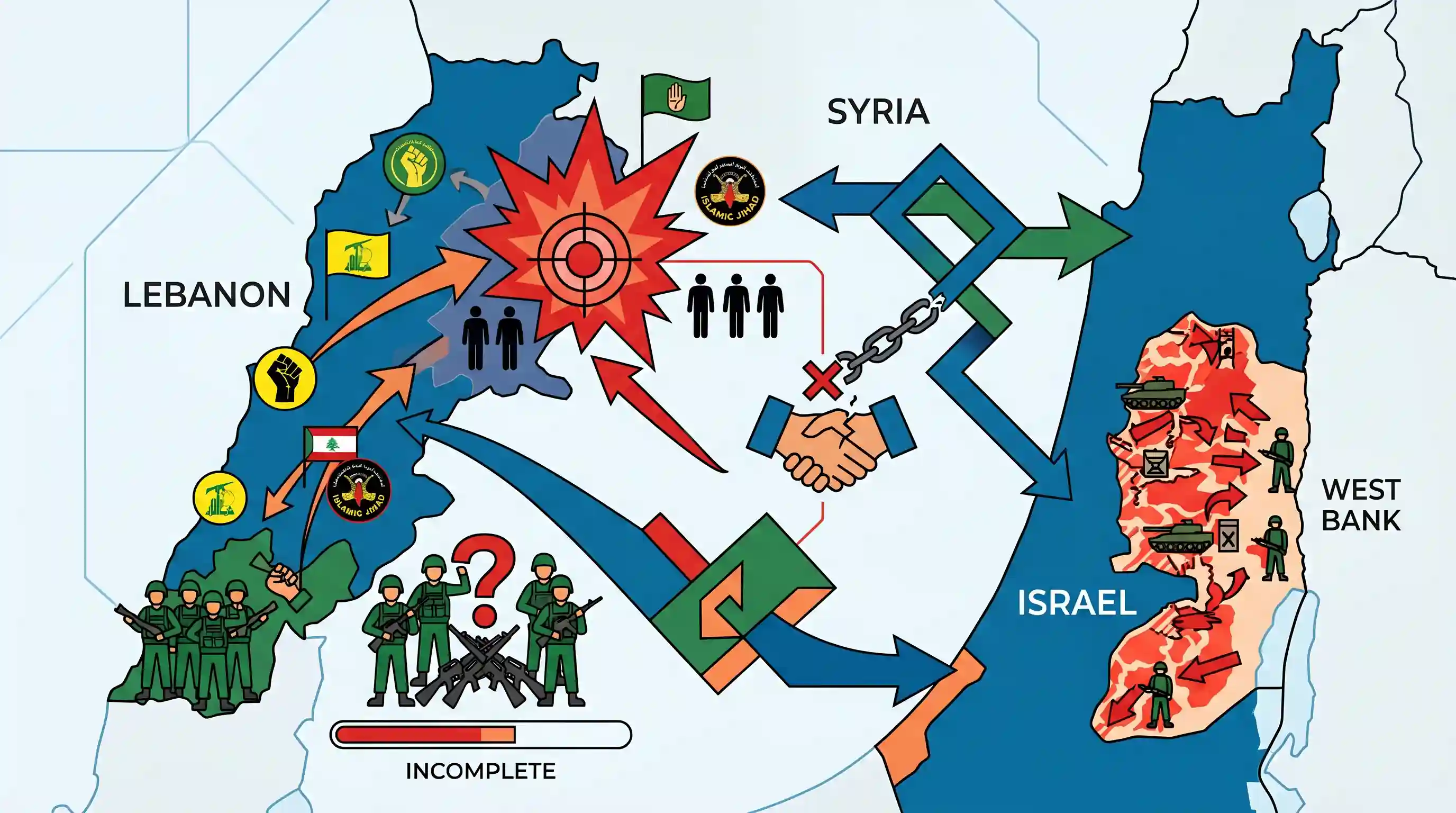
An Israeli strike in eastern Lebanon near the Syrian border killed four people, with Israel claiming it targeted the Palestinian militant group Islamic Jihad. This is the first such strike since the November 2024 ceasefire between Israel and Hezbollah. The incident highlights the precariousness of the truce and the complex security dynamics involving non-state actors like Islamic Jihad and Hezbollah operating within Lebanon. Concurrently, efforts by the Lebanese army to disarm groups in the south remain incomplete, and regional violence persists with ongoing Israeli operations in the occupied West Bank.
Key Points
- An Israeli strike in Lebanon's Majdal Anjar area, near the Syrian border, killed four people.
- Israel claimed the strike targeted operatives of the Palestinian militant group Islamic Jihad.
- This marks the first strike claimed by Israel against Islamic Jihad in Lebanon since the November 2024 ceasefire that ended hostilities with Hezbollah.
- Israel alleges that Islamic Jihad had been coordinating with Hezbollah to establish militant infrastructure in Lebanon.
- The incident highlights the fragile nature of the Israel-Hezbollah ceasefire, with over 370 people killed by Israeli strikes in Lebanon since the truce began.
- The Lebanese army's efforts to disarm armed groups under the truce agreement are ongoing, though groups like Hamas and Islamic Jihad have not committed to disarming.
Important Terms
Palestinian Islamic Jihad (PIJ)

An Iran-backed Palestinian militant group seeking the destruction of Israel and the establishment of an Islamic state. It is the second-largest militant group in Gaza and maintains significant operational presence in Lebanon.
UPSC context
GS-II (International Relations). Relevant for studying regional security, non-state actors, and the spillover of the Israel-Palestine conflict.
Hezbollah
A Lebanon-based Shia militant and political organization backed by Iran. It possesses substantial military power and political influence, often playing a dominant role in regional proxy conflicts and Lebanese domestic affairs.
UPSC context
GS-II (International Relations). Crucial for understanding West Asian stability, non-state actors, and India's strategic energy interests in the region.
United Nations Interim Force in Lebanon (UNIFIL)
A UN peacekeeping mission established in 1978 to confirm Israeli withdrawal from Lebanon, restore international peace, and assist the Lebanese government in asserting authority in the southern border region.
UPSC context
GS-II (International Relations/Global Institutions). Important for India’s major contribution to UN Peacekeeping and border management mechanics.
Islamic Group (Jamaa Islamiya)
A Lebanese Sunni Islamist organization affiliated with the Muslim Brotherhood. Its military wing, the al-Fajr Forces, coordinates with Hamas and Hezbollah to conduct operations against Israel from Lebanese territory.
UPSC context
GS-II (International Relations). Illustrates the sectarian complexities of Lebanese politics and the role of Sunni non-state actors.
Blue Line
The border demarcation between Lebanon and Israel (and the Golan Heights) established by the UN in 2000 to verify the withdrawal of Israeli forces from Lebanese territory.
UPSC context
GS-I (Geography) / GS-II. A major geopolitical flashpoint; essential for map-based analysis and understanding territorial disputes in West Asia.
Hamas
A Palestinian Sunni Islamist political and militant organization that governs the Gaza Strip. It maintains operational links with various groups in Lebanon and is a primary belligerent against Israel.
UPSC context
GS-II (International Relations). Key to understanding the Israel-Palestine conflict and the regional "Axis of Resistance."
Prelims Trap
"The Litani River serves as the international boundary between Israel and Lebanon."
The Litani flows entirely within Lebanon. The actual demarcated boundary is the UN-drawn "Blue Line," while the Litani River forms the northern edge of the UNSC 1701 demilitarized buffer zone.
Static Concepts Connected
What are the defining geographical features and borders of Lebanon?
- Land Borders: Lebanon shares land borders with only two countries: Syria to the north and east, and Israel to the south. It opens to the Mediterranean Sea to the west.
- Litani River: It is the longest river flowing entirely within Lebanon, originating in the Bekaa Valley and draining into the Mediterranean Sea near Tyre.
What is the mandate of UNSC Resolution 1701 in Lebanon?
- Buffer Zone: Establishes a demilitarized zone between the Blue Line (the recognized Israel-Lebanon border) and the Litani River.
- Authorized Forces: Mandates that only the Lebanese Armed Forces and UNIFIL peacekeepers can maintain an armed presence or weapons in this southern buffer zone.
- Disarmament: Requires the disarmament of all armed groups in Lebanon, reinforcing the 1989 Taif Agreement.
Cross-Topic Patterns
Sectarian-fluid proxy warfare
Sunni groups like Palestinian Islamic Jihad receiving backing from Shia-majority Iran shows how proxy networks (Axis of Resistance) frequently transcend traditional sectarian divides to challenge state actors.
Limits of UN Peacekeeping (UNIFIL)
Ongoing armed presence and strikes in the Litani buffer zone expose the structural limitations of UNIFIL's mandate and the broader crisis of UN enforcement mechanisms in active conflict zones.

Expect a 2026 Prelims map question matching West Asian rivers (Litani, Jordan) to their countries, or assessing UNIFIL's mandate limits.
Linked PYQs · 3
Linked PYQs · 3
- 2017PrelimsGS1
Mediterranean Sea is a border of which of the following countries? 1. Jordan 2. Iraq 3. Lebanon 4. Syria Select the correct answer using the code given below:
- 2015PrelimsGS1
Which one of the following countries of South-West Asia does not open out to the Mediterranean Sea?
- 2018MainsGS2
“India’s relations with Israel have, of late, acquired a depth and diversity, which cannot be rolled back.” Discuss.
