Israel Strike in Lebanon Targets Militant Factions
Source:The Hindu ↗
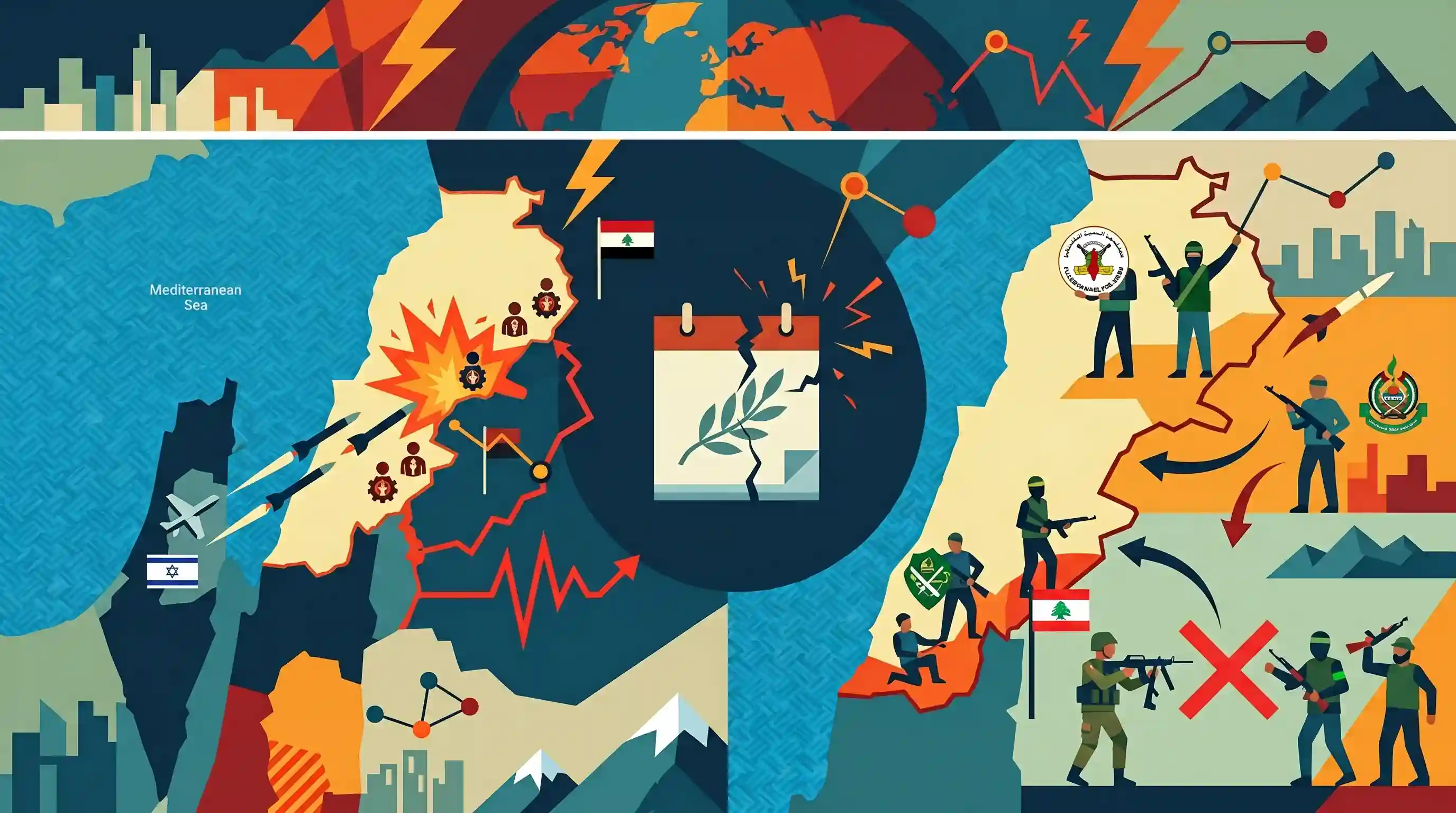
Why It Matters
The ongoing conflict involving Israel, Lebanon, and various militant factions (Hezbollah, Hamas, Islamic Jihad) significantly impacts Middle East stability and global security. The geography of the Levant and the borders of Israel, Lebanon, and Syria are recurring themes in UPSC Prelims map questions.
Summary
An Israeli strike in eastern Lebanon, near the Syrian border, resulted in four casualties. The Israeli military stated the attack targeted operatives of the Palestinian militant group Islamic Jihad. Despite a November 2024 truce intended to halt hostilities between Israel and Hezbollah, cross-border violence persists. Concurrently, Lebanon's military is attempting to disarm factions near the Israeli border, although groups like Hamas and Islamic Jihad have not committed to disarming. This ongoing conflict underscores the severe geopolitical tensions and security challenges involving non-state actors in the Levant region.
Key Points
- An Israeli strike in Lebanon's Bekaa region, near the Syrian border, killed four people, which Israel claimed targeted Islamic Jihad operatives.
- The strike occurred despite a November 2024 truce aimed at ending hostilities between Israel and the Lebanese militant group Hezbollah.
- Lebanon is currently implementing a plan to disarm militant groups near its southern border, though Palestinian factions like Hamas and Islamic Jihad remain armed.
- The incident highlights the complex web of non-state actors operating in the Levant region and their impact on Middle East stability.
- The geographical proximity of Lebanon, Syria, and Israel frequently features in UPSC Prelims map-based questions.
Important Terms
Islamic Jihad (PIJ)

A Palestinian militant group, distinct from the PLO, active in Gaza and Lebanon. It is backed by Iran and resists Lebanese state-led disarmament efforts.
UPSC context
GS Paper II (IR/West Asia); tests understanding of non-state actors and the 'Axis of Resistance' impacting regional stability.
Hezbollah
A Shia political and militant organization in Lebanon, often termed a 'state within a state.' It is a primary Iranian proxy and central to the 2024-2025 ceasefire agreements.
UPSC context
GS Paper II (IR); critical for questions on West Asian geopolitics, proxy wars, and Lebanon’s internal stability.
Hamas
A Palestinian Sunni group governing Gaza that maintains armed wings in Lebanon’s refugee camps. It coordinates with Hezbollah while resisting full disarmament.
UPSC context
GS Paper II (IR); relevant for Israel-Palestine conflict dynamics and its spillover into neighboring Lebanon.
Lebanese Armed Forces (LAF)
Lebanon's national military tasked with reclaiming sovereignty, deploying to southern borders, and disarming militias under international peace frameworks like the 2024 truce.
UPSC context
GS Paper II (IR); tests knowledge of state-building challenges and the role of national militaries in conflict zones.
The Levant
An Eastern Mediterranean region comprising Lebanon, Syria, Israel, Jordan, and Palestine. It is a frequent subject of UPSC map-based and geopolitical questions.
UPSC context
GS Paper I (Geography) and II (IR); essential for identifying conflict zones and historical boundaries in West Asia.
Litani River
A strategic Lebanese river serving as a buffer boundary. The 2024 ceasefire mandated that Hezbollah withdraw its armed forces north of this line.
UPSC context
GS Paper I (Geography); often appears in map-marking or questions regarding regional security buffer zones.
Prelims Trap
All core Levant countries, including Jordan and Lebanon, share a coastline with the Mediterranean Sea.
Jordan is often incorrectly assumed to be a Mediterranean country. It is almost entirely landlocked, save for a small coastline on the Gulf of Aqaba (Red Sea).
Static Concepts Connected
Which West Asian countries border the Mediterranean Sea?
- Levant Coast: Lebanon, Syria, Israel, and the Palestinian territories (Gaza Strip) open out directly to the eastern Mediterranean Sea.
- Notable Exclusions: Jordan and Iraq are frequently used as trap options in UPSC Prelims; neither country has a Mediterranean coastline.
How do Hezbollah, Hamas, and Islamic Jihad differ in origin and ideology?
- Hezbollah: A powerful Shia Islamist political party and militant group based in Lebanon, strongly backed and funded by Iran.
- Hamas: A Sunni Palestinian organization that politically governs the Gaza Strip while maintaining a substantial military wing.
- Islamic Jihad: A smaller Palestinian Sunni militant faction that rejects political participation entirely, focusing exclusively on armed conflict against Israel.
Cross-Topic Patterns
Levant geography & offshore energy
Map questions on the Levant increasingly intersect with Eastern Mediterranean offshore gas discoveries, linking terrestrial border conflicts to broader maritime energy security dynamics.
Non-state actors as proxies
The inability of the Lebanese state to disarm militant groups highlights a structural shift toward asymmetric proxy warfare, bypassing sovereign armies in international conflict.

Expect a match-the-pair map question linking volatile areas like the Bekaa Valley, Golan Heights, or Gaza to their respective countries.
Linked PYQs · 5
Linked PYQs · 5
- 2015PrelimsGS1
Which one of the following countries of South-West Asia does not open out to the Mediterranean Sea?
- 2017PrelimsGS1
Mediterranean Sea is a border of which of the following countries? 1. Jordan 2. Iraq 3. Lebanon 4. Syria Select the correct answer using the code given below:
- 2003PrelimsGS1
Israel has common borders with
- 2022PrelimsGS1
The term "Levant" often heard in the news roughly corresponds to which of the following regions?
- 2018MainsGS2
“India’s relations with Israel have, of late, acquired a depth and diversity, which cannot be rolled back.” Discuss.
