West Asia ceasefire violations and regional escalation
Source:The Hindu ↗
Why It Matters
The ongoing Israel-Hezbollah conflict threatens the fragile stability in West Asia (the Levant region). For UPSC aspirants, understanding the geographic nuances (like the Litani River and Mediterranean borders) and the geopolitical interplay involving non-state actors (Hezbollah, Hamas) and international mediators is essential for grasping broader international security and diplomatic issues.
Summary
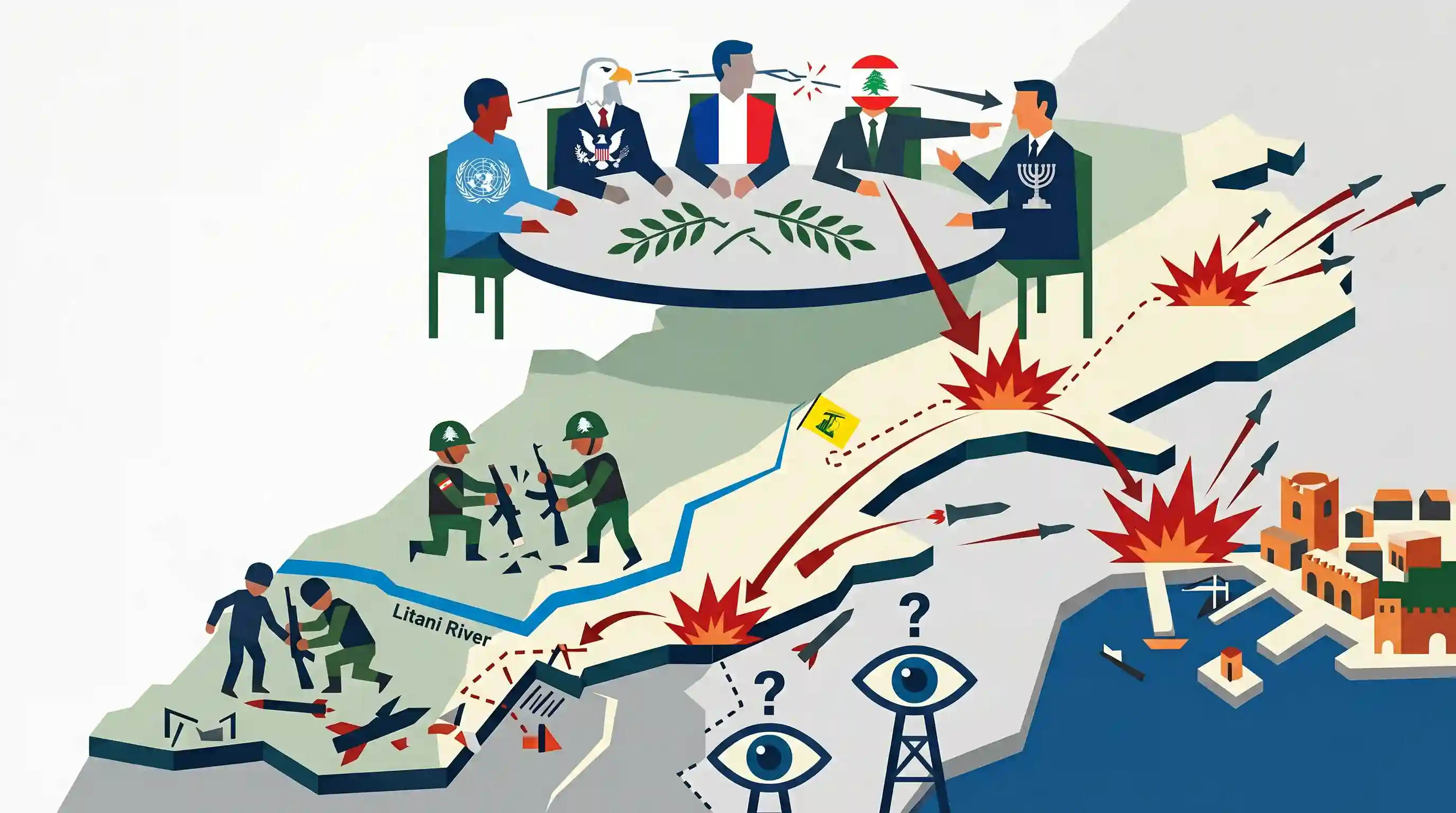
Lebanon has accused Israel of undermining efforts to prevent a regional escalation following a series of Israeli airstrikes on Lebanese territory. Despite a year-old ceasefire, Israel targeted alleged Hezbollah and Hamas infrastructure in southern and eastern Lebanon, including areas near the coastal city of Sidon. The strikes precede a meeting of an international ceasefire monitoring committee comprising the US, France, Lebanon, Israel, and the UN. Concurrently, the Lebanese government is reviewing its military's mandate to disarm Hezbollah south of the Litani River, a step Israel considers insufficiently implemented.
Key Points
- Lebanese President Joseph Aoun condemned recent Israeli airstrikes, arguing they undermine ongoing local and international efforts to de-escalate the conflict.
- Israel claimed the strikes targeted Hezbollah and Hamas military infrastructure and weapon storage facilities, including locations near the coastal city of Sidon.
- The strikes occurred despite a year-old ceasefire and ahead of a scheduled meeting of the ceasefire monitoring committee, which includes the US, France, Lebanon, Israel, and the UN.
- The Lebanese cabinet is set to discuss the Lebanese army's progress in disarming Hezbollah south of the Litani River, a critical component of the ceasefire plan.
Important Terms
Litani River

A 140-km long Lebanese river; under UN Resolution 1701, it serves as the northern boundary for a buffer zone intended to be free of Hezbollah's armed presence.
UPSC context
GS Paper II (IR); important for Middle East geopolitics and 'Places in News' regarding Lebanon-Israel security boundaries.
UN Resolution 1701
A 2006 United Nations Security Council resolution calling for a permanent ceasefire between Israel and Hezbollah, requiring Hezbollah's withdrawal north of the Litani River.
UPSC context
GS Paper II (IR); central to West Asia security architecture and international law regarding non-state actors.
International Monitoring and Implementation Mechanism (IMIM)
A US-led body, including France, Lebanon, Israel, and UNIFIL, established after the 2024 ceasefire to oversee compliance and verify Hezbollah's disarmament infrastructure.
UPSC context
GS Paper II (IR); tests knowledge of current multilateral mechanisms for conflict resolution and peacekeeping.
UNIFIL
The UN peacekeeping mission established in 1978 and expanded in 2006 to monitor hostilities and assist the Lebanese army in southern Lebanon.
UPSC context
GS Paper II (IR); significant for UN’s role in regional stability and India’s contribution to UN peacekeeping forces.
Lebanese Armed Forces (LAF)
The official state military of Lebanon, currently tasked under the 2024 ceasefire with dismantling non-state military infrastructure and asserting a state monopoly on arms.
UPSC context
GS Paper II (IR); critical for understanding state sovereignty and challenges of security sector reform in fragile states.
Sidon
A major coastal city in southern Lebanon and home to the Ain al-Hilweh refugee camp, frequently figuring in news due to targeted Israeli airstrikes.
UPSC context
GS Paper I (Geography); key 'Place in News' identifying conflict flashpoints and demographic significance in West Asia.
Prelims Trap
The Litani River forms the internationally recognized border between Israel and Lebanon.
The Litani flows entirely within Lebanon. The UN-recognized border demarcation between Israel and Lebanon is actually the 'Blue Line', established in 2000.
Static Concepts Connected
What is the geographical significance of the Litani River and the Levant?
- Litani River: The longest river flowing entirely inside Lebanon, rising in the Bekaa Valley and draining into the Mediterranean Sea. It acts as a major security buffer.
- Levant Region: A historical geographic term for the eastern Mediterranean shores, roughly encompassing present-day Syria, Lebanon, Israel, Jordan, and Palestine.
- Blue Line: The UN-published border demarcation separating Lebanon from Israel and the Golan Heights, created to determine whether Israel had fully withdrawn from Lebanon.
What are the key mandates of UNSC Resolution 1701 and UNIFIL?
- UNSC 1701: Adopted in 2006, it mandated a demilitarized zone south of the Litani River and called for the disarmament of non-state actors like Hezbollah.
- UNIFIL Mission: The United Nations Interim Force in Lebanon is a peacekeeping mission monitoring the cessation of hostilities. India is historically a major troop-contributing nation here.
Cross-Topic Patterns
Levant geography matching pairs
UPSC heavily tests Levant geography. Expect match-the-following pairs blending recent flashpoints like Sidon and the Litani River (Lebanon), Rafah (Gaza), and the Golan Heights (Syria/Israel).
Red Sea crisis & Levant instability
Continued volatility in the Levant acts as a geopolitical multiplier to the Houthi-led Red Sea crisis, compounding risks to India's maritime trade routes and energy security.

Map questions pairing Levant rivers (Litani, Jordan) and border demarcations (Blue Line) are highly probable for the 2026 Prelims.
Linked PYQs · 4
Linked PYQs · 4
- 2018MainsGS2
“India’s relations with Israel have, of late, acquired a depth and diversity, which cannot be rolled back.” Discuss.
- 2022PrelimsGS1
The term "Levant" often heard in the news roughly corresponds to which of the following regions?
- 2017PrelimsGS1
Mediterranean Sea is a border of which of the following countries? 1. Jordan 2. Iraq 3. Lebanon 4. Syria Select the correct answer using the code given below:
- 2003PrelimsGS1
Israel has common borders with
