Westminster Executive Accountability and Leadership Transition
Source:The Hindu ↗
Why It Matters
This article illustrates the practical working of the British Westminster system, which India adopted with key modifications. It provides a real-world case study for comparing executive-legislative relations, mechanisms of direct executive accountability (such as PMQs vs. India's Question Hour), and the flexibility of mid-term leadership transitions under the UK model versus India's anti-defection framework.
Summary
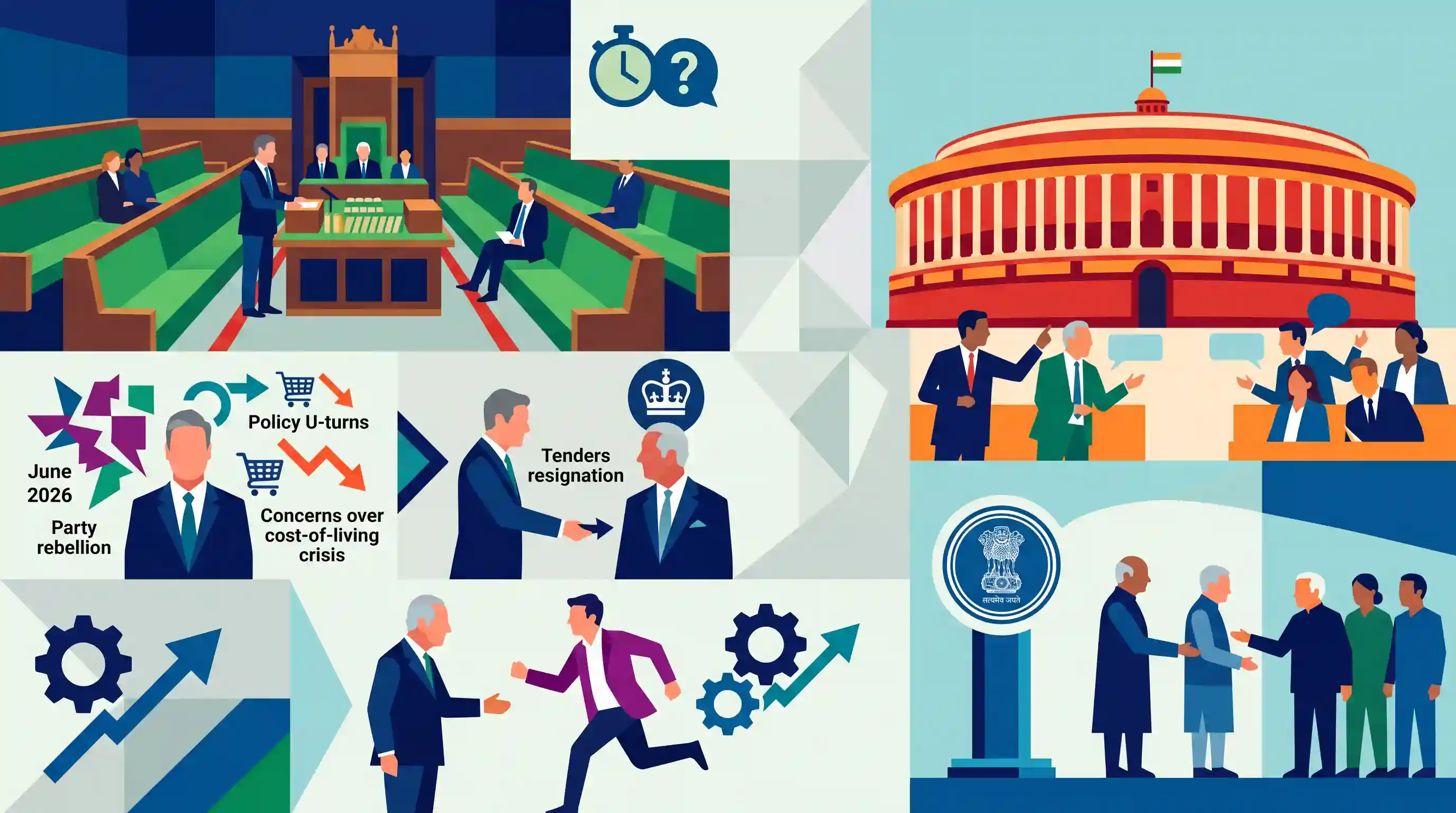
UK Prime Minister Keir Starmer held his final Prime Minister's Questions (PMQs) session in Parliament on July 15, 2026, marking the end of his premiership. Starmer resigned in June 2026 amid internal party rebellion over policy U-turns and slow action on the cost-of-living crisis, following his landslide election win in 2024. Former Mayor of Greater Manchester Andy Burnham will succeed him as Prime Minister and Labour leader, running unopposed. The transition involves Starmer tendering his resignation to King Charles III, who will then invite Burnham to form a government, illustrating the UK's swift mid-term leadership transition mechanisms.
Key Points
- UK Prime Minister Keir Starmer concluded his final Prime Minister's Questions (PMQs) session in the House of Commons on July 15, 2026, ahead of his formal resignation.
- Starmer announced his resignation in June 2026 following internal party rebellion over the cost-of-living crisis and policy U-turns, despite having won a landslide general election victory in July 2024.
- Andy Burnham, former Mayor of Greater Manchester, is set to succeed Starmer as Prime Minister and Labour leader, running unopposed with the endorsement of 349 Labour MPs.
- The transition of power involves Starmer formally tendering his resignation to King Charles III at Buckingham Palace, who will then invite Burnham to form a new government.
- Starmer's exit highlights the British political system's mechanism of mid-term leadership changes via internal party processes without requiring a general election.
Important Terms
Westminster Model

A democratic parliamentary system of government originating in the United Kingdom, where the executive is drawn from and held accountable to a bicameral legislature, featuring a ceremonial head of state.
UPSC context
GS Paper II (Polity). Essential for comparing Indian and British constitutional frameworks and assessing executive accountability.
House of Commons
The democratically elected lower house of the United Kingdom Parliament, consisting of 650 Members of Parliament, responsible for legislation, government oversight, and authorizing taxation.
UPSC context
GS Paper II (Comparison of Constitutions). Tests understanding of lower house powers, representing a direct comparison with India's Lok Sabha.
Prime Minister's Questions
A weekly constitutional convention in the UK House of Commons where the Prime Minister spends 30 minutes answering direct questions from MPs, facilitating rigorous executive scrutiny.
UPSC context
GS Paper II (Parliamentary Oversight). Tests knowledge of executive accountability mechanisms, contrasting with India’s Question Hour.
Buckingham Palace
The administrative headquarters and official London residence of the British Monarch, functioning as the symbolic center of the UK’s constitutional monarchy and formal executive transitions.
UPSC context
GS Paper II (Polity/Comparison). Illustrates the UK's ceremonial executive role, compared with the republican nature of India’s President.
Labour Party
A major center-left political party in the United Kingdom, historically tied to the trade union movement, advocating for social democracy, public services, and welfare state strengthening.
UPSC context
GS Paper II (Comparative Politics). Relevant for studying party systems, electoral politics, and leadership transition dynamics in democracies.
Conservative Party
A major center-right political party in the United Kingdom, historically advocating for free-market capitalism, private enterprise, fiscal conservatism, and the preservation of traditional British institutions.
UPSC context
GS Paper II (Comparative Politics). Important for understanding the UK's two-party system dynamics and its influence on parliamentary stability.
Prelims Trap
Like the British Westminster system, Indian ministers bear individual legal responsibility for executive acts, requiring their countersignature on presidential orders.
In India, there is no provision for the legal responsibility of ministers. Unlike the UK, official acts of the President do not require ministerial countersignatures, and courts cannot investigate ministerial advice.
Static Concepts Connected
How do the legal and individual responsibilities of ministers differ between India and the UK?
- UK Legal Responsibility: In the UK, every executive order of the monarch must be countersigned by a minister, who is legally liable in court for its legality.
- Indian Position: India has no system of legal responsibility for ministers. Official acts of the President do not require ministerial countersignatures.
- Judicial Bar: Under Article 74(2), Indian courts are constitutionally barred from inquiring into the nature of advice tendered by ministers to the President.
How do anti-defection provisions differ in the legislative functioning of India and the UK?
- Tenth Schedule: India utilizes the Tenth Schedule to disqualify MPs who defy the party whip, severely restricting public dissent against their own leadership.
- UK Flexibility: The UK has no statutory anti-defection law; MPs can freely rebel, vote against the party line, or force out their leader without losing their seats.
Cross-Topic Patterns
Inner-party democracy vs Anti-Defection
The UK’s fluid mid-term prime ministerial transitions highlight how the absence of anti-defection laws fosters inner-party democracy, contrasting with India’s stability-first Tenth Schedule model.
Executive Accountability Models
Contrasting the UK's PMQs with India's Question Hour shows how dedicated executive-specific scrutiny compares to departmental oversight in ensuring real-time parliamentary accountability.

GS-2 2026 is highly likely to feature a comparative question on parliamentary accountability, contrasting UK's PMQs and India's Question Hour.
Linked PYQs · 2
Linked PYQs · 2
- 2023MainsGS2
Compare and contrast the British and Indian approaches to Parliamentary sovereignty.
- 2021MainsGS2
To what extent, in your view, the Parliament is able to ensure accountability of the executive in India?
