Calcutta High Court cancels judicial leaves to tackle case backlogs
Source:Indian Express ↗
Why It Matters
The functioning of the subordinate judiciary is a critical component of India's justice delivery system. The massive pendency of cases frequently prompts administrative and judicial interventions. Understanding the High Court's administrative control under Article 235, and the trade-offs between clearing backlogs versus judicial training, is highly relevant for GS Paper 2 questions on judicial reforms and governance.
Summary
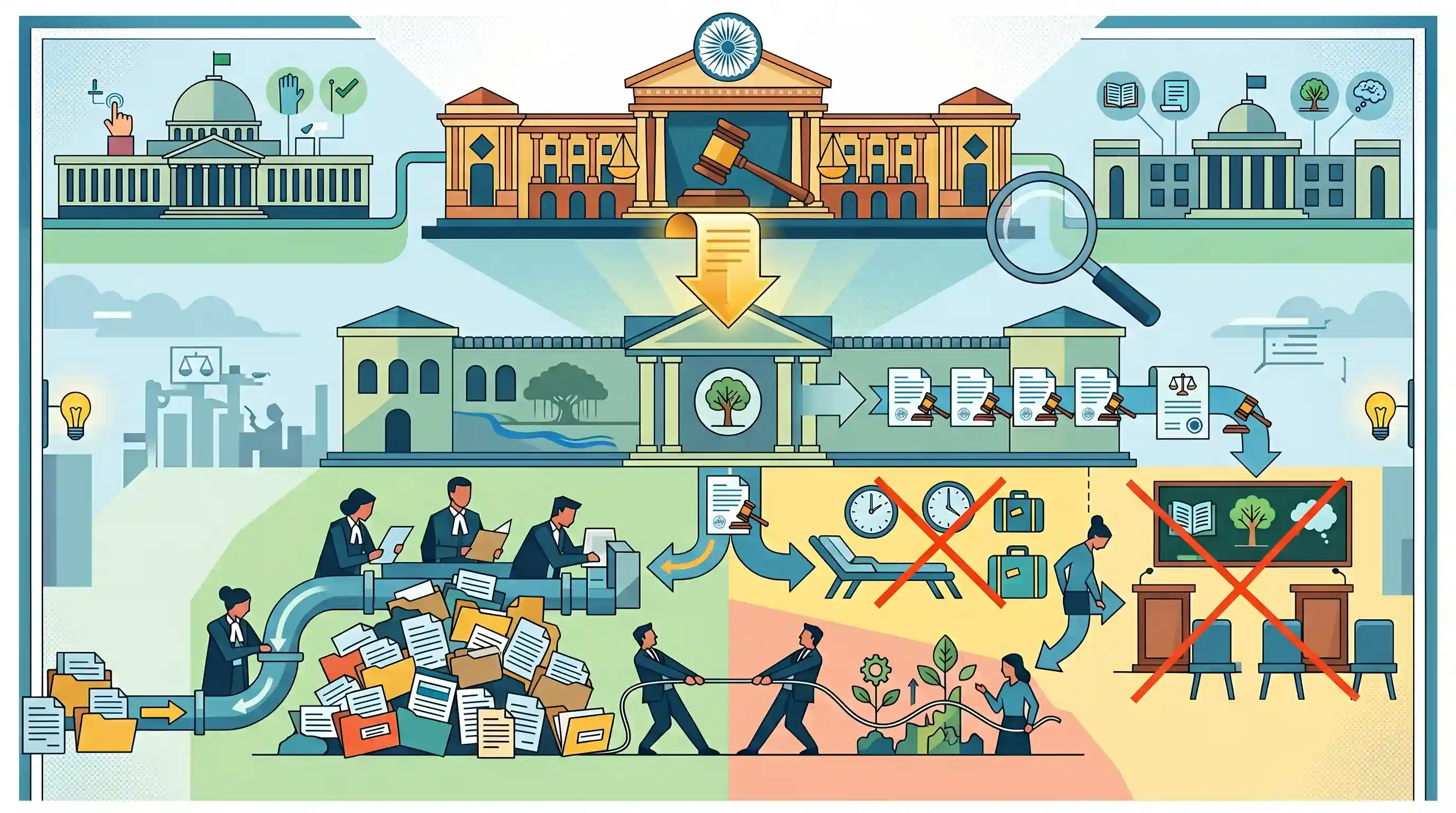
Following Supreme Court directives aimed at tackling judicial backlog and improving case disposal rates, the Calcutta High Court has issued administrative orders cancelling leaves and ongoing training programmes for judicial officers. This extraordinary administrative measure underscores the acute challenge of pendency in the subordinate judiciary and demonstrates the High Court's supervisory control over subordinate courts under Article 235 of the Constitution. While aimed at maximizing judicial working hours to clear arrears in the short term, the cancellation of training programs highlights a critical tension between immediate case disposal needs and the long-term necessity of continuous judicial education and capacity building.
Key Points
- The Calcutta High Court has cancelled leaves and training programmes for judicial officers to ensure maximum availability of judges on the bench.
- This administrative decision was taken in response to Supreme Court directives aimed at tackling the severe pendency of cases in subordinate courts.
- The order highlights the High Court's constitutional authority under Article 235, which vests administrative and supervisory control of the subordinate judiciary in the respective High Courts.
- While maximizing immediate judicial working hours, the suspension of training underscores a systemic trade-off between clearing backlogs and ensuring the continuous capacity building of judicial officers.
Important Terms
Article 235 of the Constitution of India

Constitutional provision that vests the administrative control of district and subordinate courts, including postings and leaves, in the respective High Court.
UPSC context
GS Paper II: Structure and functioning of the Judiciary; tests knowledge of High Court's supervisory jurisdiction.
Calcutta High Court
The oldest High Court in India, established in 1862, exercising jurisdiction over West Bengal and the Union Territory of Andaman and Nicobar Islands.
UPSC context
GS Paper II: Constitutional bodies and the geographical jurisdiction of Indian High Courts.
Judicial Pendency
The accumulation of unresolved cases within the court system, currently cited as a major hurdle to the 'Right to Speedy Trial'.
UPSC context
GS Paper II: Governance and judicial reforms; addresses the efficiency of the Indian legal system.
Subordinate Judiciary
Lower courts at the district and local levels that handle the bulk of litigation under the administrative supervision of High Courts.
UPSC context
GS Paper II: Dispute redressal mechanisms and institutions; essential for understanding the grass-roots justice delivery system.
Separation of Powers
The constitutional doctrine that divides the functions of the State among the legislative, executive, and judicial branches to ensure checks and balances.
UPSC context
GS Paper II: Basic structure of the Constitution and dispute redressal mechanisms between various organs.
Prelims Trap
The Governor exercises administrative control, including leaves and postings, over the district judiciary as the appointing authority.
While the Governor appoints District Judges (Art 233), Article 235 vests exclusive administrative control (leaves, postings, promotions) of the subordinate judiciary in the High Court to ensure judicial independence.
Static Concepts Connected
Who exercises administrative control over the subordinate judiciary?
- High Court Control: Article 235 vests administrative and supervisory control of district and subordinate courts exclusively in the respective State High Court.
- Scope of Power: This encompasses postings, promotions, and the granting of leaves to judicial officers, shielding grassroots judges from executive interference.
- Appointment Caveat: While the Governor appoints District Judges (Article 233) in consultation with the HC, ongoing administrative control remains entirely with the High Court.
What are Arrears Committees in the Indian judicial system?
- Core Mandate: Special committees established in High Courts and District Courts under Supreme Court directives to monitor and systematically expedite the clearance of older cases.
- Target Cases: They primarily focus on prioritizing, tracking, and disposing of cases that have been pending in the system for more than five years.
Cross-Topic Patterns
Contract enforcement and economic surveys
Economic Surveys consistently link subordinate court backlogs to poor contract enforcement, showing how judicial pendency directly hampers India's Ease of Doing Business and deters foreign investment.
Capacity building vs. service delivery
Suspending judicial training to clear immediate backlogs highlights a classic governance trade-off, mirroring civil service debates where long-term capacity building (like Mission Karmayogi) often competes with urgent daily firefighting.

Expect a multi-statement Prelims question testing the subtle distinction between Governor's appointment (Art 233) and HC's control (Art 235).
Linked PYQs · 4
Linked PYQs · 4
- 2023MainsGS2
“Constitutionally guaranteed judicial independence is a prerequisite of democracy.” Comment.
- 2024MainsGS2
Explain and distinguish between Lok Adalats and Arbitration Tribunals. Whether they entertain civil as well as criminal cases ?
- 2014MainsGS2
Instances of President's delay in commuting death sentences has come under public debate as denial of justice. Should there be a time limit specified for the President to accept/reject such petitions ? Analyse.
- 2021PrelimsGS1
With reference to Indian judiciary, consider the following statements : 1. Any retired judge of the Supreme Court of India can be called back to sit and act as a Supreme Court judge by the Chief Justice of India with prior permission of the President of India. 2. A High Court in India has the power to review its own judgement as the Supreme Court does. Which of the statements given above is/are correct?
