Arctic Geopolitics and US Territorial Ambitions over Greenland
Source:The Hindu ↗
Why It Matters
The strategic race for the Arctic region is a vital geopolitical issue. Understanding the interplay between climate change, new maritime routes, resource extraction, and major power competition (like the US interest in Greenland) provides critical context for India's own Arctic policy and its stance on international law and sovereignty.
Summary
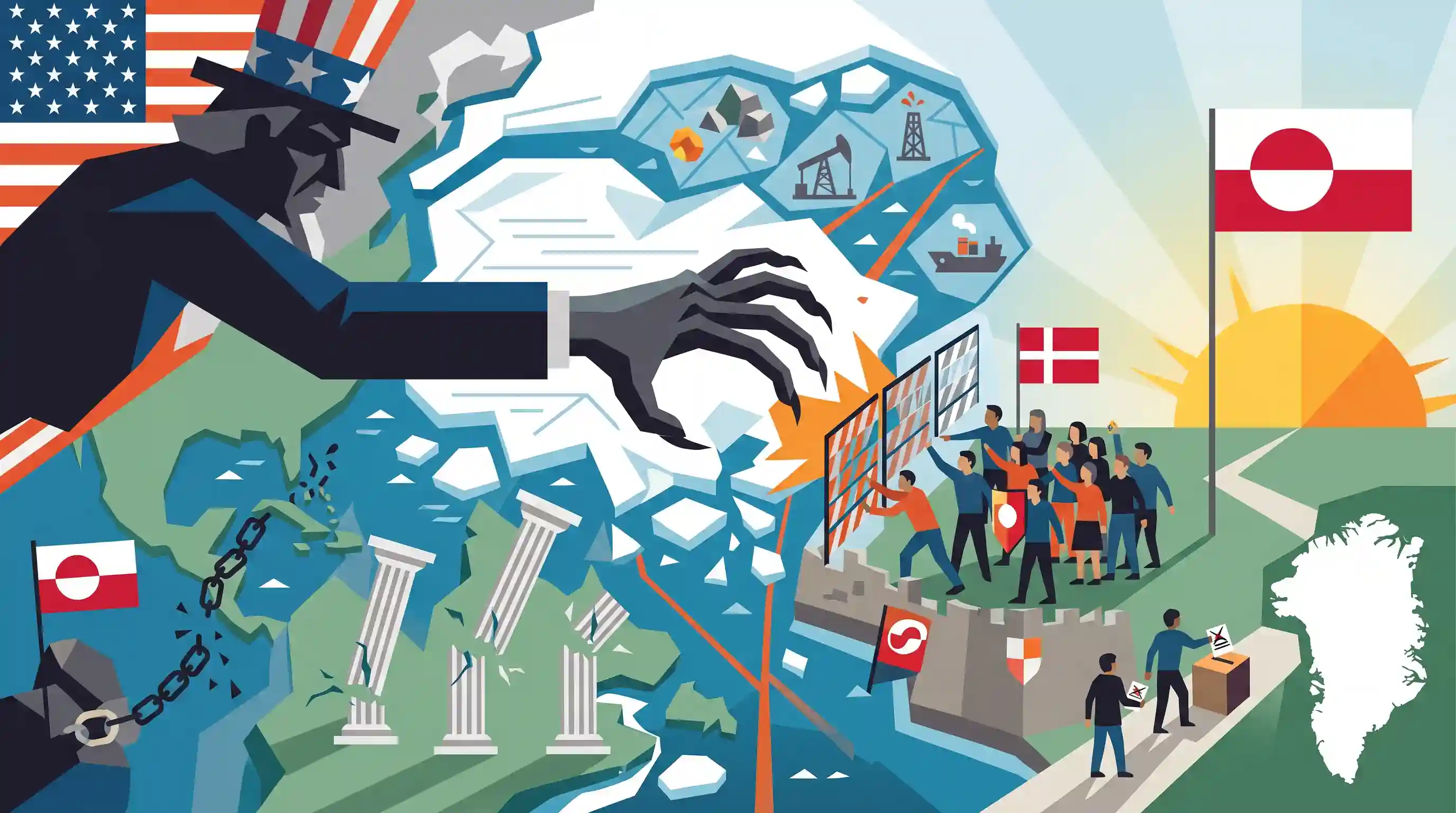
The article critiques the renewed efforts by the US administration to take control of Greenland, describing it as an expansionist move driven by the geopolitical and economic opportunities of a rapidly melting Arctic. While the US seeks to enhance its strategic footprint and resource access, Greenland's residents and the Danish government have firmly rejected the proposal. The editorial emphasizes that attempting to buy or seize territory undermines the post-war international order, and asserts that any change to Greenland's status must be decided democratically by its own people, who increasingly favor independence.
Key Points
- The US administration is renewing aggressive diplomatic efforts to acquire Greenland, driven by the strategic and economic significance of the Arctic region.
- Climate change and accelerated Arctic ice melt are opening new navigation routes and access to untapped natural resources, intensifying geopolitical competition among Arctic nations.
- Greenland, currently an autonomous territory of Denmark, and the Danish government have firmly rejected the US proposal, with a vast majority of Greenlanders supporting full independence.
- The article argues that US expansionist ambitions threaten the post-war international order, which is predicated on territorial integrity, national sovereignty, and democratic self-determination.
Important Terms
Greenland (Autonomous Territory)

An autonomous territory within the Kingdom of Denmark with extensive self-rule since 1979/2009. Denmark retains control over its defense and foreign policy, making it a strategic Arctic flashpoint.
UPSC context
GS Paper-II (International Relations); tests understanding of strategic territories, decolonization, and Great Power competition for Arctic resources.
Arctic Council
A high-level intergovernmental forum promoting cooperation among the eight Arctic states, indigenous communities, and observers (including India) on issues of sustainable development and environmental protection.
UPSC context
GS Paper-II (International Relations/Global Groupings); essential for questions on India’s Arctic Policy and regional governance frameworks.
Right to Self-Determination
A core international law principle allowing a people to freely determine their political status, sovereignty, and government form without external interference, central to Greenland's independence movement.
UPSC context
GS Paper-II (International Relations/UN Charter); tests concepts of democratic sovereignty, indigenous rights, and international legal norms.
Arctic Geopolitics
The strategic competition among major powers (US, Russia, China) intensified by melting sea ice, which opens new maritime routes and allows access to massive untapped natural resources.
UPSC context
GS Paper-II & III (Geopolitics/Environment); tests knowledge of climate change’s role in reshaping global security and resource diplomacy.
Rules-based International Order
A multilateral system of international laws and institutions (e.g., UN, UNCLOS) established after WWII to maintain peace, territorial integrity, and predictable state behavior.
UPSC context
GS Paper-II (International Relations); tests awareness of current challenges to global governance and the preservation of state sovereignty.
Sovereignty
The supreme legal and political authority a state holds over its territory. Denmark currently retains sovereignty over Greenland, while Greenlanders increasingly seek full independence.
UPSC context
GS Paper-II (Polity/International Relations); fundamental concept for understanding state boundaries, territorial integrity, and autonomy disputes.
Prelims Trap
"Greenland is an independent sovereign nation bordering the Arctic Ocean."
Greenland is not an independent country but an autonomous territory within the Kingdom of Denmark. Denmark retains control over its foreign affairs, defence, and monetary policy.
Static Concepts Connected
What is the composition and primary mandate of the Arctic Council?
- Member States: Eight states (Canada, Denmark, Finland, Iceland, Norway, Russia, Sweden, US) with sovereign territory in the Arctic.
- Core Mandate: Promotes cooperation, sustainable development, and environmental protection among Arctic States and indigenous communities.
- Key Limitation: The founding Ottawa Declaration explicitly excludes military security and territorial disputes from the Council’s mandate.
Which emerging Arctic shipping corridors are altering global trade routes?
- Northern Sea Route: Runs along the Russian Arctic coast, offering a heavily trafficked, significantly shorter path between Europe and Asia.
- Northwest Passage: Navigates through Canada's Arctic Archipelago, directly connecting the Atlantic and Pacific oceans.
- Transpolar Sea Route: A theoretical future route straight across the center of the Arctic Ocean, becoming viable only if summer ice disappears entirely.
Cross-Topic Patterns
Arctic Melting & Critical Minerals
The race for Greenland’s Rare Earth Elements highlights how climate-induced ice melt is opening new resource frontiers, sparking a geopolitical scramble to break existing global mineral monopolies.
India's Arctic Policy Implications
India’s 2022 Arctic Policy focuses on climate research and mineral cooperation. Geopolitical scrambles over autonomous territories directly impact India’s scientific and strategic interests in the region.

A map question combining Arctic Council nations, Greenland's political status, and emerging maritime routes is highly probable in 2026.
Linked PYQs · 2
Linked PYQs · 2
- 2011MainsGS2
As regards the increasing rates of melting of Arctic Sea ice, the interests of the Arctic Council nations may not coincide with those of the wider world." Explain.
- 2025MainsGS2
"With the waning of globalization, post-Cold War world is becoming a site of sovereign nationalism.” Elucidate.
