Transport Permits: One-Year Grace Period Given for Marathi Learning
Source:indiatimes ↗
Why It Matters
The issue intersects with multiple constitutional and legal domains important for MPSC Polity: the scope of Fundamental Rights (freedom of trade/profession), the statutory limitations of executive action vs. central laws (Motor Vehicles Act), and the enforcement of linguistic policies at the state level. It also highlights the role of High Courts (Article 226) in judicial review of state mandates via PILs.
Summary
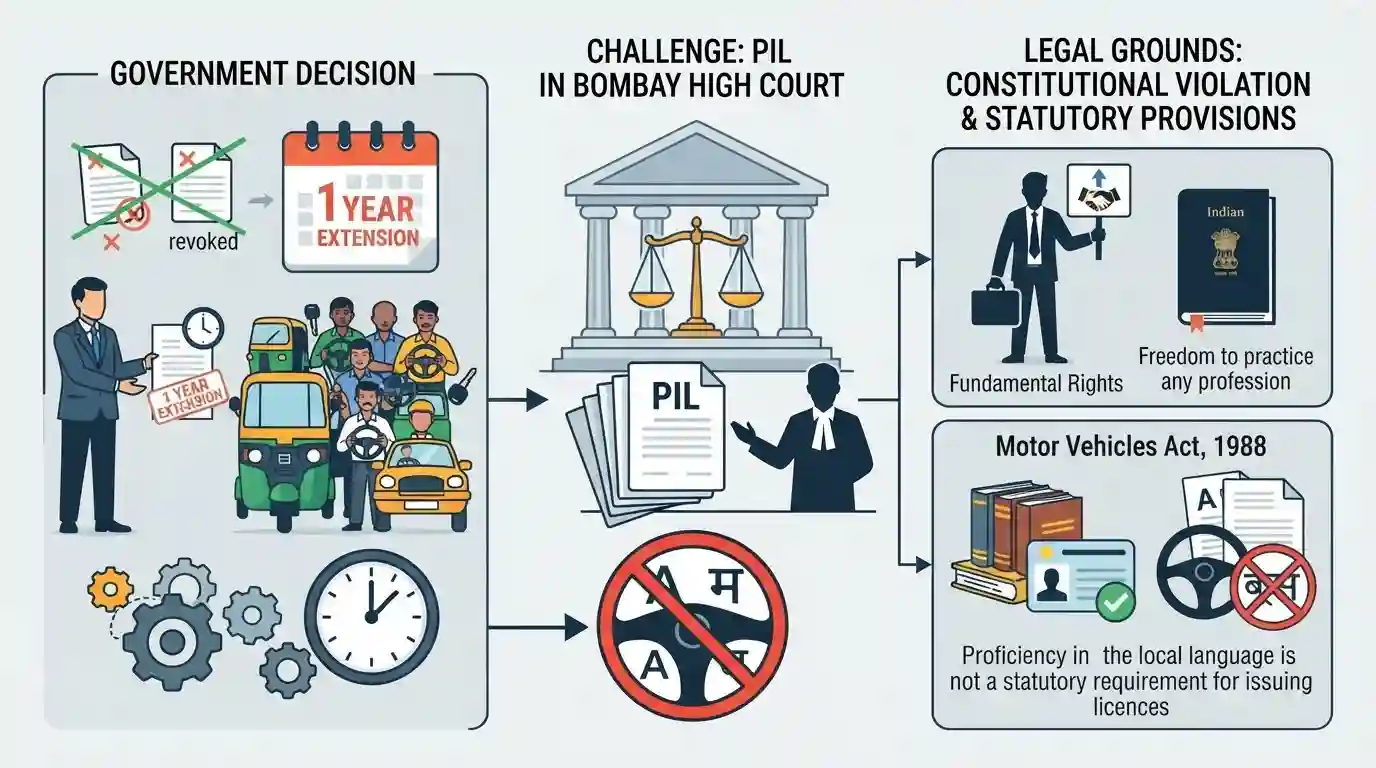
The Maharashtra government has extended the deadline by one year for auto-rickshaw and taxi drivers to learn functional Marathi, assuring that no permits will be revoked during this period. The decision comes amidst a Public Interest Litigation (PIL) in the Bombay High Court challenging the language mandate. The petitioners contend that imposing such a condition violates their fundamental right to freely practice a profession or trade and exceeds the statutory provisions of the Motor Vehicles Act, 1988, which does not require local language proficiency for issuing licences.
Key Points
- The Maharashtra government has granted a one-year extension for auto-rickshaw and taxi drivers in the state to acquire a working knowledge of Marathi.
- Chief Minister Devendra Fadnavis stated that permits will not be cancelled during this grace period for lacking language proficiency.
- A Public Interest Litigation (PIL) was recently filed in the Bombay High Court challenging the state's mandatory language requirement for drivers.
- Petitioners argue that this language condition infringes on their fundamental right to practice any profession or trade, as guaranteed under Article 19(1)(g) of the Constitution.
- The PIL also highlights that the Motor Vehicles Act, 1988 does not prescribe local language proficiency as a prerequisite for obtaining a driving licence.
Important Terms
Motor Vehicles Act, 1988

A Central parliamentary act regulating road transport vehicles, driver licensing, and permits across India. The primary statute does not explicitly prescribe local language proficiency as a prerequisite for driving licenses.
UPSC context
GS Paper 2 (Statutes). Highlights Centre-State jurisdictional tensions, specifically whether State rules can overreach Central statutory frameworks regarding licensing.
Article 19(1)(g)
A fundamental right in the Indian Constitution guaranteeing citizens the freedom to practice any profession, occupation, trade, or business, subject only to constitutionally valid "reasonable restrictions" by the State.
UPSC context
GS Paper 2 (Indian Constitution). Essential for analyzing whether mandatory language policies constitute a reasonable restriction or a violation of livelihood rights.
Public Interest Litigation (PIL)
A legal mechanism allowing any socially conscious individual or group to approach courts to seek justice for public grievances, challenging government policies to protect fundamental rights.
UPSC context
GS Paper 2 (Judiciary). Tests understanding of judicial activism and mechanisms for citizens to challenge the constitutional validity of executive mandates.
Bombay High Court
The primary constitutional court with jurisdiction over Maharashtra, Goa, and specific Union Territories, empowered to conduct judicial review over state executive actions and enforce fundamental rights.
UPSC context
GS Paper 2 (State Judiciary). Highlights the role of state-level high courts in arbitrating conflicts between local government mandates and constitutional rights.
Prelims Trap
Motor Vehicles is a Union List subject, hence states have no rule-making power.
Motor Vehicles fall under the Concurrent List (Entry 35). The PIL challenges the rule as ultra vires to the parent Central Act, not state legislative incompetence over the subject itself.
Static Concepts Connected
What are the reasonable restrictions on the freedom to practice a profession under Article 19(6)?
- General Public Interest: The state can impose restrictions in the interest of the general public.
- Technical Qualifications: The state is empowered to prescribe professional or technical qualifications necessary for practicing any profession or carrying on any occupation, trade or business.
- State Monopolies: The state can carry on any trade, business, industry or service, excluding citizens completely or partially.
How does the Constitution manage legislative conflicts in Concurrent List subjects?
- Rule of Repugnancy: Under Article 254(1), if a State law contradicts a Central law on a Concurrent List subject, the Central law prevails and the State law is void to the extent of repugnancy.
- Presidential Assent: Under Article 254(2), a conflicting State law can prevail in that state if it was reserved for the President's consideration and received their assent.
- Delegated Rule-Making: Executive rules framed by states under a Central Act cannot exceed the authority (ultra vires) granted by the parent statute.
Cross-Topic Patterns
Local quotas vs Article 19(1)(g)
This mirrors disputes over state domicile laws and local language quotas in private sector jobs (e.g., Haryana's quashed 75% local quota), highlighting the tension between regional identity politics and fundamental livelihood rights.
Limits of Delegated Legislation
The PIL focuses on state executive rules exceeding the statutory boundaries of a Central Act. This tests the doctrine of ultra vires and the limits of delegated legislation.

Expect questions linking Art 19(1)(g) reasonable restrictions (professional qualifications) with Concurrent list jurisdictional conflicts.
Linked PYQs · 3
Linked PYQs · 3
- 2024MPSC_PRELIMSGS1
Which article empowers the High Courts to issue directions for the enforcement of Fundamental Rights ?
- 2026MPSC_PRELIMSGS1
Match the correct pairs of the following articles of the Constitution of India with the subject. Subject (a) Language to be used in the complaint for redressal of grievances (b) Facilities for education in mother tongue at primary level (c) Special officer for linguistic minority communities (d) Directive for development of Hindi Language Articles (i) 350 A (ii) 351 (iii) 350 (iv) 350 B Code: (a) (b) (c) (d)
- 2023MPSC_PRELIMSGS1
Which of the following is/are the main objective/s of Committee of Parliament on Official language ? A. To review the progress made in the use of Hindi for official purposes of the Union and to make recommendations to increase the use of Hindi. B. Looking into the linguistic demands for new States and make suggestions in that regard. C. Identify the endangered language and make recommendations to protect and preserve them. D. Examine the vernacular education and make recommendations for effective implementation of the three languages formula.
