Scientific Staff Shortage and Research Funding Challenges in India
Source:The Hindu ↗
Why It Matters
Highlights the critical disconnect between India's high-tech ambitions (like AI and quantum computing) and the ground reality of scientific research funding and talent retention. It is directly relevant for GS Paper 3 (S&T ecosystem, formal vs. informal employment) and GS Paper 2 (Higher Education and Human Resources).
Summary
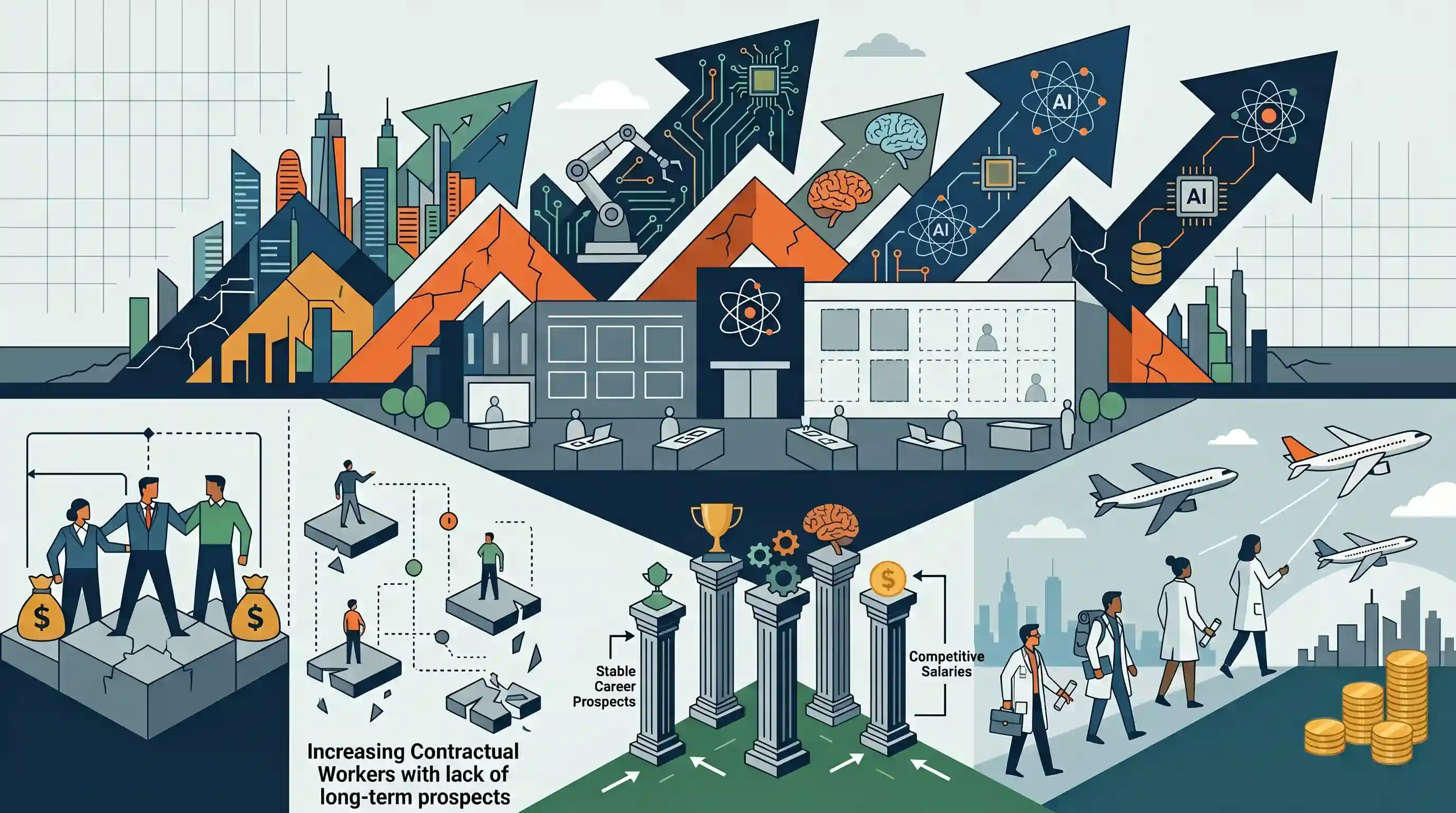
The editorial highlights the alarming trend of decreasing permanent scientific staff and increasing contractual hires in India's public-funded R&D institutions. Critical 'strategic sectors' like atomic energy also suffer from high vacancy rates, with TIFR seeing nearly three in five posts unfilled. The article argues that India's grand ambitions in emerging tech like AI and quantum computing will fail without stable, long-term career prospects, competitive salaries, and adequate funding to retain top scientific talent.
Key Points
- A recent study revealed a concerning decline in permanent scientific staff in 2022-23 across 244 public-funded R&D institutions in India, coupled with a 14% rise in short-term contractual staff.
- The study excluded strategic sectors like defense, atomic energy, and space, but data shows significant vacancies in these areas too; TIFR has nearly 60% of sanctioned posts vacant, and atomic energy institutes face 25% vacancy rates.
- India's ambitions in quantum computing, foundational AI, and industry-oriented research are jeopardized without long-term, full-time researchers.
- The government needs to ensure respectable salaries, proper funding, and well-equipped facilities to retain scientific talent and prevent a 'leaky pipeline' in STEM fields.
Important Terms
Office of the Principal Scientific Adviser (PSA)

Established in 1999, this office under the Cabinet Secretariat advises the Prime Minister and Cabinet on science, technology, and innovation policies, aiming to synergize research across various ministries and industry.
UPSC context
GS-3: Science and Technology policy and institutional framework; critical for understanding high-level R&D coordination and national missions.
Department of Atomic Energy (DAE)
Functioning directly under the Prime Minister, the DAE oversees India's nuclear power programme, basic science research, and applications in medicine and agriculture through its various autonomous research centers and units.
UPSC context
GS-3: Energy and nuclear technology; relevant for strategic sector governance and the management of India’s premier scientific institutes.
Tata Institute of Fundamental Research (TIFR)
A premier public deemed university under the Department of Atomic Energy, founded in 1945 by Homi Bhabha. It conducts advanced research in mathematics, natural sciences, and computer science.
UPSC context
GS-3: R&D and strategic sectors; its vacancy rates are a key indicator of the health of India's fundamental research ecosystem.
Indian Institutes of Science Education and Research (IISER)
A network of autonomous 'Institutes of National Importance' established to foster excellence in basic sciences by integrating high-quality undergraduate teaching with cutting-edge research from the early stages of education.
UPSC context
GS-2: Education and GS-3: Human Resource Development; vital for the 'scientific pipeline' and developing India's STEM talent.
Standing Committee on Science & Technology, Environment, Forests and Climate Change
A permanent parliamentary body that scrutinizes the policies, performance, and budgetary grants of S&T-related ministries, ensuring government accountability and effective legislative oversight of national research priorities.
UPSC context
GS-2: Parliamentary Committees; important for monitoring institutional vacancies and funding gaps in the public-funded scientific sector.
Prelims Trap
"The private sector contributes the majority of India's Gross Expenditure on Research and Development (GERD)."
Unlike advanced economies where the private sector drives 65-70% of R&D, India’s GERD is overwhelmingly driven by the government/public sector.
Static Concepts Connected
What is the structural composition of India's R&D expenditure?
- Stagnant GERD: India's Gross Expenditure on R&D (GERD) has stagnated around 0.64% of GDP for over a decade, far below the US (~2.8%) and China (~2.1%).
- Public sector driven: Unlike advanced economies, the central government accounts for the majority of R&D funding, with persistently low private sector participation.
- Strategic skew: A massive chunk of public R&D funding is heavily concentrated in strategic sectors like Defense (DRDO), Space (ISRO), and Atomic Energy (DAE).
What defines the informalization of the formal sector?
- Definition: The growing trend of formal enterprises and public institutions hiring workers on short-term contracts rather than permanent rolls.
- Bypassing safety nets: Contractual workers are often excluded from statutory benefits, bypassing safety nets like Provident Fund, Gratuity, and ESI.
- Knowledge economy impact: When informalization enters high-skilled domains like STEM, it creates a transient workforce, increases attrition, and severely discourages long-term innovation.
Cross-Topic Patterns
Quantum Mission vs. Human Resource Deficit
Ambitious schemes like the National Quantum Mission risk massive underperformance if the strategic institutions executing them (like DAE or TIFR) continue to suffer from 25-60% scientific vacancies.
Contractualization of High-Skilled Labor
Informalization is traditionally studied in low-wage manufacturing, but its creep into public STEM research shows how systemic contractualization is directly jeopardizing India’s transition to a knowledge economy.

Mains GS-3 will likely link the Anusandhan NRF and stagnant 0.64% GERD with STEM brain drain and rising R&D contractualization.
Linked PYQs · 3
Linked PYQs · 3
- 2023MainsGS3
Most of the unemployment in India is structural in nature. Examine the methodology adopted to compute unemployment in the country and suggest improvements.
- 2016MainsGS3
How globalization has led to the reduction of employment in the formal sector of the Indian economy? Is increased informalization detrimental to the development of the country?
- 2023MainsGS2
Skill development programmes have succeeded in increasing human resources supply to various sectors. In the context of the statement analyse the linkages between education, skill and employment.
