Armenia and Azerbaijan Sign US-Brokered Peace Agreement
Source:The Hindu ↗
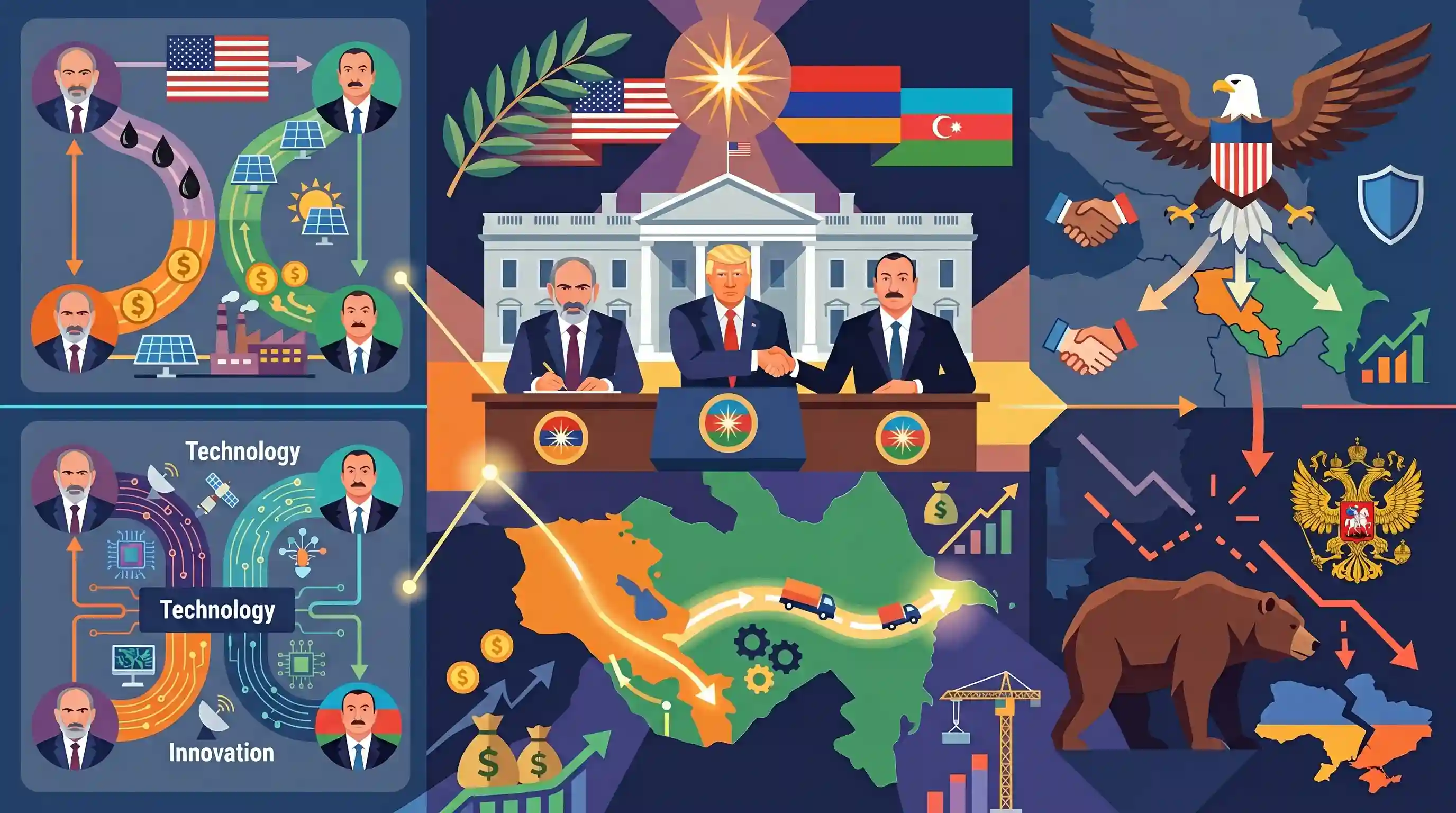
Why It Matters
The Nagorno-Karabakh region and related geographical locations (Zangezur, South Caucasus) frequently appear in UPSC Prelims as 'Places in News'. For Mains GS-2, the U.S. replacing Russian influence in a traditionally Russian sphere highlights shifting global power dynamics and the role of third-party mediation in conflict resolution.
Summary
Armenian Prime Minister Nikol Pashinyan and Azerbaijani President Ilham Aliyev signed a historic peace agreement brokered by U.S. President Donald Trump at the White House. The deal ends decades of hostility over the Nagorno-Karabakh region and includes the establishment of the 'Trump Route for International Peace and Prosperity' along the Zangezur corridor. This transit route will connect Azerbaijan to its Nakhchivan exclave through Armenia. Strategically, the agreement significantly expands U.S. geopolitical influence in the South Caucasus, filling a void left by Russia's declining presence amid its war in Ukraine. Additional pacts were also signed to strengthen U.S. ties with both nations in energy, economy, and technology.
Key Points
- The leaders of Armenia and Azerbaijan signed a U.S.-brokered peace agreement to formally end decades of conflict over the Nagorno-Karabakh region.
- The agreement establishes a major transit route called the 'Trump Route for International Peace and Prosperity' across the Zangezur corridor, connecting Azerbaijan to its Nakhchivan exclave through Armenian territory.
- The historic deal enhances U.S. geopolitical influence and strategic foothold in the South Caucasus region.
- The U.S. successfully capitalized on the vacuum created by Russia's waning regional influence, exacerbated by its ongoing war in Ukraine.
Important Terms
Zangezur Corridor

A 27-mile strategic transit route through Armenia's Syunik province connecting mainland Azerbaijan to its Nakhchivan exclave. It is a key geopolitical flashpoint involving transport, energy pipelines, and regional connectivity bypassing Russia and Iran.
UPSC context
GS-II (International Relations); important for 'Places in News' and connectivity projects affecting regional balance of power.
Trump Route for International Peace and Prosperity (TRIPP)
The official name for the Zangezur transit corridor under a 2025 U.S.-brokered peace agreement. It grants the U.S. 99-year development rights for infrastructure to stabilize the South Caucasus and expand Western influence.
UPSC context
GS-II (International Relations); tests knowledge of major international agreements and the shifting role of global superpowers.
Nagorno-Karabakh
A mountainous region in the South Caucasus recognized as Azerbaijani territory. It was the center of a decades-long conflict between Armenia and Azerbaijan until Baku regained full control in September 2023.
UPSC context
GS-II (IR) and Prelims (Mapping); frequently tested as a significant site of ethnic conflict and territorial dispute.
South Caucasus
A strategically vital region between the Black and Caspian Seas comprising Armenia, Azerbaijan, and Georgia. It serves as a gateway for energy and trade between Europe, Central Asia, and the Middle East.
UPSC context
GS-I (World Geography) and GS-II (IR); focus on regional geopolitics and energy security corridors.
Nakhchivan
An Azerbaijani landlocked exclave separated from the mainland by Armenian territory. Connecting this region to mainland Azerbaijan without passing through Iran is a primary objective of the proposed Zangezur Corridor.
UPSC context
GS-I (Geography) and Prelims; specific 'Places in News' testing geographical enclaves and exclaves.
Middle Corridor
A trade route connecting China and Central Asia to Europe via the Caspian Sea, Azerbaijan, Georgia, and Turkey. It is an alternative to the Russian-led Northern Corridor.
UPSC context
GS-III (Economy/Infrastructure); important for global supply chains and India's potential interest in diverse trade routes.
Prelims Trap
"The Nakhchivan exclave is a territory of Armenia that borders the Caspian Sea."
Nakhchivan is actually an autonomous exclave of Azerbaijan, completely separated by Armenian land. Furthermore, it borders Turkey, Iran, and Armenia, not the Caspian Sea.
Static Concepts Connected
What constitutes the geopolitical region of the South Caucasus?
- Core nations: It strictly comprises the three post-Soviet independent states of Armenia, Azerbaijan, and Georgia.
- Strategic location: It serves as a vital transcontinental land bridge connecting Europe and Asia, sandwiched geographically between the Black Sea (west) and the Caspian Sea (east).
- Energy transit: It acts as a critical chokepoint for pipelines moving Caspian basin oil and gas to European markets, traditionally bypassing Russian and Iranian territories.
How does the International North-South Transport Corridor (INSTC) function?
- Multi-modal route: It is a 7,200-km multi-mode network of ship, rail, and road route connecting India, Iran, Azerbaijan, Russia, Central Asia and Europe.
- Economic objective: Its primary aim is to bypass the traditional maritime route via the Suez Canal, reducing carriage costs by about 30% and transit time by 40%.
- Indian strategic interest: For India, it is a strategic tool to bypass Pakistan for land access to Central Asia, anchoring its broader Eurasian connectivity policy.
Cross-Topic Patterns
INSTC vs. East-West Middle Corridor
The Zangezur route bolsters the Turkey-backed East-West Middle Corridor, potentially bypassing and diluting the strategic value of India's North-South INSTC and Chabahar port investments.
Turkey-Pakistan-Azerbaijan Trilateral Nexus
A strengthened Azerbaijan emboldens the 'Three Brothers' military-diplomatic axis (Turkey-Pakistan-Azerbaijan), which historically coordinates mutually supportive, anti-India stances on the Kashmir issue at global fora.

Map questions matching Zangezur, Nakhchivan, and Syunik to their countries are highly probable, potentially paired with INSTC nodes.
Linked PYQs · 2
Linked PYQs · 2
- 2023PrelimsGS1
Consider the following pairs: Regions often mentioned in news Reason for being in news 1. North Kivu and Ituri : War between Armenia and Azerbaijan 2. Nagorno-Karabakh : Insurgency in Mozambique 3. Kherson and Zaporizhzhia : Dispute between Israel and Lebanon How many of the above pairs are correctly matched?
- 2022PrelimsGS1
Consider the following countries: 1. Armenia 2. Azerbaijan 3. Croatia 4. Romania 5. Uzbekistan Which of the above are members of the Organization of Turkic States?
