Legacy of M.S. Swaminathan in India Food Security and Agriculture
Source:The Hindu ↗
Why It Matters
M.S. Swaminathan is a foundational figure in India's post-independence economic and agricultural history. His work directly addresses core GS3 syllabus topics, including the Green Revolution, food security, and agricultural pricing policy (MSP). Understanding his shift towards sustainable, ecological farming ('evergreen revolution') is crucial for answering questions on modern agricultural and environmental challenges.
Summary
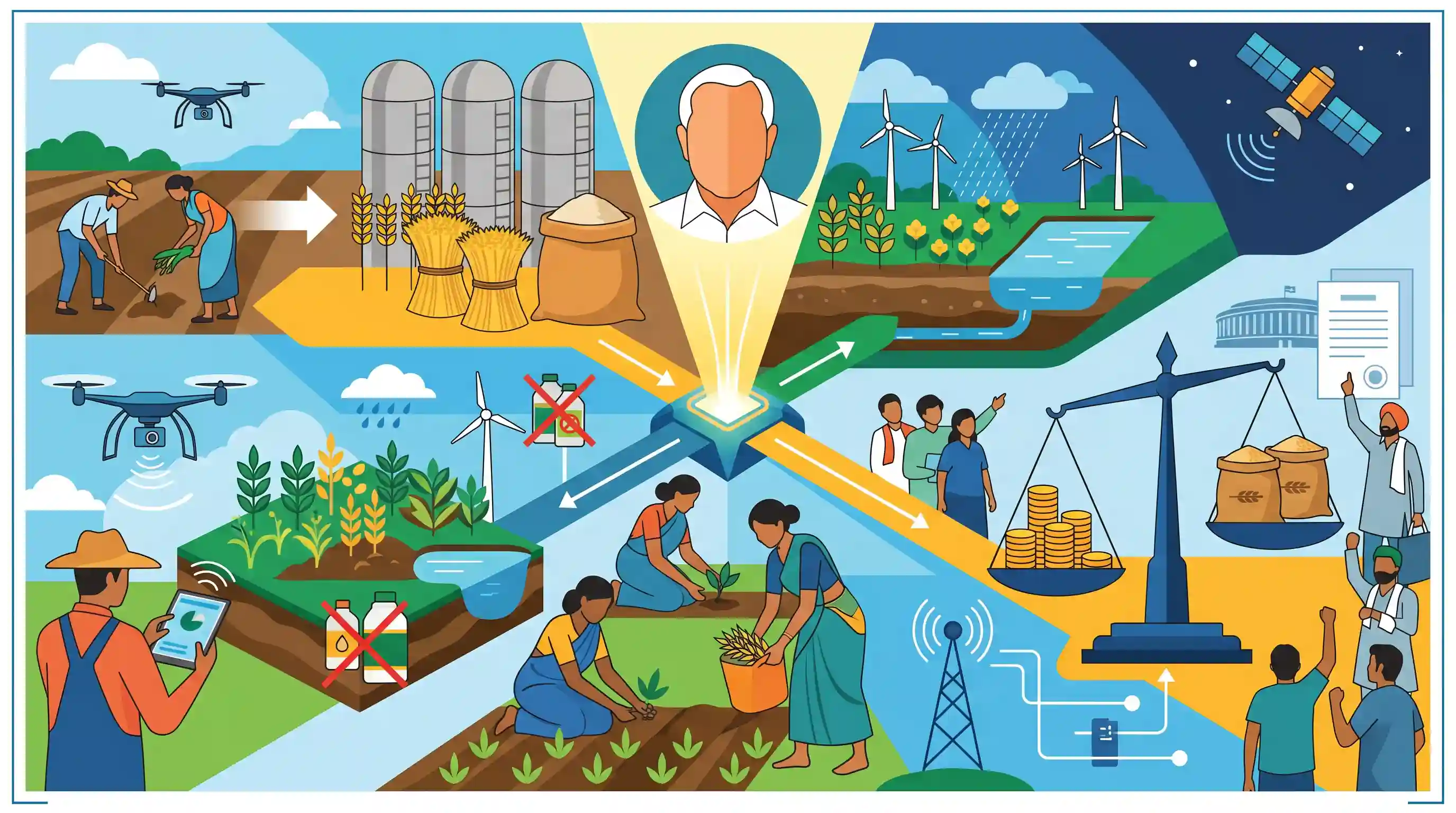
At an event in New Delhi marking his birth centenary, political leaders and experts paid tribute to M.S. Swaminathan, known as the father of India’s Green Revolution, during the launch of his biography, 'The Man Who Fed India'. Speakers emphasized his crucial role in ensuring India's food security and rescuing the country from food dependency. Beyond increasing agricultural productivity, Swaminathan was remembered for his advocacy of an "evergreen revolution" focused on ecologically sustainable farming and for highlighting the significant contribution of women in agriculture. Furthermore, his legacy persists through the National Commission on Farmers, whose recommendations on crop pricing and Minimum Support Price (MSP) remain a central benchmark in ongoing agricultural policy debates and farmers' movements.
Key Points
- The birth centenary of M.S. Swaminathan was commemorated with the launch of his biography 'The Man Who Fed India', authored by Priyambada Jayakumar.
- Leaders praised Swaminathan's pivotal role in the Green Revolution, which transformed India from a food-deficient nation into a self-sufficient one, particularly recalling the haunting memories of the Bengal famine.
- Swaminathan's vision extended beyond increased yields to an 'evergreen revolution' that emphasized ecologically sustainable agricultural practices and recognized the crucial role of women in farming.
- His chairmanship of the National Commission on Farmers remains highly relevant, with its recommendations on Minimum Support Price (MSP) continuing to form the core of current farmers' demands.
Important Terms
Green Revolution

A 1960s-70s agricultural transformation using high-yielding variety (HYV) seeds and modern inputs. Led by M.S. Swaminathan, it significantly increased foodgrain production, making India self-sufficient in wheat and rice.
UPSC context
GS Paper 3: Agriculture. Essential for understanding India's transition to food self-sufficiency and the resulting environmental and regional disparities.
National Commission on Farmers
Chaired by M.S. Swaminathan (2004–2006), this commission recommended holistic reforms for agrarian distress. Its "Swaminathan Formula" suggests setting Minimum Support Prices (MSP) at 50% above the comprehensive cost of production (C2).
UPSC context
GS Paper 3: Agricultural Policy. Key for analyzing farmers' demands, MSP calculation debates, and long-term structural reforms in agriculture.
Evergreen Revolution
A term coined by Swaminathan to transition from the intensive Green Revolution toward sustainable agriculture. It focuses on increasing productivity "in perpetuity" without ecological harm by integrating soil health and water conservation.
UPSC context
GS Paper 3: Sustainable Agriculture. Tests knowledge of eco-friendly farming, climate-resilient techniques, and balancing food production with environmental protection.
Minimum Support Price (MSP)
A government-declared price at which the state procures crops from farmers to prevent distress sales. It is recommended by the CACP to provide income security and incentivize production of essential foodgrains.
UPSC context
GS Paper 3: Farm Subsidies. Core topic for questions on market interventions, pricing formulas (A2+FL vs. C2), and farmer welfare schemes.
Food Security
Ensuring all citizens have physical and economic access to sufficient, nutritious food. In India, this is achieved through the Green Revolution’s surplus and the National Food Security Act (NFSA) 2013.
UPSC context
GS Paper 3: Food Security. Relevant for questions on the Public Distribution System (PDS), nutritional outcomes, and rights-based approaches.
Prelims Trap
"The Swaminathan Commission recommended setting MSP at 50% above the A2+FL cost."
The Commission specifically recommended C2+50% (comprehensive cost including imputed rent and interest). The government currently uses A2+FL+50%, leading to frequent confusion among aspirants.
Static Concepts Connected
What are the different cost calculations for MSP (A2, A2+FL, C2)?
- A2 Cost: Covers all direct, paid-out costs incurred by the farmer on seeds, fertilizers, pesticides, hired labor, fuel, and irrigation.
- A2+FL Cost: Adds the imputed value of unpaid family labor to the baseline A2 cost. This is the formula generally used by the government for current MSP declarations.
- C2 Cost: A comprehensive cost that includes A2+FL plus the imputed rent on owned land and interest on fixed capital assets. This was Swaminathan's benchmark.
How does the 'Evergreen Revolution' differ from the 'Green Revolution'?
- Core Objective: The Green Revolution aimed for immediate yield maximization to avert famine, relying heavily on High-Yielding Varieties (HYVs). The Evergreen Revolution focuses on perpetual productivity enhancements.
- Input Methodology: While the Green Revolution caused soil degradation and groundwater depletion via chemical inputs, the Evergreen Revolution emphasizes ecologically sustainable practices like zero-budget natural farming.
Cross-Topic Patterns
Feminization of agriculture & land titles
Swaminathan's focus on women in farming links GS1 (Society) and GS3 (Agriculture). Expect questions connecting women's lack of land ownership (under 15%) to institutional credit denial and poverty.
Evergreen revolution vs climate change
The shift from Green Revolution (yield-focused) to Evergreen Revolution (ecology-focused) bridges historical food security achievements with modern climate-resilient agriculture and natural farming debates.

Expect a multi-statement Prelims question contrasting A2+FL vs. C2 cost formulas, or a Mains question on the 'Evergreen Revolution'.
Linked PYQs · 2
Linked PYQs · 2
- 2017MainsGS3
Explain various types of revolutions, took place in Agriculture after independence in India. How these revolutions have helped in poverty alleviation and food security in India?
- 2018MainsGS3
What do you mean by Minimum Support Price (MSP)? How will MSP rescue the farmers from the low income trap?
