Electoral Pragmatism and Ideological Dilemmas for CPI(M) in Kerala
Source:Indian Express ↗
Why It Matters
Understanding the internal dynamics and ideological compromises of political parties is crucial for GS-2 (Polity). It provides practical examples of how electoral pressures shape party behavior and governance, relevant to questions on multi-party democracy and the regionalization of politics.
Summary
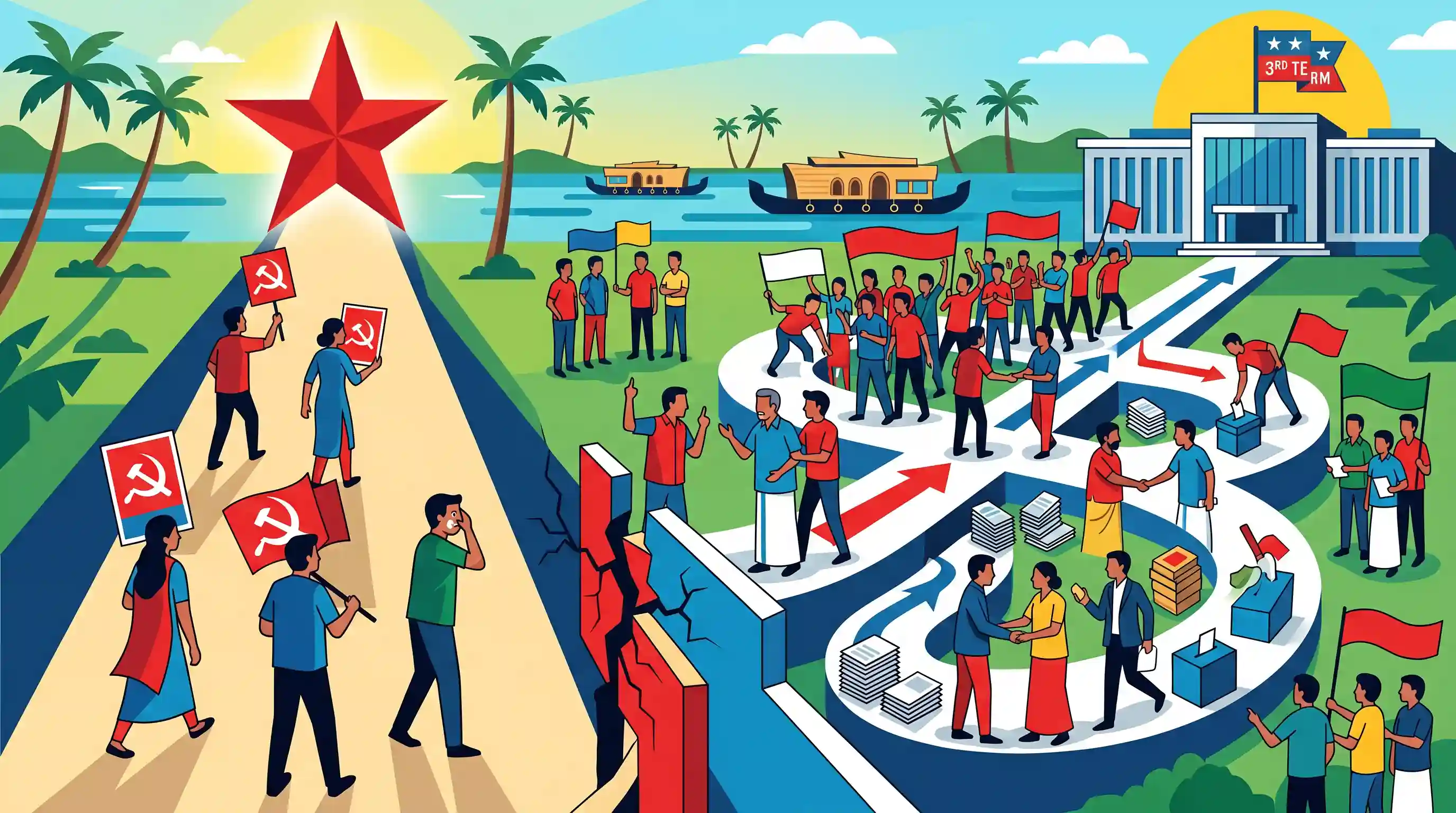
The CPI(M) in Kerala is aggressively positioning itself to win a third consecutive term (a 'hat-trick') for the Left Democratic Front (LDF). However, this intense focus on electoral pragmatism and political survival has sparked internal disquiet, with concerns that the party is compromising its core Left ideology. The situation underscores the broader challenges faced by ideological political parties in competitive democracies, where maintaining doctrinal purity often clashes with the compromises required for sustained electoral success and regional governance.
Key Points
- The CPI(M)-led LDF in Kerala is strategizing to secure a third consecutive electoral victory, aiming to permanently break the state's traditional alternating-incumbency cycle.
- The party's pursuit of electoral pragmatism and populist governance is generating internal disquiet over the perceived dilution of core Marxist ideology.
- This dynamic illustrates the classic democratic tension faced by ideological parties: balancing doctrinal purity with the practical necessities of winning elections and governing a diverse state.
- The development highlights the regionalization of national parties in India, where the CPI(M) tailors its approach heavily to sustain its last remaining stronghold in Kerala.
Important Terms
CPI(M)

Communist Party of India (Marxist); a national party (est. 1964) following Marxist-Leninist ideology. It currently leads the ruling coalition in Kerala and maintains significant presence in West Bengal and Tripura.
UPSC context
GS II: Political parties and their role in the Indian political system. Tests national party criteria and ideology.
Left Democratic Front (LDF)
A Kerala-based alliance of left-wing parties led by the CPI(M). In 2021, it became the first incumbent coalition in 40 years to win a second consecutive term in the state.
UPSC context
GS II: Federal structure and regional political dynamics. Tests understanding of state-level coalition models.
United Democratic Front (UDF)
An alliance of centrist and centre-right parties in Kerala led by the Indian National Congress. It is the primary rival to the LDF in the state’s bipolar political landscape.
UPSC context
GS II: Role of the opposition and bipolar electoral systems in Indian states.
Anti-incumbency
The tendency of voters to vote against the sitting government due to dissatisfaction with its performance, perceived corruption, or lack of progress on election promises.
UPSC context
GS II: Electoral behavior and accountability in Indian democracy. Tests factors influencing voting patterns.
Coalition Government
A governing system where multiple political parties collaborate to form a majority. It often involves a 'Common Minimum Programme' to align diverse ideological or regional interests.
UPSC context
GS II: Challenges pertaining to the federal structure and stability of cabinet governance.
Electoral Pragmatism
Prioritizing practical electoral success and political survival over strict adherence to foundational party ideology, often leading to internal doctrinal compromises.
UPSC context
GS II: Political parties and ethics. Tests the evolution of ideological parties in competitive democracies.
Prelims Trap
"The Election Commission can deregister a political party if it loses its National Party status."
The ECI can derecognize a party (stripping its reserved symbol/status), but it lacks express statutory power to deregister a party simply for poor electoral performance.
Static Concepts Connected
What are the criteria for recognition as a National Party?
- 6% Votes + 4 MPs: 6% of valid votes polled in four or more states in Lok Sabha or Assembly elections, AND wins 4 seats in the Lok Sabha.
- 2% Lok Sabha seats: Wins 2% of seats in the Lok Sabha (currently 11 seats) from at least three different states.
- State Party in 4 States: The party is recognized as a State Party in at least four states.
Which Directive Principles expressly reflect socialist ideology?
- Article 39 (b) & (c): Directs the state to ensure equitable distribution of material resources and prevent the concentration of wealth and means of production.
- Article 41: The State shall make effective provision for securing the right to work, education, and public assistance in cases of unemployment or old age.
- Article 43A: Added by the 42nd Amendment, it requires the State to secure the participation of workers in the management of industries.
Cross-Topic Patterns
Regionalization of National Parties
The shrinking footprint of ideological national parties to single-state strongholds reshapes Indian federal dynamics, forcing them to adopt pragmatic regional postures over pan-Indian doctrinal coherence.
DPSP Art 39(c) and Constitutional Amendments
The Marxist goal of preventing wealth concentration is embedded in DPSP Art 39(c), which historically drove the 25th Amendment subordinating Fundamental Rights to Socialist directives.

Expect a 2026 Prelims question on the exact criteria for National Party status and ECI's derecognition powers under the RPA 1951.
Linked PYQs · 2
Linked PYQs · 2
- 2022MainsGS2
“While the national political parties in India favour centralisation, the regional parties are in favour of State autonomy.” Comment.
- 2024PrelimsGS1
Consider the following pairs (Party — Its Leader): 1. Bharatiya Jana Sangh — Dr. Shyama Prasad Mukherjee 2. Socialist Party — C. Rajagopalachari 3. Congress for Democracy — Jagjivan Ram 4. Swatantra Party — Acharya Narendra Dev How many of the above are correctly matched?
