Role of Legal Vigilance in Preventing Democratic Erosion
Source:The Hindu ↗
Why It Matters
This article provides valuable insights for GS2 Mains, particularly concerning the evolution of PILs, the concept of constitutional morality as a defense against democratic erosion, and the ongoing debate surrounding judicial accountability and institutional respect.
Summary
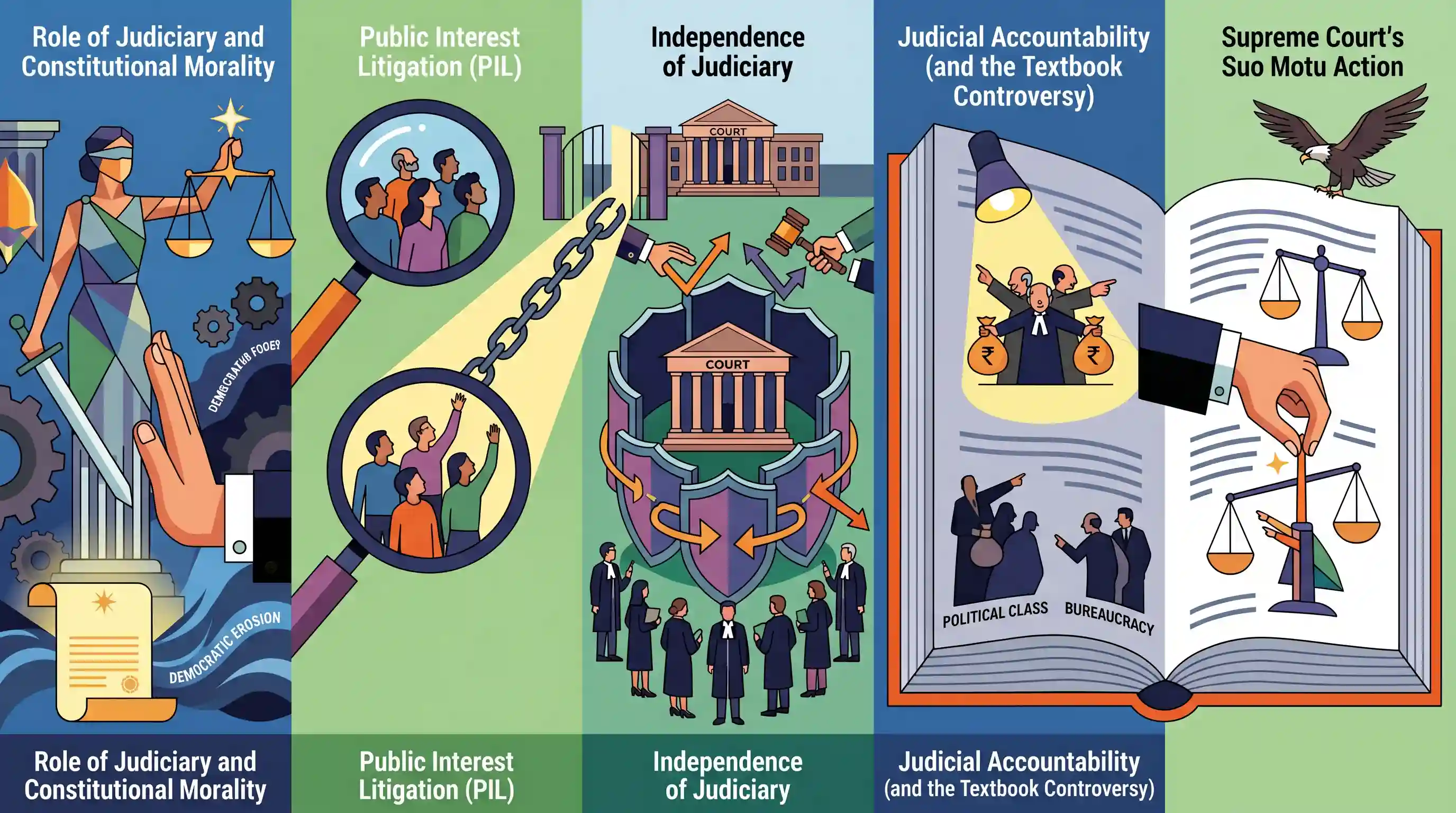
Senior Advocate A.M. Singhvi addressed a law conclave in New Delhi, asserting that a vigilant legal profession is essential to counter constitutional backsliding and democratic erosion. He praised the Indian Public Interest Litigation (PIL) mechanism for expanding access to justice. Singhvi also commented on a recent controversy involving a Class 8 NCERT textbook that selectively highlighted judicial corruption, which he argued unfairly isolates the judiciary compared to the political class and bureaucracy. The Supreme Court has already initiated a suo motu case concerning this textbook chapter, viewing it as a potential attempt to undermine the judicial institution.
Key Points
- Senior Advocate A.M. Singhvi emphasized that the vigilance of the legal profession serves as society's early warning system against constitutional backsliding and the gradual erosion of democratic values.
- He highlighted the historic role of Public Interest Litigation (PIL) in India in expanding access to justice for marginalized sections, including bonded laborers and under-trial prisoners.
- Singhvi addressed a controversy over a Class 8 NCERT textbook chapter that he argued selectively highlighted corruption within the judiciary while ignoring it in the bureaucracy and political class.
- The Supreme Court has taken up a suo motu case regarding the NCERT textbook's "selective reference" to judicial corruption, treating it as a potentially calculated attempt to denigrate the institution.
Important Terms
Supreme Court

India's highest judicial body and the final court of appeal under the Constitution, possessing original, appellate, and advisory jurisdictions to protect fundamental rights and interpret the law.
UPSC context
GS Paper 2: Judiciary. Focuses on powers, independence, and the court's role as the guardian of the Constitution.
Public Interest Litigation (PIL)
A legal mechanism allowing any citizen or group to approach the court for the protection of public interest, significantly relaxing the traditional rule of 'locus standi.'
UPSC context
GS Paper 2: Judicial Activism. Tests the evolution of social justice and judicial overreach through transformative jurisprudence.
NCERT
An autonomous government organization established to advise on school education and publish textbooks that form the core curriculum for national and various state boards.
UPSC context
GS Paper 2: Issues relating to Education. Relevant for curriculum design, institutional autonomy, and academic integrity.
Independence of Judiciary
A constitutional principle ensuring the judiciary functions without influence from the executive or legislature, vital for upholding the rule of law and the separation of powers.
UPSC context
GS Paper 2: Constitutional Provisions. Evaluates the safeguards for judges and the 'Basic Structure' doctrine.
Suo Motu
A Latin term meaning 'on its own motion,' describing an action taken by a court without a formal petition from a party, often in response to public concerns.
UPSC context
GS Paper 2: Judicial Activism. Tests the scope of judicial power in addressing systemic issues without external triggers.
Basic Structure Doctrine
A judicial principle stating that the Parliament cannot alter certain fundamental features of the Constitution, such as secularism, federalism, and judicial review.
UPSC context
GS Paper 2: Constitutional Amendments. Tests understanding of the limits on Article 368 and institutional balances.
Prelims Trap
"The Constitution of India explicitly defines 'criminal' and 'civil' contempt under Article 129."
Articles 129 and 215 grant the Supreme Court and High Courts the power to punish for contempt, but the actual definitions are in the Contempt of Courts Act, 1971.
Static Concepts Connected
What is the constitutional and statutory basis for Contempt of Court?
- Constitutional backing: Articles 129 and 215 declare the Supreme Court and High Courts as 'Courts of Record' with the inherent power to punish for their contempt.
- Statutory definition: The Contempt of Courts Act, 1971 formally defines and divides contempt into civil (willful disobedience) and criminal (scandalizing or lowering court authority).
- Reasonable restriction: Under Article 19(2), contempt of court is an explicitly listed ground for imposing reasonable restrictions on the freedom of speech and expression.
How does Public Interest Litigation (PIL) differ from traditional litigation?
- Relaxed Locus Standi: The rigid rule requiring the petitioner to be the directly aggrieved party was relaxed to allow any public-spirited citizen to approach the court.
- Epistolary jurisdiction: Courts can exercise jurisdiction based on informal communications like letters, telegrams, or even newspaper reports, treating them as formal writ petitions.
- Non-adversarial process: Unlike traditional adversarial litigation between two private parties, PILs are collaborative, often involving court-appointed expert committees for fact-finding on socio-economic rights.
Cross-Topic Patterns
Suo Motu powers & institutional credibility
The SC invoking suo motu powers against an NCERT textbook links educational curriculum autonomy with the judicial necessity to prevent systemic denigration and maintain public trust.
Constitutional Morality as a democratic safeguard
Moving beyond basic constitutionalism, courts increasingly deploy 'constitutional morality' to counter democratic backsliding, checking executive overreach and protecting institutional autonomy.

Expect a multi-statement prelims question in 2026 contrasting civil vs. criminal contempt, focusing on constitutional vs. statutory backing.
Linked PYQs · 4
Linked PYQs · 4
- 2024MainsGS2
Explain the reasons for the growth of public interest litigation in India. As a result of it, has the Indian Supreme Court emerged as the world's most powerful judiciary ?
- 2023MainsGS2
“Constitutionally guaranteed judicial independence is a prerequisite of democracy.” Comment.
- 2025MainsGS2
"Constitutional morality is the fulcrum which acts as an essential check upon the high functionaries and citizens alike...." In view of the above observation of the Supreme Court, explain the concept of constitutional morality and its application to ensure balance between judicial independence and judicial accountability in India.
- 2021MainsGS2
‘Constitutional Morality’ is rooted in the Constitution itself and is founded on its essential facets. Explain the doctrine of ‘Constitutional Morality’ with the help of relevant judicial decisions.
