US Exempts Trade Deal Partners from New Pharmaceutical Tariffs
Source:Indian Express ↗
Why It Matters
This development illustrates the real-world application of protectionist trade policies and how bilateral trade agreements provide a buffer against them. It is highly relevant to UPSC syllabus areas covering international trade dynamics, the global shift towards bilateralism over multilateralism, and the geopolitical economics of the pharmaceutical sector.
Summary
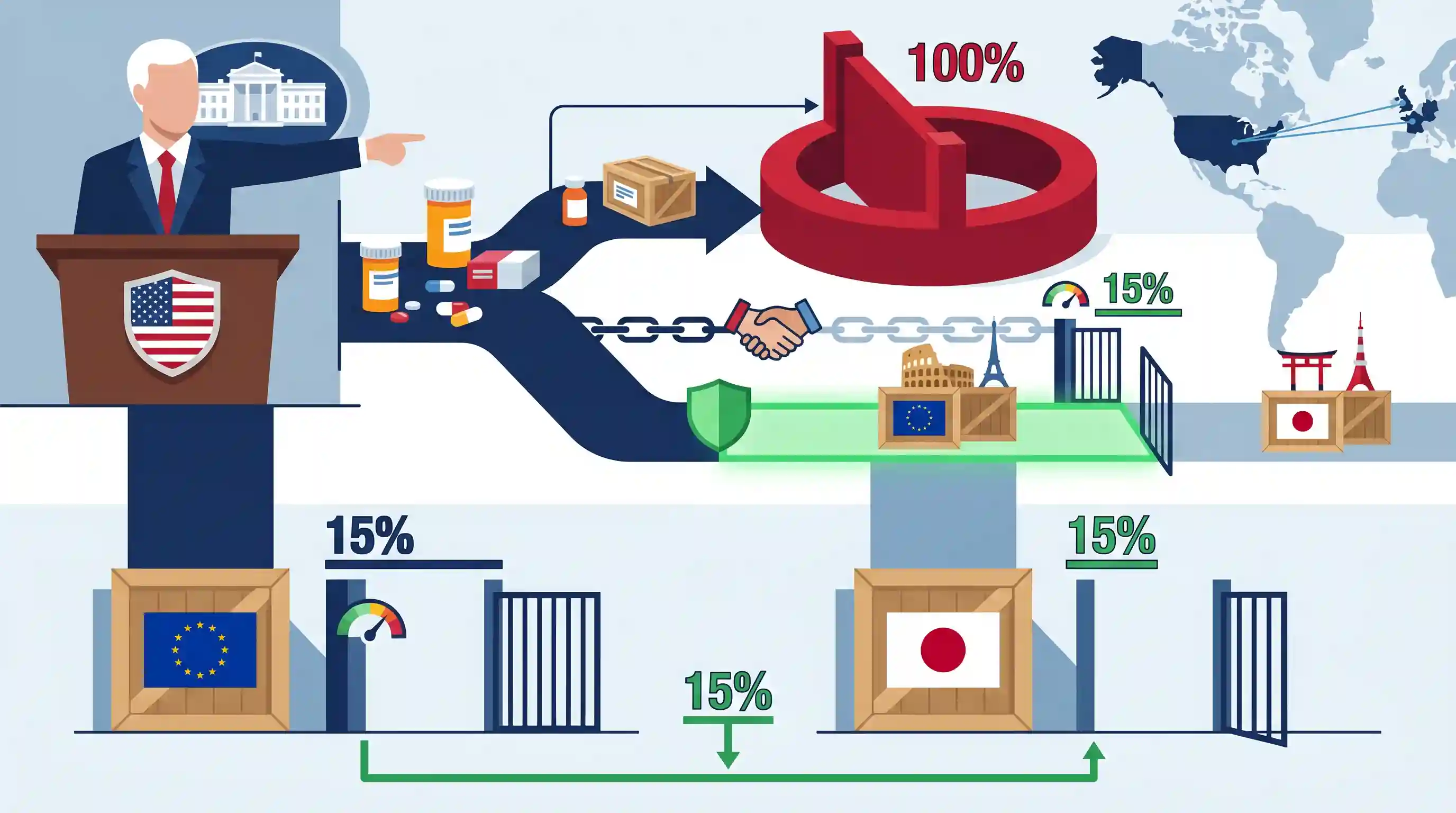
A White House official confirmed that the Trump administration's latest tariffs on pharmaceuticals will not affect countries that already have negotiated trade deals with the United States. The policy exempts major partners like the European Union and Japan, honoring a 15% tariff cap established under those existing agreements.
Key Points
- The Trump administration's newly proposed tariffs targeting pharmaceuticals will not apply to nations with existing trade deals with the US.
- Major trading partners such as the European Union and Japan are exempt from these new levies.
- The US will honor the 15% tariff cap established in its pre-existing trade pacts with these nations.
Important Terms
Protectionism

An economic policy of restricting imports through tariffs, quotas, or regulations to shield domestic industries and workers from foreign competition.
UPSC context
GS Paper 3 (Economy); tests knowledge of global trade barriers and their impact on India’s exports and domestic growth.
Section 232 (Trade Expansion Act)
A U.S. legal provision granting the President authority to impose trade restrictions on imports deemed a threat to national security.
UPSC context
GS Paper 2 (IR); vital for analyzing U.S. trade policy shifts and their legal justifications in global trade disputes.
Most Favored Nation (MFN)
A WTO principle requiring that any trade advantage or concession granted to one country be extended to all other member nations.
UPSC context
GS Paper 3 (Economy); fundamental concept in multilateral trade rules and the non-discrimination framework of the WTO.
Bilateral Trade Agreements
Formal pacts between two nations to reduce trade barriers, such as tariffs and quotas, to encourage reciprocal market access.
UPSC context
GS Paper 2 (IR); tests understanding of trade diplomacy, regionalism, and India's strategy in signing FTAs with global partners.
Tariff Cap
The maximum tax rate a country agrees to levy on specific imported goods as established under a negotiated trade framework or agreement.
UPSC context
GS Paper 3 (Economy); relates to international trade negotiations and the protection of export interests through binding ceilings.
European Union (EU)
An economic and political union of 27 member states that acts as a single entity in international trade negotiations and regulations.
UPSC context
GS Paper 2 (IR); crucial for studying India-EU relations, global economic blocs, and multilateral trade governance.
Prelims Trap
The new 100% US tariffs apply equally to Indian generic drug exports, severely disrupting supply chains.
The US levies specifically target patented medicines. India largely exports off-patent generic drugs, meaning the vast majority of its pharma trade remains shielded from this specific tariff shock.
Static Concepts Connected
How do Free Trade Agreements bypass the WTO's MFN principle?
- MFN Principle: WTO requires treating all member nations equally regarding tariffs and trade barriers, preventing discrimination between trading partners.
- GATT Article XXIV: Provides a legal exception to MFN, allowing countries to grant preferential, lower tariffs within Free Trade Areas or Customs Unions.
- Tariff Binding: Countries agree on tariff ceilings (Article II) which cannot be arbitrarily breached, ensuring predictability in international trade.
What distinguishes generic drugs from patented pharmaceuticals under TRIPS?
- Patent Monopoly: Patented drugs enjoy a 20-year exclusive market window under TRIPS to recoup research and development investments.
- Bioequivalence: Generics are chemical copies with identical active ingredients, strength, and dosage, legally manufactured after patent expiry.
- Bolar Exemption: Allows generic manufacturers to conduct research and seek regulatory approval before the original patent expires, accelerating market entry.
Cross-Topic Patterns
Protectionism reshaping pharma supply chains
The shift towards onshoring critical drug manufacturing mirrors US strategies in semiconductors and critical minerals, replacing multilateral WTO consensus with fragmented, protectionist alliances.
TRIPS, Section 3(d), and Generic Dominance
India's status as the 'pharmacy of the world' relies on strict patentability criteria (Section 3(d) of the Patents Act) and producing affordable generics, buffering it from patent-centric trade wars.

Expect a 2026 prelims statement pairing GATT Article XXIV exceptions (FTAs) with TRIPS flexibilities on patented vs. generic medicines.
Linked PYQs · 3
Linked PYQs · 3
- 2025MainsGS3
What are the challenges before the Indian economy when the world is moving away from free trade and multilateralism to protectionism and bilateralism? How can these challenges be met?
- 2016MainsGS2
The broader aims and objectives of WTO are to manage and promote international trade in the era of globalization. But the Doha round of negotiations seem doomed due to differences between the developed and the developing countries." Discuss in the Indian perspective.
- 2014MainsGS3
In a globalized world, Intellectual Property Rights assume significance and are a source of litigation. Broadly distinguish between the terms-Copyrights, Patents and Trade Secrets.
