Promotion of Indian Languages in Official Administration
Source:The Hindu ↗
Why It Matters
The debate around India's official language and the promotion of regional languages versus English is a recurring theme in post-independence Indian polity. Initiatives like 'Bhasha Sangam' and providing higher education in mother tongues directly align with GS1 (Society/Diversity) and GS2 (Governance/Education) syllabi.
Summary
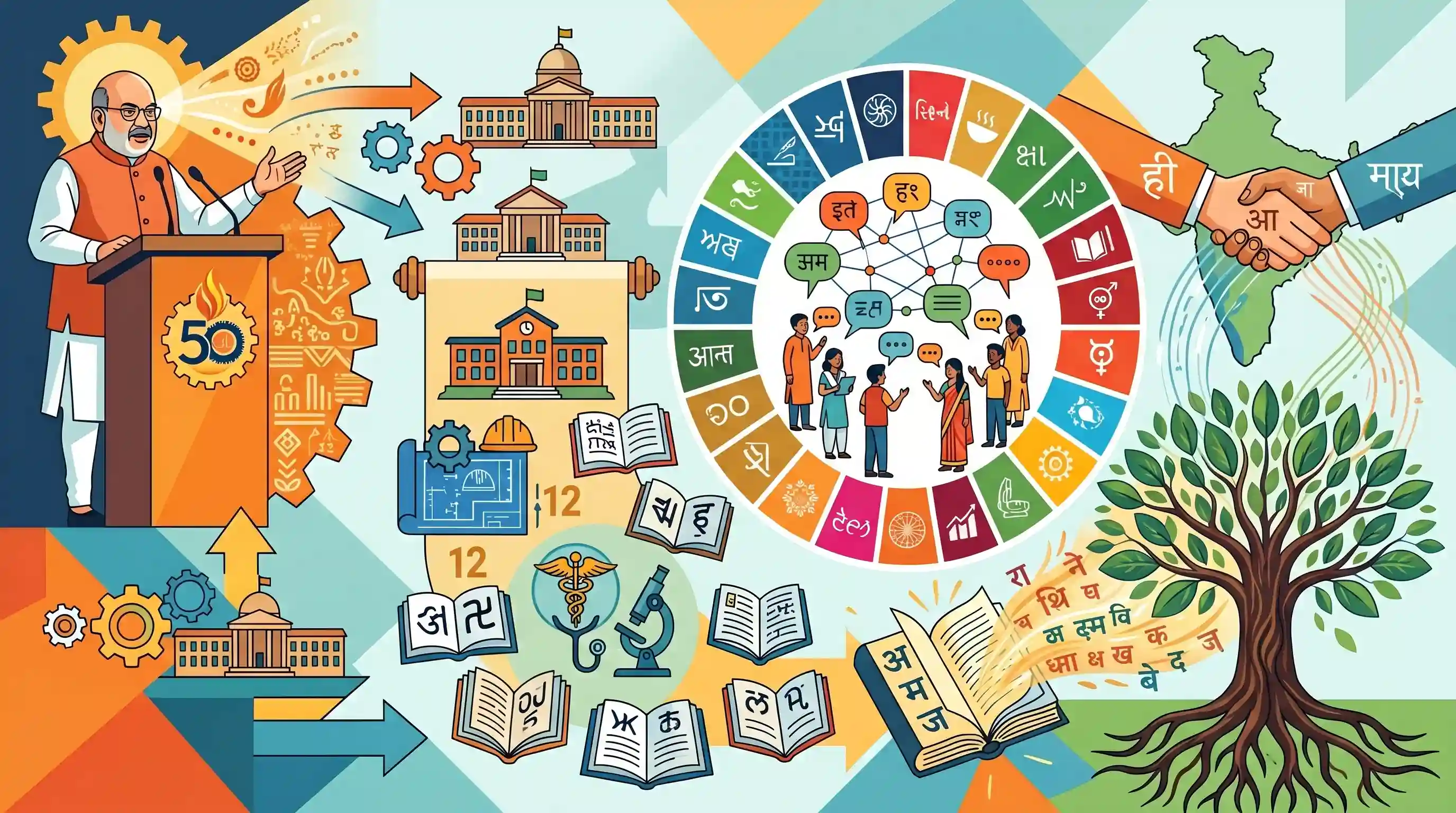
Speaking at the Golden Jubilee celebration of the Official Language Department in New Delhi, Union Home Minister Amit Shah articulated that a nation's language is its very soul, far exceeding its role as a mere medium of communication. He advocated strongly for Indian languages to serve as the primary medium of administrative work at both State and Central government levels. Underscoring the government's commitment to linguistic diversity and cultural preservation, Shah highlighted recent milestones such as the introduction of technical education in 12 Indian languages and medical education in Hindi in Madhya Pradesh. Key initiatives launched or referenced include the 'Bharatiya Bhasha Anubhag' for youth engagement, the 'Bhasha Sangam' program teaching 100 common sentences from the 22 Eighth Schedule languages in schools, and the 'Hindi Shabdsindhu' dictionary aimed at enriching the official language. Shah explicitly clarified that Hindi is a friend, not an enemy, to other regional languages, reinforcing that indigenous linguistic heritage must be utilized to unite rather than divide the nation.
Key Points
- Union Home Minister Amit Shah emphasized that language is the soul of a nation and urged the use of Indian languages in State and Central administration.
- The 'Bharatiya Bhasha Anubhag' (Indian Languages Section) was inaugurated to make Indian languages more accessible to the youth.
- Technical education has been introduced in 12 Indian languages, and Madhya Pradesh has started medical education in Hindi.
- The 'Bhasha Sangam' initiative aims to teach students 100 commonly used sentences in the 22 Constitutionally recognised languages.
- The 'Hindi Shabdsindhu' dictionary has been created to make the official language more comprehensive by incorporating commonly spoken words from various origins.
Important Terms
Department of Official Language

An independent department under the Ministry of Home Affairs responsible for implementing constitutional provisions (Articles 343-351) and the Official Languages Act, 1963, regarding the Union's official communication.
UPSC context
GS Paper II (Polity/Governance); tests knowledge of administrative structures for implementing official language policy and constitutional mandates.
Bharatiya Bhasha Anubhag
A dedicated section within the Department of Official Language launched to promote the use of Indian languages in administration and governance, reducing reliance on English.
UPSC context
GS Paper II (Governance); relevant for topics on linguistic inclusion in administration and 'decolonising' Indian governance.
Bhasha Sangam initiative
A Ministry of Education initiative under 'Ek Bharat Shreshtha Bharat' that teaches students 100 common sentences in 22 Eighth Schedule languages to foster linguistic harmony.
UPSC context
GS Paper II (Social Justice/Education); tests understanding of government efforts to promote cultural unity and multilingualism under NEP 2020.
Hindi Shabdsindhu
A comprehensive digital dictionary initiative by the Department of Official Language aimed at enriching Hindi with words from diverse Indian regional languages and technical fields.
UPSC context
GS Paper I (Culture) and GS Paper II (Polity); relates to the enrichment of the official language as per Article 351.
Eighth Schedule
A list of 22 languages recognized by the Indian Constitution (Part XVII), providing them with a formal status for representation and development.
UPSC context
GS Paper II (Polity); fundamental constitutional provision for linguistic diversity, frequently appearing in Prelims and Mains.
Prelims Trap
Hindi is designated as the National Language of India under Article 343 of the Constitution.
The Constitution does not declare any language as the 'National Language'. Article 343 only designates Hindi in Devanagari script as the 'Official Language' of the Union.
Static Concepts Connected
How does the Constitution regulate the Official Language of the Union?
- Article 343: Designates Hindi in Devanagari script as the official language of the Union, while allowing English to continue for official purposes.
- Article 344: Empowers the President to constitute an Official Language Commission to recommend the progressive use of Hindi.
- Article 351: Issues a directive to the Union to promote the spread and development of the Hindi language.
What is the constitutional significance of the Eighth Schedule?
- 22 Recognized Languages: Originally containing 14 languages, it now recognizes 22, serving as a framework to protect linguistic diversity and promote regional languages in administration.
- Key Amendments: Languages were added via the 21st (Sindhi), 71st (Konkani, Manipuri, Nepali), and 92nd (Bodo, Dogri, Maithili, Santhali) Constitutional Amendments.
- Practical Utility: These languages can be used in Parliament and serve as recognized mediums for all-India competitive examinations like the civil services.
Cross-Topic Patterns
NEP 2020 & Mother Tongue Education
The push for technical and medical education in regional languages directly executes NEP 2020 goals, building on Article 350A's spirit of providing instruction in the mother tongue.
Nodal Ministries & Language Initiatives
Aspirants must differentiate nodal ministries: 'Bhasha Sangam' falls under the Ministry of Education (Ek Bharat Shreshtha Bharat), while the Department of Official Language operates under the Ministry of Home Affairs.

Expect a 2026 multi-statement Prelims question mapping linguistic schemes like Bhasha Sangam to their correct nodal ministries (MHA vs Edu).
Linked PYQs · 3
Linked PYQs · 3
- 2020MainsGS2
National Education Policy 2020 is in conformity with the Sustainable Development Goal-4 (2030). It intends to restructure and reorient education system in India. Critically examine the statement.
- 2024MainsGS1
Critically analyse the proposition that there is a high correlation between India's cultural diversities and socio-economic marginalities.
- 2018MainsGS1
Safeguarding the Indian art heritage is the need of the moment. Discuss.
