Severe Landslide Disruption on Haridwar Dehradun Railway Route
Source:The Hindu ↗
Why It Matters
Demonstrates the severe impact of extreme weather and landslides on critical infrastructure in hilly terrains, underscoring the limitations of current physical mitigation measures and the need for robust disaster risk reduction strategies.
Summary
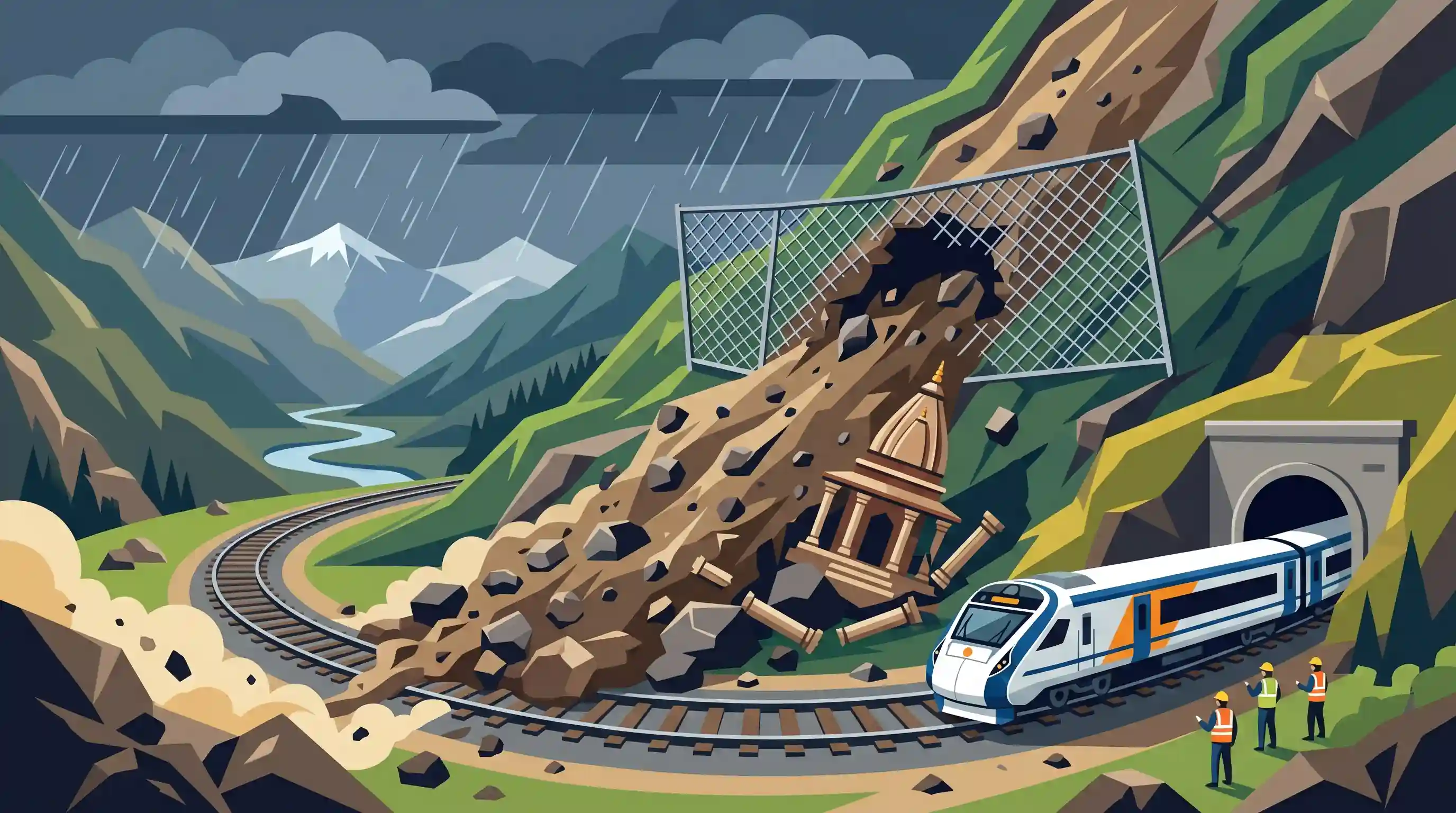
A severe landslip in the Mansa Devi hills near Haridwar, triggered by heavy rainfall, has blocked the critical Haridwar-Dehradun railway route near the Bhimgoda tunnel. The falling boulders destroyed a nearby Shiva temple and breached a previously installed iron protective net, leading to the suspension of train services, including the Vande Bharat Express. The incident highlights the geographical fragility of the Himalayan foothills and the challenges of safeguarding critical infrastructure against recurring natural disasters.
Key Points
- A major landslide in the Mansa Devi hills triggered by heavy rainfall blocked the Haridwar-Dehradun railway route near the Bhimgoda tunnel.
- The landslip caused a nearby Shiva temple to collapse and suspended the movement of multiple trains, including the Vande Bharat Express.
- Preventive measures previously installed, such as a large iron net meant to catch debris, failed to withstand the falling boulders.
- The incident emphasizes the recurring vulnerability of the cracking Mansa Devi hills to extreme weather events.
Important Terms
Government Railway Police (GRP)

A specialized branch of the State Police responsible for maintaining law and order, investigating crimes, and ensuring passenger safety within railway premises and on trains.
UPSC context
GS Paper 2/3; tests understanding of federal policing structures (State List) and internal security coordination between state police and the Railway Protection Force (RPF).
Geological Fragility
The inherent instability of a region's rock and soil structure, often due to tectonic activity or soft rock composition (like shale), making it prone to erosion and landslides.
UPSC context
GS Paper 1 (Geography); critical for explaining why the Himalayan foothills (Shivaliks) are susceptible to disasters during heavy rainfall.
National Landslide Risk Management Strategy
A 2019 framework by the NDMA focusing on hazard mapping, monitoring, early warning systems, and capacity building to create a landslide-resilient India.
UPSC context
GS Paper 3 (Disaster Management); the primary policy reference for evaluating government response and mitigation efforts for landslides.
Landslide Susceptibility Mapping
The process of identifying and categorizing geographical areas based on their likelihood of experiencing landslides, often led by the Geological Survey of India (GSI).
UPSC context
GS Paper 1/3; a key technical tool in urban planning and disaster preparedness to limit construction in high-risk zones.
Structural Mitigation
Physical engineering interventions—such as retaining walls, protective nets, or drainage systems—designed to prevent or reduce the physical impact of natural hazards on infrastructure.
UPSC context
GS Paper 3; tests the ability to distinguish between engineering solutions and non-structural measures like early warning systems in disaster management.
Shivalik Range
The southernmost and youngest mountain range of the Himalayas, characterized by loose sediments and high vulnerability to landslides and soil erosion.
UPSC context
GS Paper 1; the specific geographical context for Haridwar, testing knowledge of India's physiographic divisions and their environmental challenges.
Prelims Trap
"The Shivalik ranges are composed of highly consolidated, ancient hard rocks that resist minor climatic triggers."
The Shivaliks are actually the geologically youngest part of the Himalayas, composed of weak, unconsolidated fluvial sediments (sandstone, clay, conglomerates), making them inherently fragile.
Static Concepts Connected
Why are the Shivalik ranges highly susceptible to landslides?
- Geological youth: They are the geologically youngest Himalayan range, formed by the relatively recent deposition of river sediments from higher elevations.
- Unconsolidated materials: The range is largely composed of loose sandstone, conglomerate, and clay, lacking the structural cohesion found in older, metamorphic rock formations.
- Pore water pressure: Intense monsoonal rains rapidly increase pore water pressure, which drastically reduces the shear strength and friction of the slope materials, causing failure.
What are the core strategies for slope stabilization in hilly terrains?
- Drainage control: Creating surface and subsurface drainage channels to prevent water accumulation, thereby keeping pore pressure low within the soil mass.
- Bio-engineering: Utilizing deep-rooted vegetation and afforestation to naturally bind loose soil and reduce the velocity and erosive power of surface runoff.
- Structural defenses: Using retaining walls, soil nailing, and protective iron nets; however, these often fail in the Himalayas if not combined with proper drainage.
Cross-Topic Patterns
Himalayan Infrastructure vs. Carrying Capacity
The failure of structural nets at Mansa Devi mirrors the Joshimath subsidence crisis, highlighting the limits of hard engineering in geologically unconsolidated Himalayan terrains.
National Landslide Risk Management Strategy
This incident reinforces the National Landslide Risk Management Strategy's emphasis on detailed hazard zonation mapping and predictive EWS over purely reactive structural defenses.

Expect a GS3 Mains question analyzing the failure of 'hard engineering' in Himalayan infrastructure projects and carrying capacity.
Linked PYQs · 5
Linked PYQs · 5
- 2021MainsGS3
Describe the various causes and the effects of landslides. Mention the important components of the National Landslide Risk Management Strategy.
- 2019MainsGS3
Disaster preparedness is the first step in any disaster management process. Explain how hazard zonation mapping will help disaster mitigation in the case of landslides.
- 2021MainsGS1
Differentiate the causes of landslides in the Himalayan region and Western Ghats.
- 2016MainsGS1
The Himalayas are highly prone to landslides. Discuss the causes and suggest suitable measures of mitigation.
- 2013MainsGS1
Bring out the causes for more frequent occurrence of landslides in the Himalayas than in the Western Ghats.
