Google Criticizes EU Digital Markets Act Regulations
Source:The Hindu ↗
Why It Matters
The debate over the EU's Digital Markets Act highlights the complex global challenge of regulating multinational tech monopolies without stifling innovation or harming user experience. This represents a crucial case study for India's own evolving digital competition framework and tech regulations.
Summary
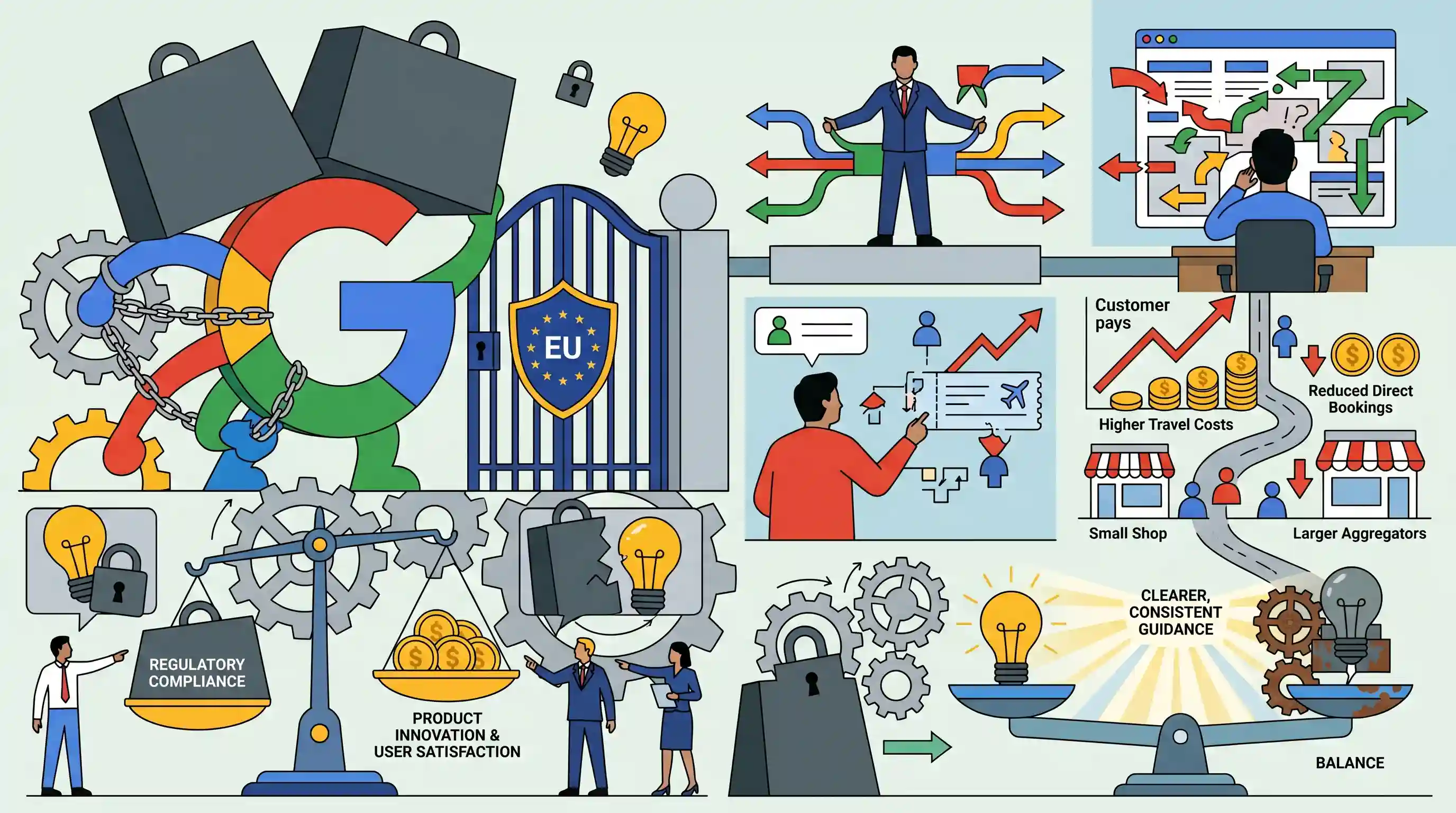
Google has publicly criticized the European Union's Digital Markets Act (DMA), arguing that the stringent regulations aimed at curbing the monopolistic practices of Big Tech are stifling innovation. The tech giant highlighted that early compliance efforts have resulted in compromised user experiences, higher travel costs for consumers, and reduced direct bookings for businesses. The DMA specifically targets "gatekeepers" by preventing them from favoring their own integrated services, such as Google Shopping and Flights. Consequently, Google has urged the EU Commission to provide clearer, consistent guidance to balance regulatory compliance with product innovation and user satisfaction.
Key Points
- Google claims that the European Union’s Digital Markets Act (DMA) is hindering technological innovation and negatively impacting European businesses and consumers.
- Early data indicates the DMA has led to increased travel costs for users and a decrease in direct bookings for businesses.
- The DMA mandates strict rules for 'gatekeepers' like Alphabet, Meta, and Apple to prevent anti-competitive behaviour, particularly the favoring of their own services (e.g., Google Flights, Shopping).
- Google has appealed to the EU Commission for consistent implementation and detailed guidance to comply with the rules without significantly downgrading user experiences.
Important Terms
Digital Markets Act (DMA)

An EU regulation aimed at ensuring fair competition in digital markets by imposing specific 'do's and don'ts' on large tech platforms to prevent monopolistic behavior.
UPSC context
GS Paper II (Global Governance) and GS Paper III (Digital Economy); tests knowledge of global regulatory standards and their impact on Indian tech.
Gatekeepers
Large digital platforms designated by the EU that provide essential core services (like search or app stores) and act as bottlenecks between businesses and consumers.
UPSC context
GS Paper III (Technology); important for understanding market dominance, platform neutrality, and the regulation of Big Tech monopolies.
European Commission
The executive arm of the European Union responsible for proposing legislation, implementing decisions, and serving as the sole enforcer of the Digital Markets Act.
UPSC context
GS Paper II (International Institutions); involves studying the role of global executive bodies in regulating transnational corporations.
Anti-Trust Law
Regulations designed to promote fair competition and prevent companies from engaging in anti-competitive practices, such as price-fixing or abusing a dominant market position.
UPSC context
GS Paper III (Indian Economy); relates to the Competition Act, 2002 and the role of the Competition Commission of India (CCI).
Digital Single Market
An EU strategy aimed at removing virtual borders and unifying 27 national digital markets into one to ensure free movement of digital services and data.
UPSC context
GS Paper II (Regional Groupings); tests understanding of economic integration and international trade frameworks in the digital age.
Prelims Trap
"India's Competition Act, 2002 relies on an ex-ante framework to regulate digital monopolies."
The Competition Act, 2002 relies on an ex-post framework (acting after anti-competitive behaviour occurs). It is the proposed Digital Competition Bill that introduces the ex-ante framework.
Static Concepts Connected
What is the difference between ex-ante and ex-post regulatory frameworks?
- Ex-ante (Preventative): Proactive rules set in advance to prevent market failures or monopolistic abuses before they occur (e.g., EU's Digital Markets Act).
- Ex-post (Reactive): Reactive enforcement taken by regulators only after an anti-competitive practice or violation has already happened (e.g., India's Competition Act, 2002).
What constitutes 'self-preferencing' in digital antitrust enforcement?
- Definition: When a vertically integrated dominant platform manipulates its algorithms or interface to heavily favor its own proprietary products over third-party competitors.
- Market Impact: It distorts the level playing field, creates entry barriers for smaller firms, and is a primary target of new ex-ante regulations.
Cross-Topic Patterns
EU DMA & India's Digital Competition Bill
The EU’s designation of tech giants as 'Gatekeepers' directly mirrors India's proposed 'Systemically Significant Digital Enterprises' (SSDEs), signalling a global shift towards proactive ex-ante regulation.
Antitrust & Digital Personal Data Protection (DPDP)
Curbing tech monopolies heavily overlaps with India's DPDP Act, as platform dominance is often built on unregulated user data harvesting, creating systemic entry barriers for startups.

Expect a multi-statement Prelims question comparing the "ex-ante" framework of India's Digital Competition Bill with the EU's DMA.
Linked PYQs · 2
Linked PYQs · 2
- 2017PrelimsGS1
The term 'Digital Single Market Strategy' seen in the news refers to
- 2024MainsGS3
Describe the context and salient features of the Digital Personal Data Protection Act, 2023.
