Draft WHO Pandemic Agreement Finalised on Pathogen Sharing
Source:The Hindu ↗
Why It Matters
It addresses critical ongoing debates in global governance and health security, specifically the reform of the WHO and intellectual property disputes over life-saving medical technologies. Directly addresses the GS2 theme of 'Important International institutions, agencies and fora - their structure, mandate' and the North-South divide in global policy.
Summary
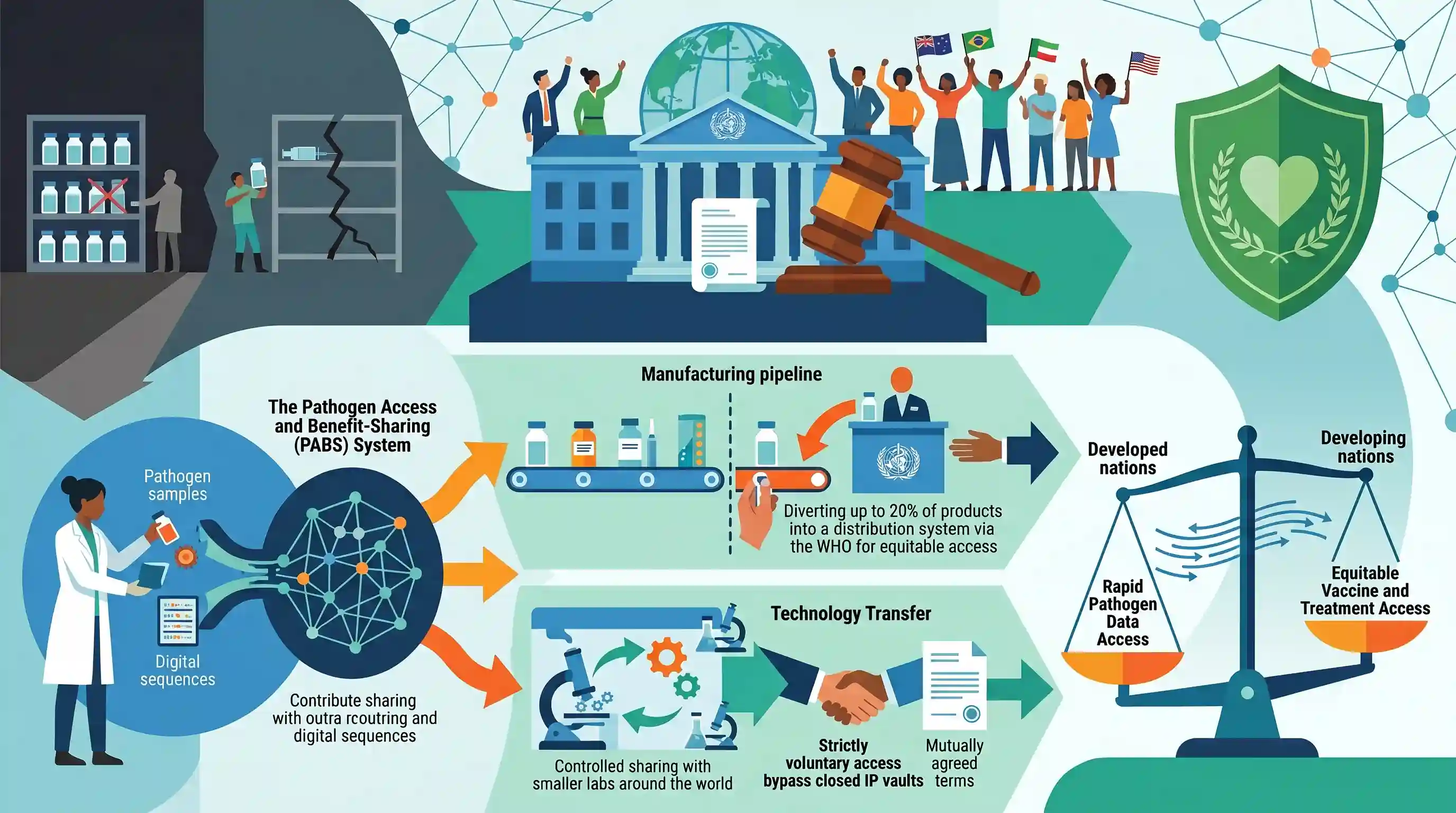
The editorial analyses the finalisation of the draft WHO Pandemic Agreement by the Intergovernmental Negotiating Body, characterising it as a landmark step toward global health security. Designed to prevent the stark inequities seen during the Covid-19 crisis, the agreement introduces a Pathogen Access and Benefit-Sharing (PABS) system. It mandates pharmaceutical companies to allocate up to 20% of pandemic-related production for equitable distribution via the WHO and frames technology transfer on 'mutually agreed terms' rather than being strictly voluntary. This establishes a more balanced framework between developed nations seeking rapid access to pathogen data and developing nations demanding equitable access to vaccines and treatments.
Key Points
- The WHO's Intergovernmental Negotiating Body (INB) has finalised a draft pandemic agreement to be adopted at the upcoming World Health Assembly in Geneva.
- The agreement aims to enhance global prevention, preparedness, and response to pandemics while addressing severe inequities exposed during the Covid-19 pandemic between the Global North and developing nations.
- A major contentious issue resolved was the Pathogen Access and Benefit-Sharing (PABS) system, balancing developed countries' demand for pathogen data with developing countries' demand for assured medical countermeasures.
- Pharmaceutical companies will be required to donate 10% of their production to the WHO and offer up to an additional 10% at affordable prices to ensure equitable access.
- Technology transfer for medical countermeasures will be based on 'mutually agreed terms' rather than remaining entirely voluntary, a crucial win for developing countries seeking resilient health infrastructure.
Important Terms
WHO Pandemic Agreement

A legally binding treaty under Article 19 of the WHO Constitution adopted in 2025 to enhance global cooperation, preparedness, and equitable access during health emergencies.
UPSC context
GS Paper II: International Relations/Global Health Governance. Tests knowledge of multilateral treaties and equitable access to global public goods.
Pathogen Access and Benefit-Sharing (PABS) system
A mechanism within the Pandemic Agreement where countries share pathogen data in exchange for guaranteed access to 20% of resulting vaccines and treatments.
UPSC context
GS Paper III: S&T/IPR. Focuses on benefit-sharing models, technology transfer, and balancing commercial innovation with public health equity.
Intergovernmental Negotiating Body (INB)
The member-state-led body established by the World Health Assembly in 2021 to draft and negotiate the first-ever global pandemic treaty.
UPSC context
GS Paper II: International Institutions. Relevant for understanding the procedural mechanisms and negotiations involved in forming international legal instruments.
World Health Assembly (WHA)
The supreme decision-making body of the WHO, representing 194 member states, responsible for approving the Pandemic Agreement and setting global health policies.
UPSC context
GS Paper II: International Organizations. Essential for understanding the legislative and governance structures of the United Nations' health agency.
World Health Organization (WHO)
The United Nations' specialized agency for international public health, serving as the coordinating authority for global health security and pandemic response.
UPSC context
GS Paper II: International Institutions. A core agency for studying global health architecture, mandate effectiveness, and pandemic preparedness.
Prelims Trap
The Pandemic Agreement mandates compulsory technology transfer and overrides WTO TRIPS.
Technology transfer is framed on 'mutually agreed terms', not strictly compulsory. It facilitates access but does not automatically trigger compulsory licensing or void intellectual property rights.
Static Concepts Connected
What is the treaty-making power of the World Health Assembly (WHA)?
- Article 19: Grants the WHA authority to adopt legally binding conventions or agreements by a two-thirds majority of its member states.
- Historic Precedent: The WHO Framework Convention on Tobacco Control (FCTC) is currently the most prominent binding treaty previously adopted under this constitutional provision.
How does the Nagoya Protocol differ from the proposed PABS system?
- Nagoya Protocol: Governs access to general biodiversity/genetic resources and traditional knowledge under the UN Convention on Biological Diversity (CBD).
- PABS System: Specifically carves out a specialized framework for pandemic-potential pathogens to ensure rapid data sharing and equitable vaccine distribution under WHO.
Cross-Topic Patterns
IPR vs. Public Health Flexibilities
Connects the new agreement's 'mutually agreed terms' for tech transfer to the historical India-South Africa TRIPS waiver push and compulsory licensing debates at the WTO.
Zoonosis and the One Health approach
The formal adoption of 'One Health' in the treaty links global pandemic preparedness directly to environmental conservation, deforestation, and wildlife trade regulation.

Expect a multi-statement Prelims question contrasting the WHO's PABS system with the CBD's Nagoya Protocol on access and benefit-sharing.
Linked PYQs · 3
Linked PYQs · 3
- 2020MainsGS2
Critically examine the role of WHO in providing global health security during the Covid-19 pandemic.
- 2024MainsGS3
What is the present world scenario of intellectual property rights with respect to life materials? Although, India is second in the world to file patents, still only a few have been commercialized. Explain the reasons behind this less commercialization.
- 2023PrelimsGS1
Consider the following statements: 1. In India, the Biodiversity Management Committees are key to the realization of the objectives of the Nagoya Protocol. 2. The Biodiversity Management Committees have important functions in determining access and benefit sharing, including the power to levy collection fees on the access of biological resources within its jurisdiction. Which of the statements given above is/are correct?
