Andhra Pradesh Comprehensive Land Resurvey and Blockchain Passbooks
Source:The Hindu ↗
Why It Matters
The digitization of land records using cutting-edge technologies like blockchain marks a significant advancement in state e-governance and property rights security. Additionally, welfare schemes targeting specific agrarian sectors (aquaculture and tobacco) are critical components of the APPSC syllabus under state economy, governance, and public administration.
Summary
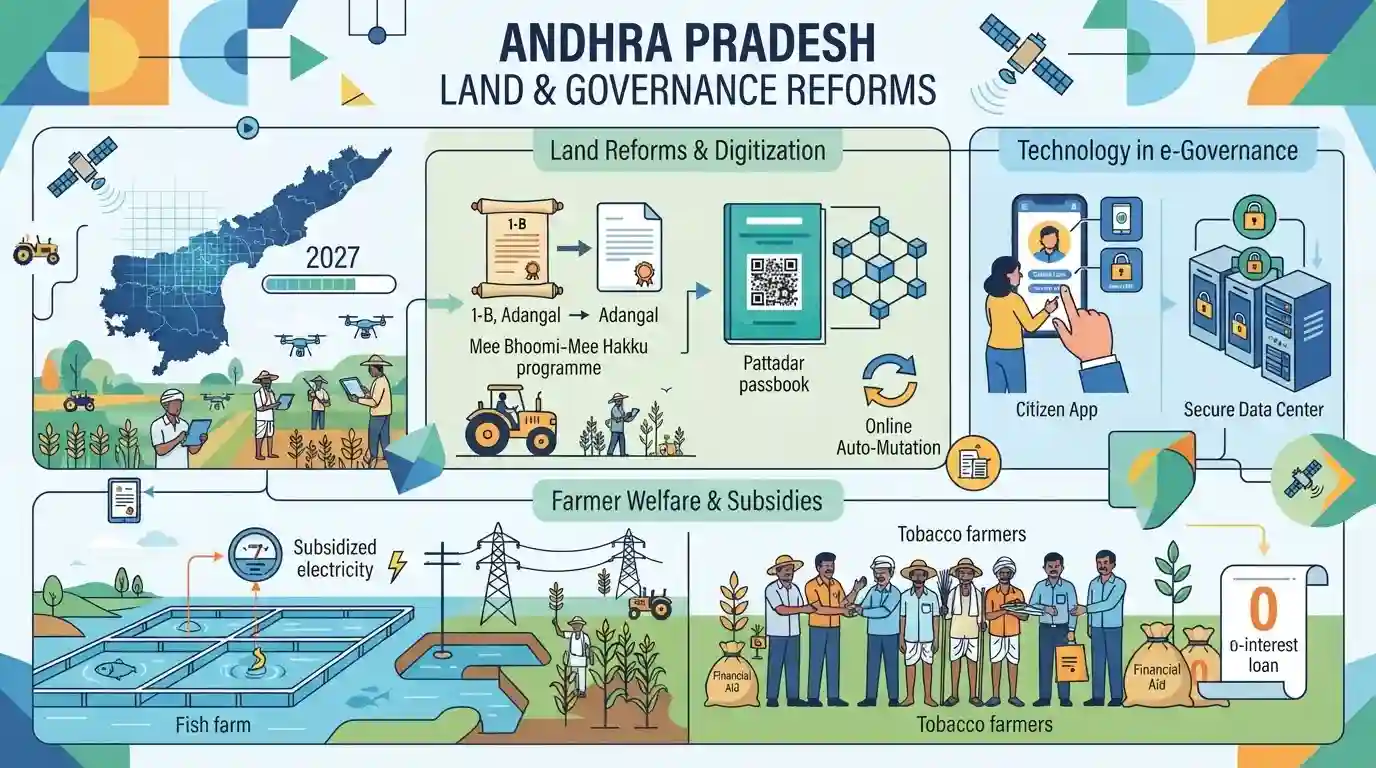
The Chief Minister of Andhra Pradesh has announced that the state's comprehensive land re-survey will be finalized by the end of 2027. As part of the 'Mee Bhoomi–Mee Hakku' programme launched in Kalidindi, the government is issuing new, highly secure pattadar passbooks equipped with blockchain technology and QR codes to ensure the inviolability of land records. The initiative also involves the digitization of traditional records (such as 1-B and Adangal) and the introduction of online auto-mutation. Beyond land reforms, the state government is prioritizing farmer welfare by offering subsidized electricity for the aquaculture sector and mobilizing financial assistance and interest-free loans for tobacco farmers hit by a recent price crash.
Key Points
- The Andhra Pradesh government targets completing a comprehensive land re-survey across the state by the end of 2027.
- Under the 'Mee Bhoomi–Mee Hakku' programme, landowners will receive highly secure pattadar passbooks integrated with blockchain technology, QR codes, and the State emblem to prevent tampering.
- Historical land disputes, including those concerning properties of Second World War ex-servicemen placed under Section 22-A, have been effectively resolved.
- Legacy land records like 1-B, Adangal, DKT, and Inam have been digitized, and an auto-mutation facility has been made available online.
- The government extended welfare measures for the agriculture sector, including supplying power to aquaculture farmers at a subsidized rate of ₹1.50 per unit and providing financial relief to tobacco farmers affected by price crashes.
Important Terms
Mee Bhoomi–Mee Hakku

An Andhra Pradesh government initiative for land record modernization. It involves comprehensive land re-surveys and issuing highly secure, digitized Pattadar Passbooks to landowners to ensure clear title ownership and resolve disputes.
UPSC context
Relevant for GS Paper II and III. Highlights the role of digital technology and re-surveys in citizen-centric state governance.
Section 22-A of the Registration Act, 1908
A legal provision empowering state governments to prohibit the registration of specific properties, such as disputed or government lands. In Andhra Pradesh, the wrongful inclusion of private lands under this section caused widespread distress.
UPSC context
GS Paper II (Polity & Governance). Tests understanding of land administration laws, property rights, and dispute resolution mechanisms.
Adangal and 1-B Records
Crucial land records in Andhra Pradesh. The 'Adangal' details agricultural land usage and crop types, while the '1-B' (Record of Rights) establishes formal ownership and tracks the mutation history of the property.
UPSC context
GS Paper III (Land Reforms). Tests knowledge of regional land administration terminology and the ongoing digitization of agricultural records.
Auto-mutation of Land Records
The automated process of updating government land revenue databases to reflect a change in ownership immediately after a property transfer, eliminating manual bureaucratic delays and enhancing transparency.
UPSC context
GS Paper II & III (e-Governance). Demonstrates the application of digital infrastructure to improve transparency and ease of doing business.
Pattadar Passbook
An official land ownership document issued to agricultural landholders in Andhra Pradesh. Recently upgraded with blockchain technology and QR codes, it serves as secure legal proof of ownership for transactions and subsidies.
UPSC context
GS Paper III (Agriculture & Land Reforms). Important for understanding how state governments secure property rights and target farmer welfare.
Prelims Trap
Blockchain-based land records are centrally managed and controlled by the State Government to ensure data security.
Blockchain is inherently a decentralized distributed ledger. A claim that it is controlled by a single central authority contradicts its core feature, which relies on network consensus.
Static Concepts Connected
What are the core components of the DILRMP?
- Computerization: Digitization of the Record of Rights (RoR) and all related spatial land records.
- Survey & Resurvey: Updating traditional survey and settlement records across states using modern technology like drones and GIS.
- Integrated Registration: Automating mutation and seamlessly linking property registration with the digital land records system.
What is the difference between presumptive and conclusive land titling?
- Presumptive System: India's current model where property registration merely records a transaction but does not officially guarantee absolute title ownership.
- Conclusive System: The proposed model where the State actively guarantees title ownership and provides financial compensation for subsequent title disputes.
Cross-Topic Patterns
Blockchain meets Agri-Stack
Linking immutable land records to the national Agri-Stack enables automated crop insurance payouts and targeted MSP procurement without manual verification, advancing paperless e-governance.
Blue Economy allied subsidies
As traditional agricultural subsidies face WTO scrutiny, states are heavily incentivizing allied sectors like aquaculture to boost rural incomes and bypass direct crop-support limits.

Expect a multi-statement Prelims question blending DILRMP land titling shifts (presumptive to conclusive) with Web3/blockchain basics.
Linked PYQs · 3
Linked PYQs · 3
- 2023APPSC_PRELIMSGS1
The CCRC introduced by Government of Andhra Pradesh stands for
- 2023APPSC_PRELIMSGS1
Government of Andhra Pradesh is implementing YSR Rythu Bharosa - PM Kisan Scheme for the benefit of farmers of Andhra Pradesh. Which of the following statements are correct about the above scheme ?
- 2024APPSC_PRELIMSGS1
Consider the following Assertion (A) and Reason (R) and choose the correct code: Assertion (A): 'India Stack' has enabled an online, paperless and cashless digital access to various public and private services. This has reduced the cost of conducting e-KYC. Reason (R): India Stack consists of two interconnected layers, and of these, the 'Payment Layer' has reduced the cost of conducting e-KYC. Code:
