Anti Corruption Laws and Judicial Charges in Public Office
Source:The Hindu ↗
Why It Matters
The case highlights the practical application of anti-corruption frameworks like the Prevention of Corruption Act and PMLA. It provides a contemporary example of political corruption and the role of central investigative agencies (CBI and ED), which are frequent subjects in UPSC Mains GS2 (Governance/Polity) and GS3 (Internal Security/Economy).
Summary
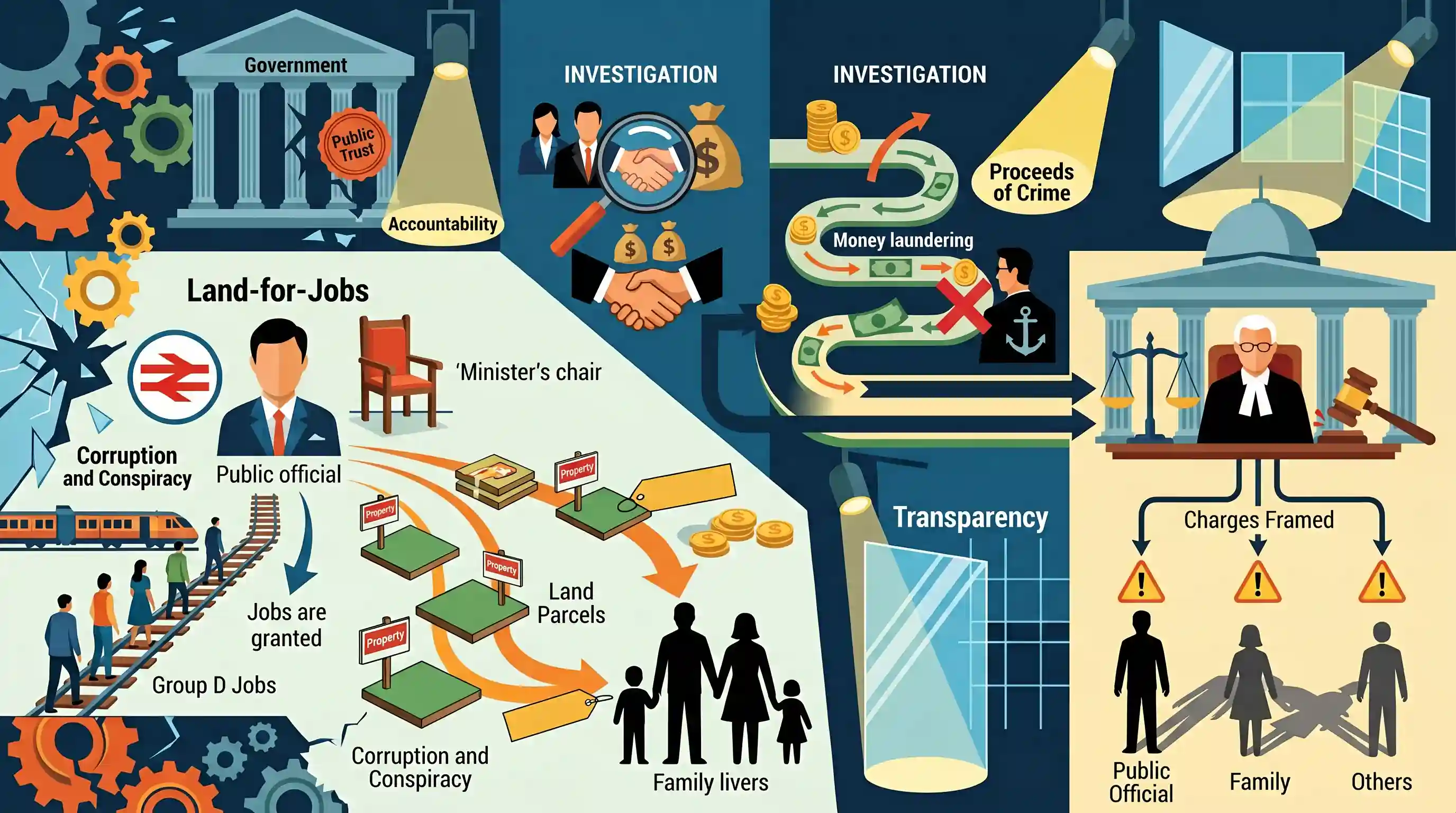
A Delhi court has framed charges against former Union Minister Lalu Prasad, his family members, and others in the 'land-for-jobs' scam. The charges, filed under the Prevention of Corruption Act and the IPC, revolve around allegations that during his tenure as Railway Minister (2004-2009), Group D jobs in the Indian Railways were given in exchange for land parcels transferred to his family at highly discounted rates. The CBI is investigating the corruption and conspiracy angles, while the Enforcement Directorate (ED) is conducting a parallel probe under the Prevention of Money Laundering Act (PMLA) to trace the proceeds of crime.
Key Points
- A Delhi court framed charges of corruption, cheating, and criminal conspiracy against former Railway Minister Lalu Prasad and his family members in the land-for-jobs case.
- The CBI alleges that between 2004 and 2009, prime land parcels in Bihar were transferred to the Prasad family at throwaway prices in exchange for Group D appointments in the Indian Railways.
- The charges have been framed under the Indian Penal Code (IPC) and the Prevention of Corruption Act.
- A parallel investigation is being conducted by the Enforcement Directorate (ED) under the Prevention of Money Laundering Act (PMLA) to trace the proceeds of crime associated with the case.
Important Terms
Prevention of Corruption Act

Primary legislation enacted in 1988 to combat corruption among public servants. It criminalizes bribery, criminal misconduct, and the possession of assets disproportionate to known sources of income.
UPSC context
GS Paper II (Governance) and Paper IV (Ethics); tests understanding of anti-corruption frameworks and institutional integrity.
Prevention of Money Laundering Act (PMLA)
A 2002 Act aimed at preventing money laundering and enabling the confiscation of property derived from the proceeds of crime, often involving three stages: placement, layering, and integration.
UPSC context
GS Paper III (Internal Security); tests knowledge of money laundering challenges and legislative measures to curb illicit financial flows.
Central Bureau of Investigation (CBI)
India's premier investigating agency for corruption, economic offenses, and serious crimes. It derives its investigative powers from the Delhi Special Police Establishment (DSPE) Act, 1946.
UPSC context
GS Paper II (Statutory/Regulatory Bodies); tests the role, autonomy, and federal challenges of central investigative agencies.
Enforcement Directorate (ED)
A specialized financial law enforcement agency under the Ministry of Finance responsible for enforcing the PMLA, FEMA, and Fugitive Economic Offenders Act.
UPSC context
GS Paper III (Economy/Security); focuses on the agency’s role in protecting the financial system and tackling economic crimes.
Indian Penal Code (IPC)
The historic criminal code of India (1860), defining offenses and punishments. Replaced by the Bharatiya Nyaya Sanhita (BNS) in 2024, but remains applicable for crimes committed before the transition.
UPSC context
GS Paper II (Criminal Justice System); tests knowledge of legal evolution and the decolonization of Indian laws.
Prelims Trap
"The CBI is a statutory body established under the Prevention of Corruption Act."
The CBI is not a statutory body. It derives its investigative powers from the Delhi Special Police Establishment (DSPE) Act, 1946, not the PCA.
Static Concepts Connected
How do the jurisdictions of the CBI and ED differ in multi-agency corruption cases?
- CBI Mandate: Investigates the predicate or 'scheduled' offences such as bribery (under PCA) and cheating (under IPC).
- ED Mandate: Investigates specifically the 'proceeds of crime' to track and attach assets generated through money laundering under the PMLA, 2002.
- Predicate Dependency: The ED generally relies on a predicate offence registered by another agency (like the CBI or state police) to initiate its own PMLA investigation.
Who is classified as a 'public servant' under the Prevention of Corruption Act (PCA)?
- Broad Definition: Any person in the pay or service of the government, local authority, or a statutory corporation.
- Elected Representatives: The Supreme Court has clarified that MPs, MLAs, and Union/State Ministers fall under the ambit of public servants for PCA purposes.
- Prior Sanction Requirement: Under Section 19 of the PCA, investigative agencies require prior sanction from competent authorities to prosecute these public servants.
Cross-Topic Patterns
PMLA scope vs. Political Corruption
UPSC increasingly links money laundering mechanisms with political corruption, often contrasting PMLA's stringent bail conditions and asset attachment rules with general criminal law.
Investigative agencies and federal friction
The jurisdiction of central agencies (CBI, ED) investigating state-level figures frequently connects to center-state relations, particularly regarding the withdrawal of General Consent under the DSPE Act.

Expect a 2026 Prelims statement testing the exact distinction between a 'predicate offence' (CBI) and 'proceeds of crime' (ED under PMLA).
Linked PYQs · 5
Linked PYQs · 5
- 2021MainsGS2
The jurisdiction of the Central Bureau of Investigation (CBI) regarding lodging an FIR and conducting probe within a particular State is being questioned by various States. However, the power of the States to withhold consent to the CBI is not absolute. Explain with special reference to the federal character of India.
- 2025MainsGS2
Discuss the 'corrupt practices' for the purpose of the Representation of the People Act, 1951. Analyze whether the increase in the assets of the legislators and/or their associates, disproportionate to their known sources of income, would constitute 'undue influence' and consequently a corrupt practice.
- 2021MainsGS3
Discuss how emerging technologies and globalisation contribute to money laundering. Elaborate measures to tackle the problem of money laundering both at national and international levels.
- 2013MainsGS3
Money laundering poses a serious security threat to a country's economic sovereignty. What is its significance for India and what steps are required to be taken to control this menace?
- 2020MainsGS2
There is a need for simplification of procedure for disqualification of persons found guilty of corrupt practices under the Representation of Peoples Act". Comment.
