Centre Notes Land Disputes Delay AMRUT Projects in Rajasthan
Source:timesofindia ↗
Why It Matters
This article highlights the administrative, legal, and environmental bottlenecks (such as land acquisition disputes, multi-departmental clearances, and GRAP restrictions) that hinder the execution of flagship urban transformation schemes like AMRUT 2.0 in Rajasthan. It provides critical factual data on central-state funding splits and physical progress of civic amenities for the RAS exam.
Summary
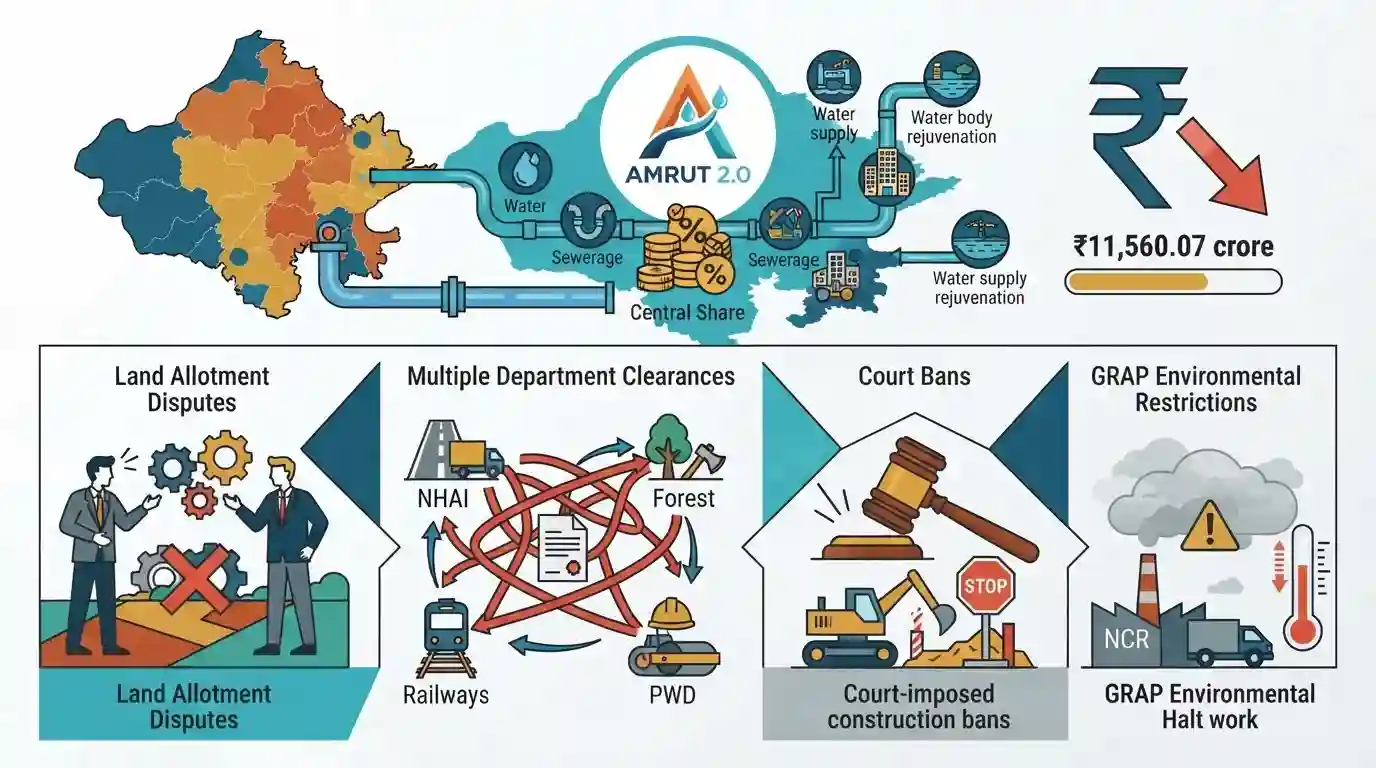
Implementation of AMRUT 2.0 urban infrastructure projects worth ₹11,560.07 crore in Rajasthan is experiencing significant delays. The Union Ministry of Housing and Urban Affairs revealed that while 363 projects spanning water supply, sewerage, and water body rejuvenation have been designed with a central share of ₹3,552 crore, progress is slowed by land allotment disputes, department clearances (NHAI, Forest, Railways, PWD), court-imposed construction bans, and GRAP environmental restrictions in NCR cities.
Key Points
- Rajasthan is implementing 363 infrastructure projects under the AMRUT 2.0 scheme with a total cost of ₹11,560.07 crore, of which Central assistance accounts for ₹3,552 crore.
- The 363 projects are categorized into 178 drinking water schemes, 48 sewerage and septage management works, 134 water body rejuvenation projects, and 3 parks/green spaces.
- Contracts have already been awarded for 109 drinking water projects (₹1,428.9 crore), 42 sewerage/septage projects (₹4,656.8 crore), and 129 water body rejuvenation works (₹443.86 crore).
- The Centre has released ₹745.12 crore under the mission until 2025-26, with an additional mother sanction of ₹250 crore issued for the current fiscal year (₹104.44 crore utilized till July 20).
- Implementation delays are due to land allotment issues arising from court cases, local resistance, pending department permissions (Forest, NHAI, Railways, PWD), and construction bans/GRAP restrictions in NCR cities of Rajasthan.
Important Terms
Atal Mission for Rejuvenation and Urban Transformation (AMRUT 2.0)

A Centrally Sponsored Scheme to make Indian cities water-secure. It provides universal water supply coverage, comprehensive sewerage management, water body rejuvenation, and promotes a circular water economy in urban areas.
UPSC context
GS-2 (Government Policies) & GS-3 (Infrastructure). Tests knowledge of urban infrastructure development, water management, and sustainable city planning.
Graded Response Action Plan (GRAP)
An emergency incremental framework implemented by CAQM to combat air pollution in Delhi-NCR. It activates progressively stricter bans, like halting construction, based on the severity of the Air Quality Index.
UPSC context
GS-3 (Environment). Tests understanding of environmental pollution control mechanisms, statutory bodies, and regional air quality governance.
National Highways Authority of India (NHAI)
An autonomous statutory body formed in 1988 under the Ministry of Road Transport and Highways. It is responsible for developing, maintaining, and managing India's extensive network of National Highways.
UPSC context
GS-3 (Infrastructure). Tests knowledge of transportation infrastructure, statutory bodies, investment models, and national connectivity projects.
Ministry of Housing and Urban Affairs (MoHUA)
A central government ministry responsible for executing policies and programs related to urban development, housing, and poverty alleviation, including flagship schemes like AMRUT, Smart Cities Mission, and Swachh Bharat.
UPSC context
GS-2 (Governance). Tests understanding of central ministries' roles in implementing urban development policies and centrally sponsored schemes.
Prelims Trap
AMRUT 2.0 features a uniform central-state funding ratio of 60:40 for all urban water projects across India.
Funding is graded by population: 50% central share for towns under 1 lakh, 33% for cities of 1-10 lakh, and 25% for million-plus cities.
Static Concepts Connected
How does the planning and approval mechanism work under AMRUT 2.0?
- City Water Balance Plan: Local bodies assess water sources, demand, and deficits to design targeted city-level water projects.
- State Water Action Plan: States aggregate individual city plans into a single state-wide action plan for central clearance.
- Decentralized execution: Shifts project formulation power to Urban Local Bodies (ULBs) rather than relying on top-down central planning.
What is the trigger framework of the Graded Response Action Plan (GRAP)?
- Regulatory authority: Implemented by the Commission for Air Quality Management (CAQM) for Delhi and the NCR.
- Four-stage response: Actions are strictly tied to AQI levels, ranging from Stage I (Poor) to Stage IV (Severe Plus).
- Infrastructure bans: Public construction activities are mandatorily halted when AQI crosses 400 (Stage III and above).
Cross-Topic Patterns
Green regulations vs public utility timelines
Strict environmental mandates like GRAP during winter pollution episodes create trade-offs by halting crucial urban water and sanitation projects.
Fiscal federalism and project execution gaps
Centrally Sponsored Schemes often stall because land procurement and local department clearances remain under exclusive state jurisdiction.

AMRUT 2.0's decentralized planning (SWAP) and graded funding structure are highly testable under GS-3 urban infrastructure.
Linked PYQs · 2
Linked PYQs · 2
- 2013RPSC_PRELIMSGS1
The Atal Mission for Rejuvenuation and Urban Transformation (AMRUT) primarily focuses on – 1. Water supply. 2. Sewerage facilities. 3. Public transportation facilities. 4. Construction of parks and recreational centers, mainly for children. 5. Flood control through drainage of floodwater. Select the correct answer using the codes given below
- 2023RPSC_PRELIMSGS1
Which of the following is not a part of the Rajasthan Urban Drinking Water, Sewage and Infrastructure Corporation Limited?
