Land acquisition hurdles push CPSUs into state solar park pacts
Source:Indian Express ↗
Why It Matters
It highlights the persistent practical challenges of land acquisition in large-scale infrastructure projects and demonstrates how cooperative federalism (Center-State joint ventures) can be used as an effective administrative workaround to achieve national climate and energy transition targets.
Summary
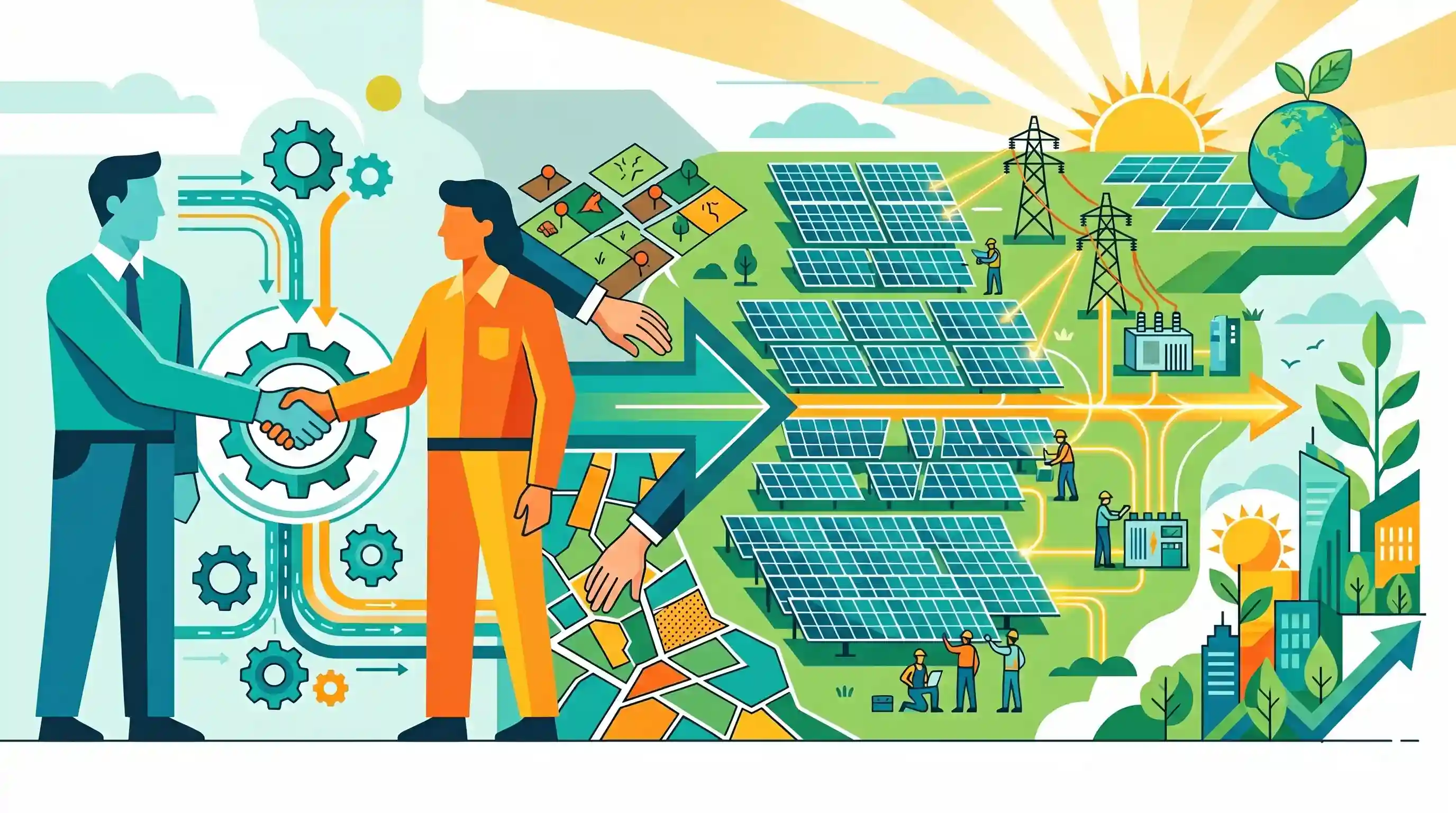
Facing significant land acquisition challenges, Central Public Sector Undertakings (CPSUs) are increasingly entering into joint ventures with state governments to develop 33 new solar parks. This collaborative approach aims to circumvent traditional land procurement delays by utilizing state resources and administrative machinery, thereby accelerating the expansion of India's renewable energy infrastructure and helping the country progress toward its climate goals.
Key Points
- Central Public Sector Undertakings (CPSUs) are partnering with state governments to develop 33 new solar parks across the country.
- The primary driver for these joint ventures is the persistent bottleneck in land acquisition, which has historically delayed independent infrastructure and renewable energy projects.
- By teaming up with states, CPSUs can leverage state machinery for easier land pooling, faster regulatory clearances, and mitigation of local resistance.
- This collaborative strategy is essential to fast-track the creation of renewable energy infrastructure and ensure India meets its ambitious clean energy targets.
Important Terms
Solar Park Scheme

MNRE scheme providing 'plug-and-play' infrastructure (land, transmission, roads) to solar developers. It targets 40,000 MW capacity across 50+ parks to minimize project risks and approvals.
UPSC context
GS Paper III: Infrastructure & Energy. Tests knowledge of sectoral schemes and hurdles in renewable energy scaling.
National Solar Mission (NSM)
A key component of the National Action Plan on Climate Change (NAPCC) launched in 2010. It aims to establish India as a global solar leader with an initial 100GW target.
UPSC context
GS Paper III: Environment & Energy. Relevant for climate change commitments (Indented Nationally Determined Contributions) and energy security.
Central Public Sector Undertakings (CPSUs)
Government-owned enterprises (e.g., NTPC, SECI) that spearhead large-scale infrastructure. Under Phase-II, they receive financial support to set up grid-connected solar projects using domestic cells/modules.
UPSC context
GS Paper III: Indian Economy. Tests the role of state-led investment in strategic sectors like renewable energy.
Viability Gap Funding (VGF)
A grant provided by the Central Government to infrastructure projects that are socially/economically desirable but not commercially viable without financial support. Used in solar projects to lower tariffs.
UPSC context
GS Paper III: Economic Development & Investment Models. Tests understanding of public-private partnership (PPP) and infrastructure financing.
Renewable Purchase Obligation (RPO)
A regulatory mechanism requiring electricity distribution companies (DISCOMs) and large consumers to purchase a minimum percentage of their total power from renewable energy sources.
UPSC context
GS Paper III: Energy Sector. Tests knowledge of regulatory tools used to drive demand for green energy.
Prelims Trap
The Centre can independently acquire land for Ultra-Mega Solar Parks as renewable energy infrastructure falls under the Union List.
While Electricity is in the Concurrent List (Entry 38), 'Land' is strictly a State Subject (Entry 18). The Centre requires state cooperation.
Static Concepts Connected
How are Land and Electricity distributed under the 7th Schedule?
- Land (State List): Entry 18 covers land rights, land tenures, rents, and transfer of agricultural land.
- Acquisition (Concurrent): Entry 42 allows both the Centre and States to legislate on the acquisition and requisitioning of property.
- Electricity (Concurrent): Entry 38 grants shared jurisdiction over power generation, transmission, and distribution.
What is the 'Plug-and-Play' model in the Solar Park Scheme?
- Pre-packaged approvals: Developers receive demarcated land with all necessary statutory clearances (environmental, local body) already secured by the implementing agency.
- Ready infrastructure: Includes built-in power evacuation grids, water access, and road networks, eliminating the historical 2-3 year gestation delays for private developers.
Cross-Topic Patterns
Green energy vs. Forest Rights Act
Large solar parks (needing 4-7 acres/MW) increasingly encroach on commons and grazing lands, triggering Forest Rights Act (FRA) conflicts. This 'green vs. green' dilemma is a recurring Mains GS3 theme.
SPVs and Cooperative Federalism
CPSU-State Joint Ventures shift states from mere regulatory gatekeepers to active equity partners, mirroring the institutional frameworks seen in PM Gati Shakti and National Monetisation Pipeline.

Expect a 2026 prelims question merging the 'Plug-and-Play' solar model with 7th Schedule entries on land, acquisition, and electricity.
Linked PYQs · 4
Linked PYQs · 4
- 2022MainsGS3
Do you think India will meet 50 percent of its energy needs from renewable energy by 2030 ? Justify your answer. How will the shift of subsidies from fossil fuels to renewables help achieve the above objective ? Explain.
- 2016MainsGS3
Give an account of the current status and the targets to be achieved pertaining to renewable energy sources in the country. Discuss in brief the importance of National Programme on Light Emitting Diodes (LEDs).
- 2016MainsGS3
Rehabilitation of human settlements is one of the important environmental impacts which always attracts controversy while planning major projects. Discuss the measures to be adopted to mitigate the impact of the recent incidents of cloudbursts in many places of Uttarakhand.
- 2025PrelimsGS1
Consider the following statements about 'PM Surya Ghar Muft Bijli Yojana': I. It targets installation of one crore solar rooftop panels in the residential sector. II. The Ministry of New and Renewable Energy aims to impart training on installation, operation, maintenance and repairs of solar rooftop systems at grassroot levels. III. It aims to create more than three lakhs skilled manpower through fresh skilling, and up-skilling, under scheme component of capacity building. Which of the statements given above are correct?
