Madhya Pradesh to Hike Ladli Behna Aid
Source:The Hindu ↗
Why It Matters
Direct Benefit Transfer (DBT) schemes like the Ladli Behna Yojana highlight the shift towards targeted cash assistance for poverty alleviation and women's empowerment, a frequent theme in GS2. The simultaneous focus on recognizing tribal land rights under the Forest Rights Act touches upon issues of environmental justice, tribal welfare, and inclusive governance. Understanding these policies is crucial for evaluating state-level interventions addressing vulnerability and socio-economic inequality.
Summary
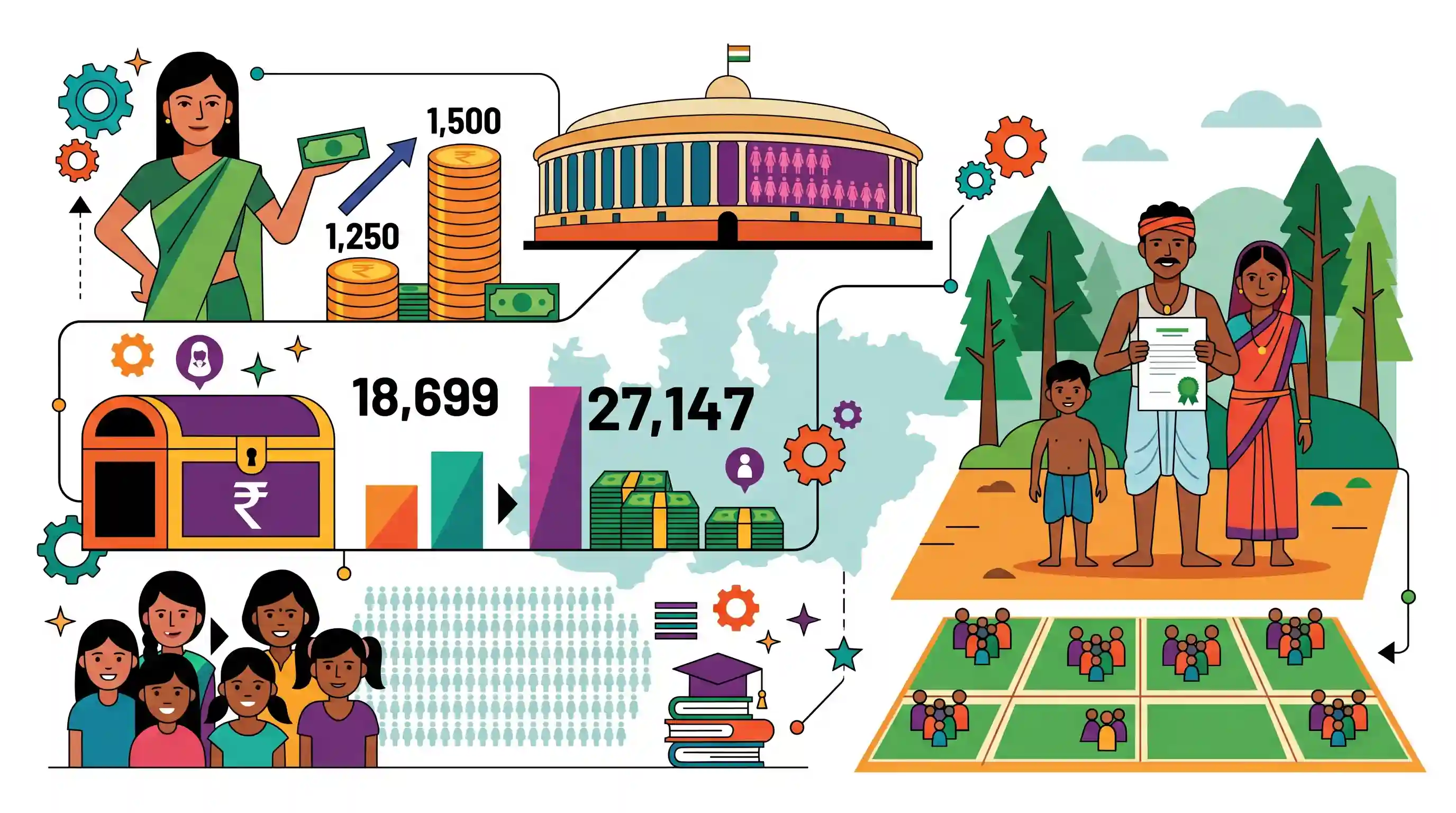
The Madhya Pradesh government is intensifying its focus on women's empowerment and tribal welfare through enhanced financial allocations and rights recognition. Chief Minister Mohan Yadav announced an increase in the monthly stipend under the Ladli Behna Yojana from ₹1,250 to ₹1,500 following Diwali, supported by a substantial ₹18,699 crore budget allocation. Overall, the state has earmarked ₹27,147 crore for women-centric initiatives, including the successful Ladli Laxmi Yojana, which has benefited 51 lakh girls. Additionally, the government has recognized the land rights of 9,000 tribal families under the Forest Rights Act, aligning state governance with broader national empowerment goals, such as the upcoming 33% legislative reservation for women.
Key Points
- The Madhya Pradesh government will increase the monthly aid under the Ladli Behna Yojana from ₹1,250 to ₹1,500 after Diwali.
- A significant portion of the state budget, ₹27,147 crore, has been allocated for women-centric programs, including ₹18,699 crore specifically for the Ladli Behna scheme.
- The Ladli Laxmi Yojana continues to support girl children, having benefited around 51 lakh girls with an allocation of ₹672 crore.
- In a push for tribal welfare, the state government has granted land rights to over 9,000 tribal families under the Forest Rights Act.
- The Chief Minister linked state-level women empowerment initiatives to the broader national agenda of implementing 33% reservation for women in Parliament and State Assemblies.
Important Terms
Nari Shakti Vandan Adhiniyam

The 106th Constitutional Amendment Act (2023) reserving one-third (33%) of seats for women in the Lok Sabha, State Legislative Assemblies, and the Delhi Legislative Assembly.
UPSC context
GS Paper II: Parliament and State Legislatures, Governance, and Women Empowerment. Tests knowledge of constitutional amendments and political representation.
Forest Rights Act (FRA) 2006
Legislation recognizing land and resource rights for forest-dwelling Scheduled Tribes and other traditional forest dwellers who have resided in forests for generations to correct historical injustices.
UPSC context
GS Paper II & III: Welfare schemes for vulnerable sections and Environment/Governance. Key for tribal rights and social justice.
Ladli Behna Yojana
A Madhya Pradesh state welfare scheme providing monthly cash transfers (increasing to ₹1,500) to eligible women to enhance economic independence and decision-making within households.
UPSC context
GS Paper II: Social Justice and State-level welfare schemes. Tests understanding of Direct Benefit Transfer (DBT) and gender-specific governance.
Ladli Laxmi Yojana
A conditional cash transfer scheme in Madhya Pradesh designed to improve the child sex ratio and ensure educational milestones for girls from birth to age 21.
UPSC context
GS Paper II: Issues relating to development and management of Social Sector/Services relating to Education and Health.
Prelims Trap
"The State Forest Department initiates the process for determining Individual Forest Rights."
Under the FRA 2006, the Gram Sabha (not the Forest Department) is the statutory authority empowered to initiate the process for determining forest rights.
Static Concepts Connected
What is the institutional mechanism for recognizing rights under the Forest Rights Act (FRA), 2006?
- Initiating Authority: The Gram Sabha receives claims, consolidates them, and passes a resolution initiating the rights recognition process.
- Review Committees: Sub-Divisional Level Committees (SDLC) and District Level Committees (DLC) review and give final approval to the claims.
- Nodal Agency: The Ministry of Tribal Affairs is the national nodal agency responsible for ensuring effective implementation.
How is Gender Budgeting classified in India?
- Part A: Reflects schemes with 100% allocation specifically targeted at women (e.g., Ladli Laxmi, Mahila Samman Savings Certificate).
- Part B: Reflects schemes where at least 30% of the allocation is earmarked for women.
- Core Objective: It is not a separate budget, but a dissection of the main budget to establish its gender-specific impact and correct structural inequalities.
Cross-Topic Patterns
DBT schemes and State Fiscal Health
Proliferation of state-level cash transfer schemes frequently sparks GS-3 debates on "freebies vs. welfare" and their impact on state fiscal deficits under FRBM targets.
Political Quotas + Financial Autonomy
Linking the 106th CAA (33% legislative reservation) with state financial DBTs highlights the holistic shift from mere political representation to actual intra-household economic decision-making power.

Expect a GS2 Mains question evaluating if state DBT cash transfers for women effectively improve gender indices or just strain state finances.
Linked PYQs · 5
Linked PYQs · 5
- 2025MainsGS2
Women's social capital complements in advancing empowerment and gender equity. Explain.
- 2023MainsGS2
Discuss the contribution of civil society groups for women's effective and meaningful participation and representation in state legislatures in India.
- 2013PrelimsGS1
Under the Scheduled Tribes and Other Traditional Forest Dwellers (Recognition of Forest Rights) Act, 2006, who shall be the authority to initiate the process for determining the nature and extent of individual or community forest rights or both?
- 2019PrelimsGS1
Consider the following statements: 1. As per recent amendment to the Indian Forest Act, 1927, forest dwellers have the right to fell the bamboos grown on forest areas. 2. As per the Scheduled Tribes and Other Traditional Forest Dwellers (Recognition of Forest Rights) Act, 2006, bamboo is a minor forest produce. 3. The Scheduled Tribes and Other Traditional Forest Dwellers (Recognition of Forest Rights) Act, 2006 allows ownership of minor forest produce to forest dwellers. Which of the statements given above is/are correct?
- 2021PrelimsGS1
At the national level, which ministry is the nodal agency to ensure effective implementation of the Scheduled Tribes and Other Traditional Forest Dwellers (Recognition of Forest Rights) Act, 2006?
