Ladakh Statehood Protests Trigger Curfew Relaxation and Unrest
Source:The Hindu ↗
Why It Matters
The Ladakh protests intersect with crucial UPSC themes like the constitutional provisions of the Sixth Schedule for tribal autonomy, the reorganization of states/UTs, and the legal framework for internet shutdowns (Telecommunication Act, 2023) balancing public order with fundamental rights.
Summary
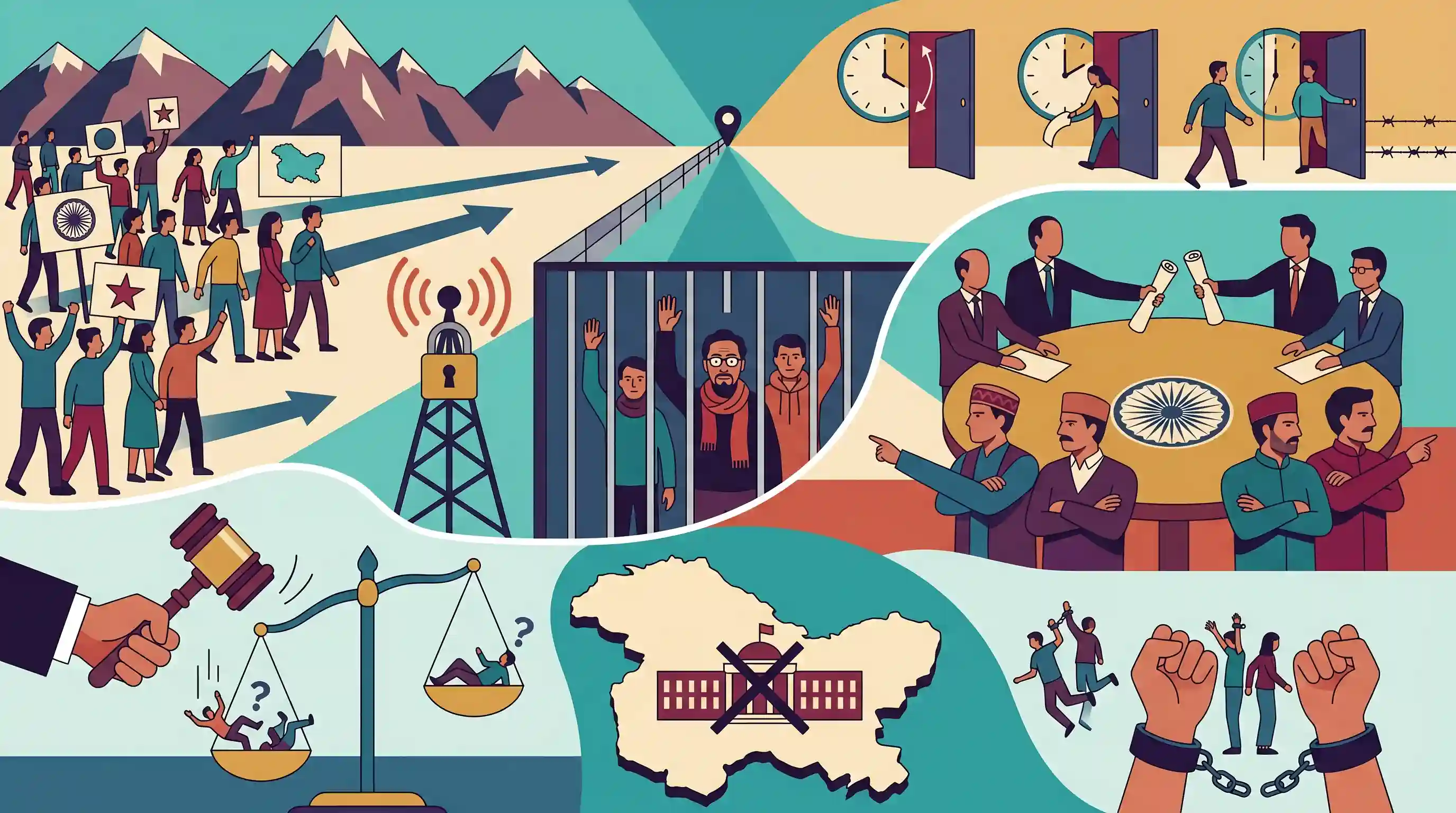
Amidst escalating protests for statehood and inclusion in the Sixth Schedule, the Ladakh UT administration partially relaxed a curfew in Leh but maintained an internet blackout. The unrest follows the detention of activist Sonam Wangchuk and other marchers at the Delhi border. Influential local groups, the Kargil Democratic Alliance (KDA) and Leh Apex Body (LAB), have boycotted talks with the Centre, demanding a judicial probe into civilian deaths and the unconditional release of the detainees. The situation underscores the ongoing political complexities in the region since it was designated a Union Territory without a legislature.
Key Points
- A curfew in Leh district was partially relaxed, but internet and public Wi-Fi services remain suspended under the Telecommunication Act, 2023 to maintain public order.
- The Kargil Democratic Alliance (KDA) and Leh Apex Body (LAB) are leading protests demanding statehood for Ladakh and its inclusion in the Sixth Schedule.
- Protest leaders are refusing to resume dialogue with the Centre until detained 'Delhi Chalo' marchers, including Sonam Wangchuk, are unconditionally released and a judicial probe is ordered into recent civilian deaths.
- The developments highlight tensions arising from the constitutional and administrative arrangements following the creation of the Ladakh Union Territory.
Important Terms
Sixth Schedule of the Indian Constitution

Constitutional framework under Articles 244(2) and 275(1) providing autonomous administration for tribal areas via District Councils. It grants legislative and judicial powers over land, forests, and local customs.
UPSC context
GS-II (Polity/Tribal Rights). Relates to decentralized governance and Ladakh's demand for land and cultural protection post-UT status.
Telecommunication Act, 2023
Legislation replacing the 1885 Telegraph Act to modernize telecom regulation. Section 20(2)(b) empowers the government to suspend services for public safety, providing the legal basis for internet shutdowns.
UPSC context
GS-II (Govt Policies) & GS-III (Security). Tests knowledge of digital rights and the legal evolution of telecom regulation.
Leh Apex Body (LAB)
A coalition of political, religious, and social groups in Leh district. It leads the movement for Ladakh's statehood and constitutional safeguards alongside the Kargil Democratic Alliance.
UPSC context
GS-II (Federalism). Relevant for understanding regional political movements and the "representation deficit" in Union Territories.
Kargil Democratic Alliance (KDA)
An umbrella organization representing socio-political and religious interests in Kargil. It partners with the Leh Apex Body to demand full statehood and Sixth Schedule status for Ladakh.
UPSC context
GS-II (Constitution/Federalism). Highlights the political convergence between Leh and Kargil on shared constitutional and regional grievances.
Ministry of Home Affairs (MHA)
The nodal central ministry for the administration of Union Territories and internal security. It manages high-level negotiations with Ladakh’s leadership regarding statehood and constitutional safeguards.
UPSC context
GS-II (Governance). Essential for understanding the central-state administrative relationship and resolution of internal security crises.
Temporary Suspension of Telecom Services Rules
A procedural framework for shutting down internet services during emergencies. The 2017 rules were largely superseded by the 2024 Rules under the new Telecommunication Act.
UPSC context
GS-II (Fundamental Rights) & GS-III (Security). Tests the balance between state security and Article 19 freedoms.
Prelims Trap
The President can notify Ladakh under the Sixth Schedule through a simple executive order.
Adding a region outside Assam, Meghalaya, Tripura, and Mizoram to the Sixth Schedule requires a Constitutional Amendment, unlike Fifth Schedule areas which the President can notify directly.
Static Concepts Connected
How does the administration of a UT without a legislature (like Ladakh) function?
- Article 239: It is governed directly by the President through an appointed administrator (Lieutenant Governor).
- Legislative Vacuum: Parliament has the power to make laws on all subjects (State, Concurrent, and Union lists) for such Union Territories.
- Contrast with 239A: Unlike Article 239A (Puducherry), a UT under Article 239 lacks a legislative assembly and elected council of ministers.
What constitutional framework governs Internet Suspensions in India?
- Statutory Backing: Internet shutdowns are now authorized under the Telecommunications Act, 2023, which replaced the colonial-era Indian Telegraph Act, 1885.
- Fundamental Rights: Access to the internet is a protected right under Article 19(1)(a) (speech) and 19(1)(g) (trade/profession).
- Anuradha Bhasin (2020): The SC ruled that indefinite internet shutdowns are unconstitutional and must pass the test of proportionality.
Cross-Topic Patterns
Telecom Act 2023 vs Fundamental Rights
The use of the Telecommunications Act 2023 to suspend internet in Leh directly tests the 'proportionality' and transparency safeguards mandated by the Supreme Court in the Anuradha Bhasin (2020) judgment.
Border Security & Local Governance
Alienation in border regions impacts internal security. The military's strategic footprint in eastern Ladakh relies heavily on local cooperation, making civil-military synergy crucial for border management against China.

Prelims 2026 will likely feature a multi-statement question contrasting 6th Schedule ADCs with 5th Schedule areas and UT administrations.
Linked PYQs · 3
Linked PYQs · 3
- 2015PrelimsGS1
The provisions in Fifth Schedule and Sixth Schedule in the Constitution of India are made in order to
- 2025MainsGS2
Discuss the nature of Jammu and Kashmir Legislative Assembly after the Jammu and Kashmir Reorganization Act, 2019. Briefly describe the powers and functions of the Assembly of the Union Territory of Jammu and Kashmir.
- 2024MainsGS3
Social media and encrypting messaging services pose a serious security challenge. What measures have been adopted at various levels to address the security implications of social media? Also suggest any other remedies to address the problem.
