Ladakh Protests Intensify Demand for Statehood and Sixth Schedule
Source:Indian Express ↗
Why It Matters
The ongoing Ladakh protests sit at the intersection of constitutional governance, tribal rights, and national security. The debate tests the constitutional boundaries of the Sixth Schedule and highlights the challenges of balancing strategic centralization in border regions against the democratic aspirations and ecological concerns of the local population.
Summary
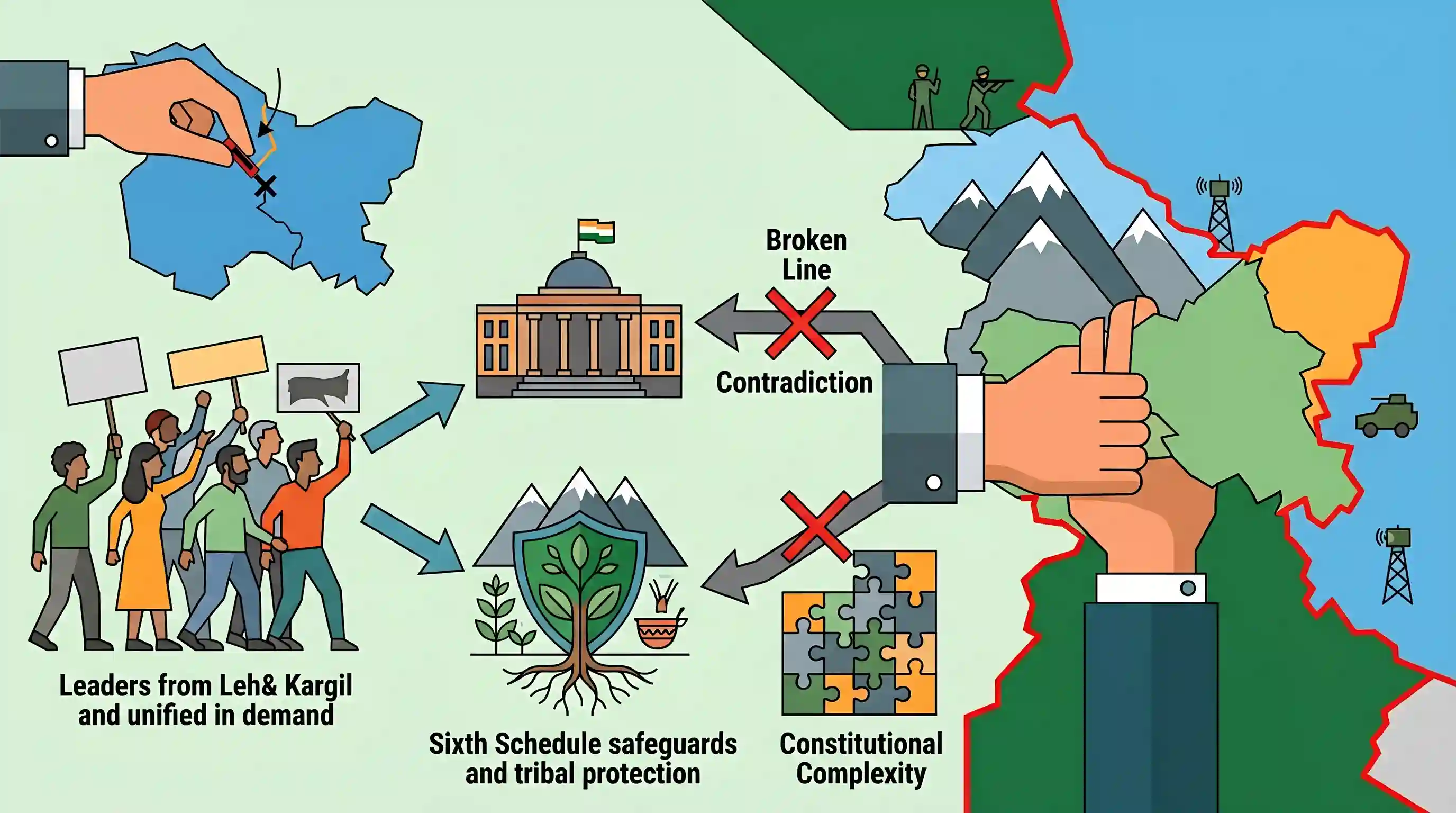
The article examines the ongoing protests in Ladakh and the underlying demands for full statehood and constitutional safeguards under the Sixth Schedule. Following the 2019 bifurcation of Jammu & Kashmir, Ladakh was designated a Union Territory without a legislature, a move that initially brought hope but soon sparked anxieties over democratic representation, land rights, and the protection of its fragile ecology and tribal majority. The protests, driven by a united front of leaders from both Leh and Kargil, have put the Union Government in a difficult position. Conceding to statehood would contradict the Centre's 2019 reorganization narrative, while applying the Sixth Schedule to a UT remains constitutionally complex. Furthermore, Ladakh's strategic location along the volatile borders with China and Pakistan compells the Centre to retain direct administrative and security oversight, limiting its willingness to grant regional autonomy.
Key Points
- Following the 2019 abrogation of Article 370, Ladakh was carved out of Jammu & Kashmir as a Union Territory without a legislature, removing previous constitutional protections on land and jobs.
- The Leh Apex Body (LAB) and Kargil Democratic Alliance (KDA) united to put forward a four-point demand: full statehood, application of the Sixth Schedule, local job reservations, and separate parliamentary seats for Leh and Kargil.
- Protesters, including climate activist Sonam Wangchuk, argue that the Sixth Schedule is essential to protect the region's tribal identity (over 90% tribal population) and its fragile Himalayan ecology from unregulated industrial development.
- The Centre faces a dilemma: granting statehood reverses its 2019 reorganization policy, and applying the Sixth Schedule to a UT outside the Northeast (Assam, Meghalaya, Tripura, Mizoram) is constitutionally unprecedented.
- Due to Ladakh's highly sensitive borders with China and Pakistan, the Central Government is reluctant to cede direct administrative and security control by granting political autonomy.
Important Terms
Sixth Schedule of the Constitution

Provisions under Articles 244(2) and 275(1) establishing Autonomous District Councils in tribal areas. It grants legislative, judicial, and administrative powers over land and customs to protect tribal identity.
UPSC context
GS-II (Polity/Governance); tests knowledge of tribal autonomy, decentralization, and the specific protections for Scheduled Areas.
Jammu and Kashmir Reorganization Act, 2019
The landmark 2019 legislation that bifurcated the state of Jammu and Kashmir into two Union Territories: Jammu & Kashmir (with legislature) and Ladakh (without legislature).
UPSC context
GS-II (Union & Territories); central to understanding the 2019 administrative overhaul and current federal structure.
Leh Apex Body (LAB)
A socio-political conglomerate representing Leh district's religious and political groups. It leads the movement for Ladakh's statehood and inclusion under the Sixth Schedule.
UPSC context
GS-II (Pressure Groups); tests understanding of civil society's role in regional identity and constitutional negotiations.
Kargil Democratic Alliance (KDA)
A coalition of political and religious groups in Kargil district. It collaborates with the Leh Apex Body to demand regional safeguards and political representation.
UPSC context
GS-II (Pressure Groups); illustrates regional cooperation and the impact of non-state actors on federal policy.
Article 371
Constitutional clauses providing "special provisions" for specific states to protect land, culture, and employment. It is considered a potential compromise for Ladakh's autonomy concerns.
UPSC context
GS-II (Polity); tests understanding of asymmetric federalism and flexible constitutional safeguards for specific regions.
Article 370
A temporary provision that formerly granted special autonomous status to Jammu and Kashmir. Its abrogation in 2019 paved the way for Ladakh's current Union Territory status.
UPSC context
GS-II (Historical Underpinnings); essential context for the legal transition of the region and Indian federalism.
Prelims Trap
"The Constitution explicitly prohibits the application of the Sixth Schedule to Union Territories or non-Northeastern states."
False. The Sixth Schedule specifically lists Assam, Meghalaya, Tripura, and Mizoram, but Parliament can amend the Constitution to include other areas, including UTs.
Static Concepts Connected
What are the distinct powers granted under the Sixth Schedule compared to the Fifth?
- 6th Schedule Autonomy: Creates Autonomous District Councils (ADCs) with actual legislative, judicial, and financial powers.
- 5th Schedule Autonomy: Creates Tribes Advisory Councils (TACs), which are purely advisory bodies to the state governor.
- Applicability: 6th applies exclusively to AMTM states (Art 244(2)); 5th applies to scheduled areas in any other state (Art 244(1)).
How does the constitutional administration of Ladakh differ from J&K or Delhi?
- Article 239 (Ladakh): Administered directly by the President through a Lieutenant Governor without a legislative assembly.
- Article 239A/239AA: Have legislative assemblies and Councils of Ministers, allowing local law-making on specific State List subjects.
Cross-Topic Patterns
Sixth Schedule vs. Inner Line Permit
Ladakh's demands parallel Northeast states' agitations where Sixth Schedule autonomy overlaps with the Inner Line Permit (ILP) under the Bengal Eastern Frontier Regulation to prevent demographic changes.
Strategic UTs & Border Infrastructure
The Centre's administrative dilemma highlights the friction between local ecological/tribal demands and the fast-tracking of dual-use border infrastructure by the BRO along the LAC.
UT to Statehood historical trajectories
Historically, UTs like Goa, Himachal, and Mizoram transitioned to full states. Ladakh revives the constitutional debate on criteria for granting statehood versus strategic centralization.

Expect a mixed Prelims statement on Art 244(1) vs 244(2) applied to UTs, or a Mains Q on balancing strategic border control with autonomy.
Linked PYQs · 5
Linked PYQs · 5
- 2025MainsGS2
Discuss the nature of Jammu and Kashmir Legislative Assembly after the Jammu and Kashmir Reorganization Act, 2019. Briefly describe the powers and functions of the Assembly of the Union Territory of Jammu and Kashmir.
- 2016MainsGS2
To what extent is Article 370 of the Indian Constitution, bearing marginal note "Temporary provision with respect to the State of Jammu and Kashmir", temporary? Discuss the future prospects of this provision in the context of Indian polity.
- 2024MainsGS3
India has a long and troubled border with China and Pakistan fraught with contentious issues. Examine the conflicting issues and security challenges along the border. Also give out the development being undertaken in these areas under the Border Area Development Programme (BADP) and Border Infrastructure and Management (BIM) Scheme.
- 2023PrelimsGS1
With reference to 'Scheduled Areas' in India, consider the following statements: 1. Within a State, the notification of an area as Scheduled Area takes place through an Order of the President. 2. The largest administrative unit forming the Scheduled Area is the District and the lowest is the cluster of villages in the Block. 3. The Chief Ministers of the concerned States are required to submit annual reports to the Union Home Ministry on the administration of Scheduled Areas in the States. How many of the above statements are correct?
- 2019PrelimsGS1
Under which Schedule of the Constitution of India can the transfer of tribal land to private parties for mining be declared null and void?
