Ladakh Administration Approves Creation of Five New Districts
Source:The Hindu ↗
Why It Matters
The creation of new districts in Ladakh underscores the Union government's strategy for administrative restructuring in newly formed Union Territories. It provides a real-world example of decentralisation and governance reforms aimed at improving service delivery in strategically sensitive border regions, which is highly relevant for GS-2 Polity and Governance.
Summary
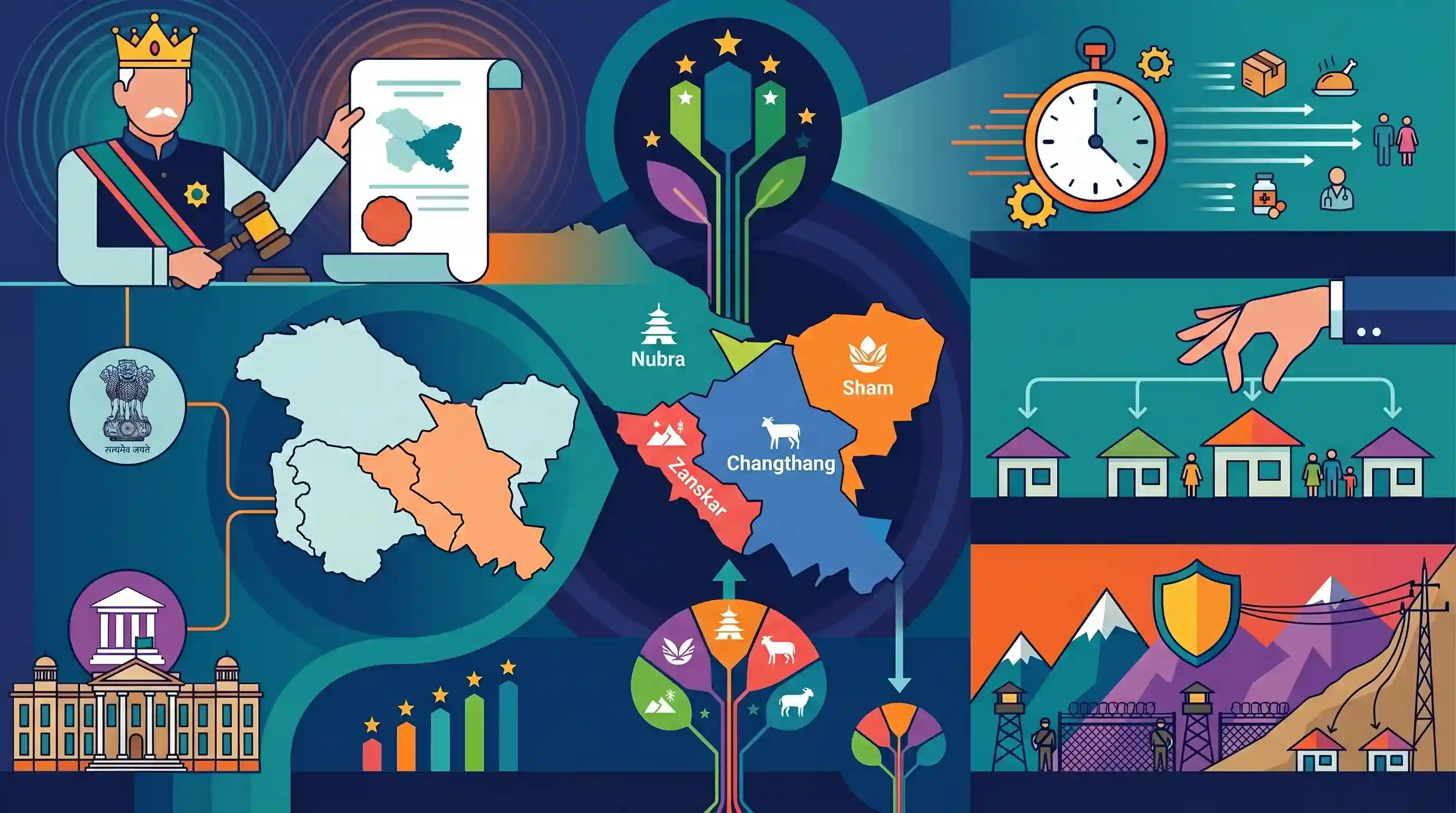
Ladakh Lieutenant Governor Vinai Kumar Saxena has officially approved the creation of five new districts—Nubra, Sham, Changthang, Zanskar, and Drass—bringing the total number of districts in the Union Territory to seven. The decision, initially approved by the Ministry of Home Affairs in August 2024, is intended to decentralise administration, improve grassroots governance, and facilitate faster public service delivery in the geographically vast and strategically important border region.
Key Points
- Ladakh Lieutenant Governor Vinai Kumar Saxena approved the creation of five new districts: Nubra, Sham, Changthang, Zanskar, and Drass.
- This increases the total number of districts in the Union Territory of Ladakh to seven, joining the existing districts of Leh and Kargil.
- The decision was previously approved by the Ministry of Home Affairs in August 2024 to fulfil long-pending demands of the region.
- The creation of these districts aims to decentralise administration, strengthen grassroots governance, and ensure faster delivery of public services in remote and border areas.
- Ladakh, a Union Territory without a legislature, was created following the bifurcation of Jammu and Kashmir and the abrogation of Article 370 on August 5, 2019.
Important Terms
Jammu and Kashmir Reorganisation Act, 2019

An Act of Parliament that bifurcated the erstwhile state of Jammu and Kashmir into two Union Territories—Jammu & Kashmir and Ladakh—effective from October 31, 2019.
UPSC context
GS Paper II (Polity). Tests knowledge of State reorganisation, UT administration, and constitutional changes post-abrogation of Article 370.
Lieutenant Governor (L-G)
The constitutional head and chief administrator of a Union Territory, appointed by the President. In Ladakh, the L-G exercises extensive executive powers without a local legislature.
UPSC context
GS Paper II (Executive). Relevant for understanding the administration of UTs and the role of the President's representative.
Grassroots Governance
A governance model focusing on local-level administration to ensure direct service delivery and empower communities, often through the creation of smaller administrative units like districts.
UPSC context
GS Paper II (Governance). Evaluates concepts of local self-government, decentralisation, and administrative efficiency in remote regions.
Ministry of Home Affairs (MHA)
The nodal central ministry responsible for internal security, border management, and the overall administration of Union Territories in India.
UPSC context
GS Paper II (Governance/Executive). Essential for understanding the relationship between the Centre and Union Territories.
Article 370
A former constitutional provision that granted special status and internal autonomy to Jammu and Kashmir; its 2019 abrogation led to the region's reorganisation.
UPSC context
GS Paper II (Constitution). Key background for reorganisation of states and asymmetrical federalism in India.
Decentralisation
The transfer of administrative authority and responsibility from central or state levels to local levels to improve efficiency and public participation.
UPSC context
GS Paper II (Governance). A core administrative principle tested in the context of democratic governance and regional development.
Prelims Trap
"The creation of new districts in Ladakh falls under the exclusive domain of the Ladakh Autonomous Hill Development Council."
While LAHDCs govern local development, creating or altering districts in a UT without a legislature requires Ministry of Home Affairs approval, not just a local council resolution.
Static Concepts Connected
Who holds the authority to create new districts in States and Union Territories?
- States: State governments can create, alter, or abolish districts via executive order (gazette notification) or state legislation without Central approval.
- UTs (No Legislature): For UTs without a legislature like Ladakh, the power vests with the Union Government (Ministry of Home Affairs), executed by the Lieutenant Governor.
- Renaming Caveat: While States create districts independently, they still require a No Objection Certificate (NOC) from the MHA if they want to rename a district or railway station.
What are the key geographical and ecological features of the Changthang region?
- Nomadic Tribes: Home to the nomadic pastoralist Changpa tribe, known for traditionally rearing Changthangi goats which yield premium Pashmina wool.
- Ramsar Wetlands: Features high-altitude wetlands including Tso Moriri and Tso Kar, both designated as wetlands of international importance under the Ramsar Convention.
- Unique Fauna: Crucial breeding ground for the near-threatened Black-Necked Crane and habitat for trans-Himalayan fauna like the Snow Leopard and Tibetan Wild Ass.
Cross-Topic Patterns
Border Security via Civil Decentralisation
Creating districts in strategic border areas like Changthang dovetails with the Vibrant Villages Programme, integrating deeper civil administration footprint with forward border security along the LAC.
LAHDC vs. Sixth Schedule Status
Ladakh's administrative restructuring directly ties into the ongoing civil society protests demanding Sixth Schedule status, highlighting the gap between LAHDC statutory powers and Constitutional tribal autonomy.

A prelims map question matching Ladakh's new districts (Zanskar, Nubra, Changthang) with their rivers, tribes, or Ramsar sites is highly likely.
Linked PYQs · 3
Linked PYQs · 3
- 2022MainsGS2
To what extent, in your opinion, has the decentralisation of power in India changed the governance landscape at the grassroots?
- 2025MainsGS2
Discuss the nature of Jammu and Kashmir Legislative Assembly after the Jammu and Kashmir Reorganization Act, 2019. Briefly describe the powers and functions of the Assembly of the Union Territory of Jammu and Kashmir.
- 2016MainsGS2
Discuss the essentials of the 69th Constitutional Amendment Act and anomalies, if any, that have led to recent reported conflicts between the elected representatives and the institution of the Lieutenant Governor in the administration of Delhi. Do you think that this will give rise to a new trend in the functioning of the Indian federal politics?
