Ladakh Sui Generis Governance Model and Constitutional Safeguards
Source:Indian Express ↗
हे का महत्त्वाचे आहे
The negotiations over a sui generis governance model for Ladakh highlight the evolving contours of Indian asymmetric federalism, balancing regional aspirations, tribal/indigenous protections, and national security in sensitive border regions.
सारांश
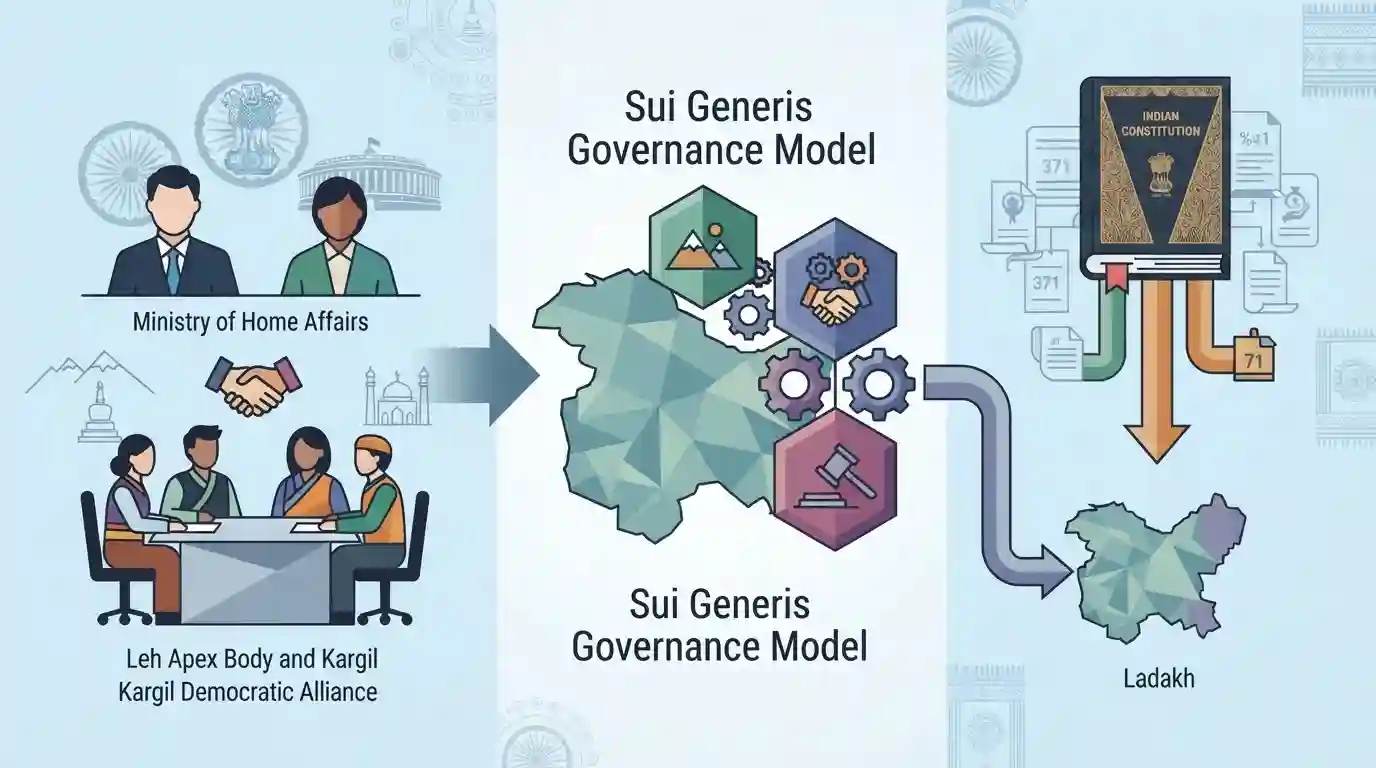
Discussions between the Ministry of Home Affairs and Ladakh representatives (Leh Apex Body and Kargil Democratic Alliance) are exploring a sui generis governance model, akin to Article 371 provisions, to address regional demands for land protection, employment safeguards, and legislative powers in the Union Territory of Ladakh.
मुख्य मुद्दे
- The Ministry of Home Affairs (MHA) and representatives from Ladakh (Leh Apex Body and Kargil Democratic Alliance) are engaged in discussions regarding a unique governance model (sui generis) for Ladakh, drawing parallels to Article 371-style special provisions.
- Ladakh leadership has been demanding constitutional safeguards for land, employment, environmental protection, and a legislative assembly, following the abrogation of Article 370 and creation of the Union Territory in 2019.
- The concept of a 'sui generis' model indicates a tailor-made framework distinct from standard Sixth Schedule or Article 371 provisions, aiming to address the strategic and geopolitical sensitivity of the region while fulfilling regional aspirations.
महत्त्वाच्या संज्ञा
Article 371

A set of constitutional provisions providing special transitional and regional safeguards for various Indian states to protect local culture, resources, and land rights.
UPSC context
UPSC Mains GS-II: Indian Constitution - Significant Provisions and Federal Structure. Important for questions on asymmetric federalism and regional autonomy.
Sixth Schedule
Constitutional provisions under Articles 244(2) and 275(1) providing for Autonomous District Councils to protect tribal populations and their traditional land and cultural rights in specified northeastern states.
UPSC context
UPSC Mains GS-II: Federalism, Scheduled and Tribal Areas. Evaluates mechanisms for decentralization and tribal autonomy.
Sui Generis
A unique legal or governance arrangement tailored to specific, exceptional circumstances, distinct from standard templates of governance.
UPSC context
UPSC Mains GS-II: Governance and Federal Structure. Useful for writing answers on innovative solutions for unique regional administrative challenges.
Leh Apex Body (LAB)
A prominent political body in Leh representing Buddhist and regional interests, spearheading demands for constitutional safeguards, land protection, and statehood for Ladakh.
UPSC context
UPSC Mains GS-II: Regional Aspirations and Federal Dynamics. Tests understanding of regional political movements in sensitive border Union Territories.
Kargil Democratic Alliance (KDA)
A prominent political platform in Kargil representing diverse religious and political groups, collaborating with Leh Apex Body to demand regional autonomy and constitutional protections for Ladakh.
UPSC context
UPSC Mains GS-II: Federal Structure and Regional Movements. Highlights inter-regional consensus building in border areas.
संबंधित स्थिर संकल्पना
What are the key constitutional provisions under Article 371 for regional protection?
- Asymmetric Federalism: Part XXI contains temporary, transitional and special provisions for states like Nagaland (371A), Mizoram (371G), and Sikkim (371F) to protect local customs and land.
- Governor Powers: Governor often holds special responsibility for law and order or regional boards, overriding ministerial advice in specific designated states.
- Legislative Safeguards: Parliamentary laws on religious or social practices and land transfer do not apply to certain Article 371 states unless the state legislature concurs.
आंतर-विषय नमुने
Asymmetric Federalism & Tribal Land Rights
Ladakh's demands for constitutional land safeguards mirror the Sixth Schedule protections operating in Northeast India, testing the limits of asymmetric federalism in border UTs.
Strategic Frontier Governance & National Security
Ladakh's unique border position requires balancing strategic military control with local democratic aspirations, paralleling security governance models in sensitive frontier regions.

Asymmetric federalism provisions (Art 371 vs Sixth Schedule vs Sui Generis UT models) will likely be tested via a multi-statement match question.
संबंधित PYQ · 1
संबंधित PYQ · 1
- 2014MainsGS2
Though the federal principle is dominant in our Constitution and that principle is one of its basic features, but it is equally true that federalism under the Indian Constitution leans in favour of a strong Centre, a feature that militates against the concept of strong federalism. Discuss.
