Ladakh Regional Talks and Constitutional Safeguards
Source:The Hindu ↗
Why It Matters
This development directly ties into India's federal framework, regional autonomy demands, tribal and geographic safeguards (Sixth Schedule), and governance structures in Union Territories post-reorganization.
Summary
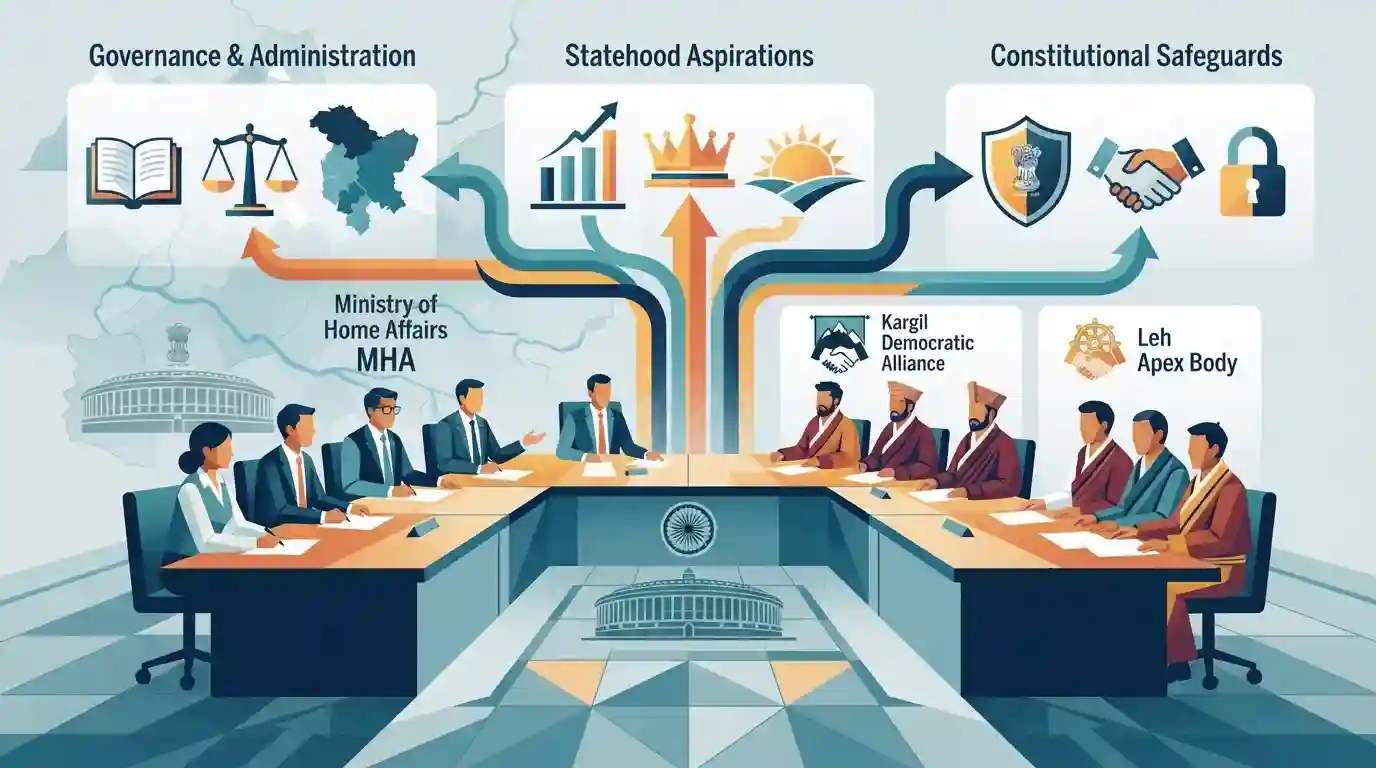
The Ministry of Home Affairs has decided to include elected members from both Kargil and Leh bodies, namely the Kargil Democratic Alliance and Leh Apex Body, in upcoming dialogue sessions regarding Ladakh's governance, statehood, and constitutional safeguards.
Key Points
- The Union Ministry of Home Affairs agreed to include elected representatives and members from both the Kargil Democratic Alliance (KDA) and the Leh Apex Body (LAB) in ongoing high-powered committee talks.
- Ladakh bodies have been persistently agitating for statehood, constitutional safeguards under the Sixth Schedule, protection of land and employment, and a separate Lok Sabha seat structure.
- The decision marks a step toward formalizing structured democratic engagement between the Centre and regional stakeholders of Ladakh.
Important Terms
Sixth Schedule

A constitutional provision under Part X that provides special governance mechanisms, autonomy, and safeguards for tribal areas in the North-Eastern states of Assam, Meghalaya, Tripura, and Mizoram.
UPSC context
GS Paper II (Polity & Governance) - Important provisions of the Constitution and decentralization of powers.
Jammu and Kashmir Reorganization Act
Legislation passed in 2019 that bifurcated the erstwhile State of Jammu and Kashmir into two Union Territories: Jammu & Kashmir, and Ladakh.
UPSC context
GS Paper II (Polity & Governance) - Reorganization of states, Union Territories, and federal dynamics.
Kargil Democratic Alliance
A joint socio-political front based in Kargil advocating for full statehood, constitutional safeguards under the Sixth Schedule, and democratic rights for Ladakh.
UPSC context
GS Paper II (Polity & Governance) - Regional autonomy, federalism, and civil society agitations.
Leh Apex Body
A prominent representative body from Leh negotiating with the Central government for statehood, Sixth Schedule status, and environmental protections for Ladakh.
UPSC context
GS Paper II (Polity & Governance) - Regional autonomy, federalism, and public representation.
Ministry of Home Affairs
The nodal central ministry responsible for internal security, domestic policy, centre-state relations, and administrative oversight of Union Territories in India.
UPSC context
GS Paper II (Polity & Governance) - Structure and functioning of the Union executive and ministries.
Static Concepts Connected
What are the constitutional mechanisms for tribal self-governance under the Indian Constitution?
- Fifth Schedule: Fifth Schedule covers Scheduled Areas in peninsular India with Tribes Advisory Councils (TAC) and Governor's legislative power.
- Sixth Schedule: Sixth Schedule covers tribal areas in Assam, Meghalaya, Tripura, and Mizoram with Autonomous District Councils (ADCs).
- Article 371 Provisos: Article 371 series provides special provisions and regional development boards for several states (Nagaland, Mizoram, Sikkim, etc.).
Cross-Topic Patterns
Asymmetrical Federalism and Border UT Governance
Regional autonomy movements in border regions intersect directly with Article 371-style safeguards and Schedule VI provisions, testing the limits of asymmetrical federalism.

Sixth Schedule extension criteria vs. Article 243M exemptions for Fifth/Sixth Schedule areas likely in prelims statement-based Qs.
Linked PYQs · 1
Linked PYQs · 1
- 2022MainsGS2
“While the national political parties in India favour centralisation, the regional parties are in favour of State autonomy.” Comment.
