Labour Codes and Industrial Growth in Low-Income States
Source:Indian Express ↗
Why It Matters
Labour codes are a major structural reform in the Indian economy. Understanding how these reforms can act as a catalyst for industrialization in underdeveloped states is crucial for GS-3 answers on economic growth, job creation, and industrial policy.
Summary
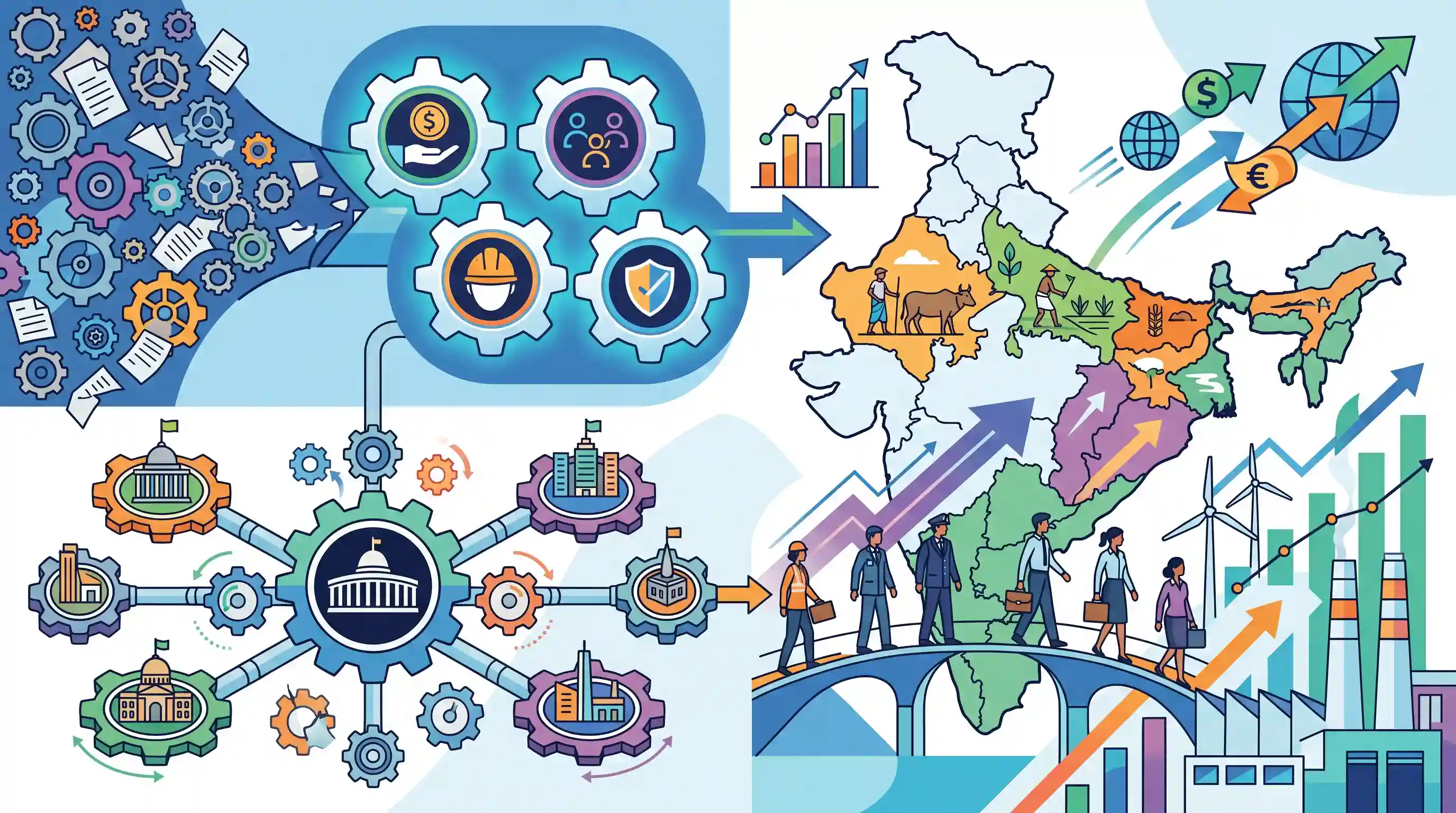
The consolidation of 29 Central labour laws into four new Labour Codes presents a strategic opportunity for India's economically weakest states. Although implementation has been delayed because labour is a Concurrent subject requiring state-level rules, the codes aim to introduce flexibility in hiring and retrenchment while simplifying compliance. For low-income states with abundant unskilled labour, swift adoption of these reforms could create a competitive advantage, attracting domestic and foreign manufacturing investments (such as those exploring the 'China-plus-one' strategy). This industrial push would help absorb surplus agricultural workers, formalise employment, and accelerate Gross State Domestic Product (GSDP) growth, ultimately promoting regional economic convergence.
Key Points
- The four new Labour Codes consolidate 29 existing Central labour laws to simplify compliance and improve ease of doing business.
- Labour is on the Concurrent List, requiring both the Centre and states to frame rules, which has delayed nationwide implementation.
- Economically weaker states with large populations and high agricultural dependency can use these codes to attract labour-intensive manufacturing.
- Flexible hiring and firing norms (e.g., increasing the retrenchment threshold to 300 workers) can help low-income states capitalize on the 'China-plus-one' strategy and drive regional economic convergence.
Important Terms
Code on Wages, 2019

A consolidated law subsuming four acts to universalize minimum wages and timely payment for all workers, regardless of sector or wage ceiling.
UPSC context
GS III (Economy); tests minimum wage universalization and its role in reducing regional disparities and formalizing the unorganized sector.
Industrial Relations Code, 2020
A law merging acts on trade unions and disputes; it increases the establishment threshold for layoffs/closures without government permission from 100 to 300 workers.
UPSC context
GS III (Industrial Policy); tests the balance between business flexibility (hiring/firing) and job security for workers.
Code on Social Security, 2020
Legislation integrating nine laws to extend social security benefits (insurance, maternity leave) to unorganized, gig, and platform workers for the first time.
UPSC context
GS II (Social Justice); tests the expansion of the safety net to include the "gig economy" and non-traditional employment.
Occupational Safety, Health and Working Conditions Code, 2020
A code consolidating 13 laws to set uniform standards for workplace safety and health, while permitting women to work night shifts with safety protocols.
UPSC context
GS III (Inclusive Growth); tests barriers to female labor participation and modernization of workplace health standards.
Concurrent List (Labour)
A legislative list in the Seventh Schedule where both Centre and States can enact laws; labour falls here, requiring state-level rules for implementation.
UPSC context
GS II (Polity); tests federalism and the legislative hurdles in implementing national codes across diverse states.
China-plus-one Strategy
A global business strategy where firms diversify manufacturing away from China to countries like India to mitigate supply chain risks.
UPSC context
GS III (Economy); tests India's industrial strategy to attract foreign investment and compete in global manufacturing.
Ministry of Labour and Employment
The nodal Central Ministry responsible for formulating and implementing policies related to worker welfare, social security, and industrial relations.
UPSC context
GS II (Governance); tests the institutional mechanisms managing India's transition to a modern labour law framework.
Prelims Trap
Labour regulations fall exclusively under the Union List, allowing the Centre to immediately enforce the new Labour Codes nationwide without state involvement.
Labour is actually in the Concurrent List (List III). Both the Union and States must frame and notify rules, which is the primary reason for the prolonged delay in nationwide implementation.
Static Concepts Connected
How is legislative power over 'Labour' distributed in the Indian Constitution?
- Concurrent List: Labour falls under Entries 22, 23, and 24 of the Concurrent List (List III) in the Seventh Schedule.
- Dual Rule-making: Both Parliament and State Legislatures can make laws. States must draft specific rules for Central acts to be operationalised locally.
- Doctrine of Repugnancy: Under Article 254, a Central law prevails over a conflicting State law unless the State law has received the President's assent.
What is the economic concept of structural transformation related to labour?
- Structural Transformation: Shifting surplus, low-productivity labour from agriculture to higher-productivity sectors like manufacturing to spur rapid economic growth.
- Lewis Model: A developmental economics concept proposing that developing nations grow by absorbing an unlimited supply of rural labour into the modern capitalist/industrial sector.
- Demographic Dividend: Creating low-skill, labour-intensive manufacturing jobs is essential to absorb India's working-age population and fully harness its demographic dividend.
Cross-Topic Patterns
PLI Schemes + Labour Flexibility
To successfully capture 'China-plus-one' supply chains, Production Linked Incentives (PLI) must be actively paired with flexible labour codes and land reforms at the state level.
Social Security Code & Gig Economy
The inclusion of gig/platform workers under the Social Security Code (mandating aggregator contributions) links legislative reforms directly to the rapidly expanding platform economy, a frequent UPSC mains topic.
Regional Convergence & Fiscal Federalism
Weaker states leveraging labour flexibility to attract manufacturing ties directly into broader syllabus debates on Finance Commission tax devolutions, demographic dividends, and regional economic convergence.

Expect a 2026 Prelims question linking the Concurrent List status of Labour with specific threshold changes in the Industrial Relations Code.
Linked PYQs · 3
Linked PYQs · 3
- 2024MainsGS3
Discuss the merits and demerits of the four 'Labour Codes' in the context of labour market reforms in India. What has been the progress so far in this regard?
- 2022MainsGS3
Economic growth in the recent past has been led by increase in labour productivity." Explain this statement. Suggest the growth pattern that will lead to creation of more jobs without compromising labour productivity.
- 2021PrelimsGS1
With reference to casual workers employed in India, consider the following statements : 1. All casual workers are entitled for Employees Provident Fund coverage. 2. All casual workers are entitled for regular working hours and overtime payment. 3. The government can by a notification specify that an establishment or industry shall pay wages only through its bank account. Which of the above statements are correct?
