Challenges in implementing the four new labour codes in India
Source:The Hindu ↗
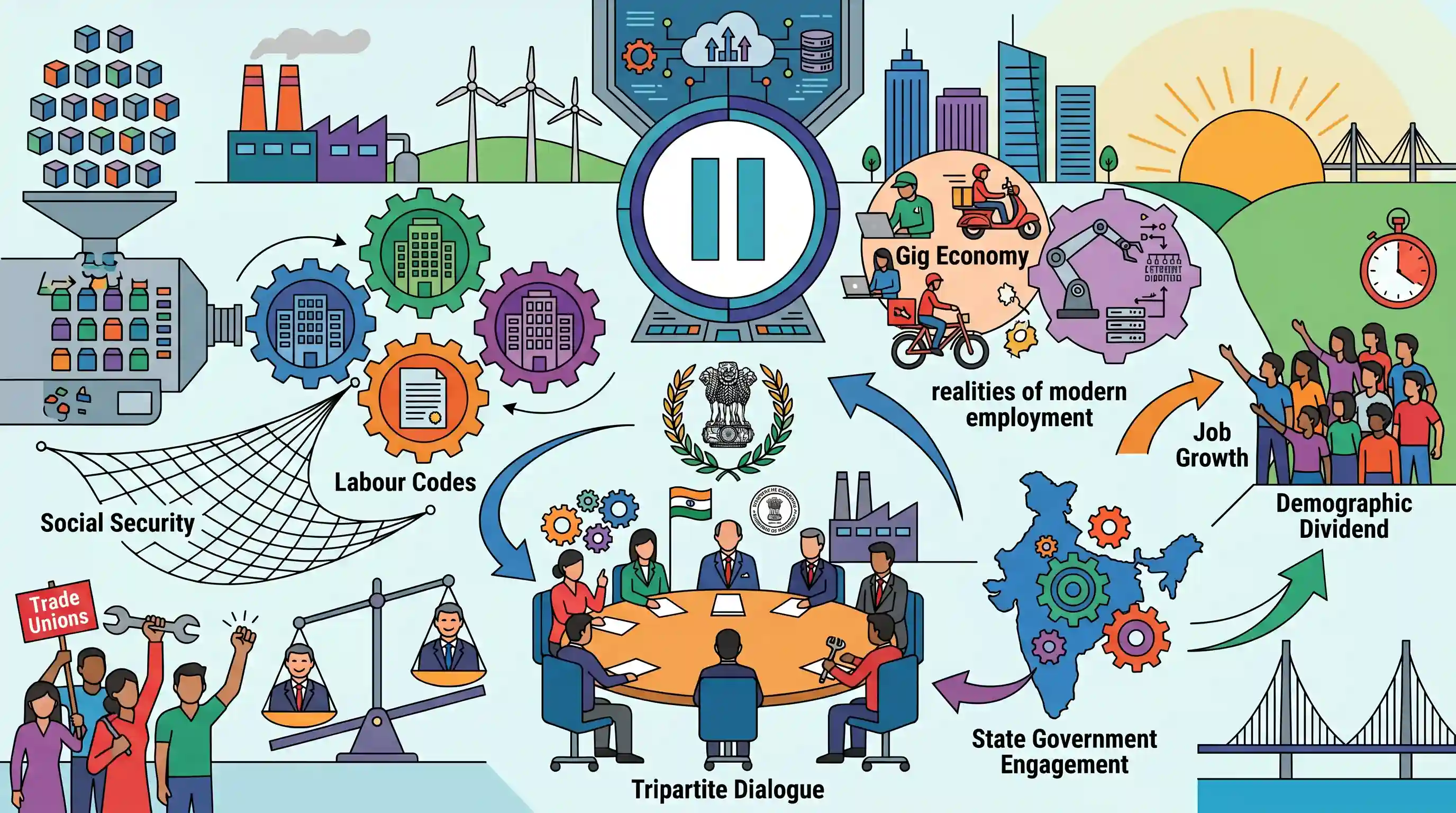
Why It Matters
The transition to the new Labour Codes is a landmark structural reform in India's economy. Understanding the friction points, the role of tripartite consultations, and the challenges posed by new forms of work (like the gig economy) is critical for GS3 (Economy/Employment) and Essay topics concerning India's demographic dividend and labor rights.
Summary
The editorial discusses the implementation of the four new Labour Codes, which consolidate 29 central laws to streamline compliance and expand the social security net. However, trade unions argue the codes are biased toward employers and fail to address the realities of modern employment, such as the gig economy and AI. Given India's need to generate 78.5 lakh non-farm jobs annually to leverage its demographic dividend, the author emphasizes the necessity of pausing the rollout. It calls for comprehensive tripartite consultations by reconvening the Indian Labour Conference (ILC) and engaging state governments to ensure equitable and forward-looking labor reforms.
Key Points
- The four Labour Codes passed between 2019 and 2020 aim to consolidate 29 central labor laws, expanding social security coverage while easing compliance burdens for employers.
- Trade unions strongly oppose the codes, arguing they are 'pro-employer' and were drafted without adequate tripartite consultations.
- The changing nature of work, characterized by the rise of the gig economy, platform workers, and Artificial Intelligence, requires updated labor frameworks rather than relying on the outdated 2002 Second National Commission on Labour report.
- To harness its demographic dividend, India needs to create 78.5 lakh non-farm jobs annually until 2030, necessitating labor reforms that balance growth with worker protection.
- The editorial urges the government to reconvene the Indian Labour Conference (ILC), unheld since 2015, and engage deeply with state governments since labor falls under the Concurrent List.
Important Terms
Labour Codes

A legislative overhaul consolidating 29 central labor laws into four functional categories—Wages, Industrial Relations, Social Security, and Occupational Safety—aiming to simplify compliance and modernize labor regulations.
UPSC context
GS Paper III: Indian Economy/Labour Reforms; tests knowledge of regulatory simplification versus worker rights in the pursuit of economic growth.
Code on Social Security, 2020
A landmark code that amalgamates nine laws to extend welfare benefits, such as health and life insurance, to gig, platform, and unorganized workers for the first time.
UPSC context
GS Paper III: Employment; critical for discussing the 'Gig Economy' and social safety nets for a future-ready workforce.
Industrial Relations Code, 2020
Consolidates laws governing trade unions and industrial disputes; it notably raises the employee threshold for layoffs without government approval from 100 to 300 workers.
UPSC context
GS Paper III: Industrial Growth; tests the balance between 'Ease of Doing Business' (hiring/firing flexibility) and collective bargaining rights.
Indian Labour Conference (ILC)
The apex tripartite consultative committee in India, bringing together government, employers, and trade unions to advise on labor policy and uphold ILO-standard social dialogue.
UPSC context
GS Paper II: Governance; emphasizes the importance of tripartite consultation in democratic policymaking and international labor obligations.
Second National Commission on Labour
A commission established in 1999 (reporting in 2002) that recommended rationalizing India's complex labor laws into functional codes to suit a globalized economy.
UPSC context
GS Paper III: Economic History/Reforms; provides the historical and structural basis for the current labor law codification.
Code on Wages, 2019
The first passed code replacing four major acts to establish a statutory 'National Floor Wage' and ensure universal minimum wage coverage for all employees.
UPSC context
GS Paper II: Social Justice; focuses on wage equality, gender-neutral pay, and the elimination of wage exploitation.
Prelims Trap
The new Labour Codes officially classify gig and platform workers as traditional 'employees' to ensure minimum wages.
The Code on Social Security recognises gig workers for specific benefits but explicitly avoids classifying them as "employees," denying them collective bargaining rights under the Industrial Relations Code.
Static Concepts Connected
How is 'Labour' positioned within the Indian Constitutional framework?
- Concurrent List: Labour welfare, trade unions, and social security fall under the Concurrent List of the Seventh Schedule (Entries 22, 23, 24, and 55).
- State-level Rules: Both Centre and States can legislate. Central Labour Codes require State governments to notify corresponding rules for actual on-ground implementation.
What is the Indian Labour Conference (ILC)?
- Tripartite Body: It is the apex tripartite consultative committee in India, comprising representatives of the government (Centre/States), employers, and trade unions.
- Advisory Role: It advises the government on labour policy issues, aligning with International Labour Organization (ILO) conventions on democratic consensus building.
Cross-Topic Patterns
Gig Economy + e-Shram Portal
Registration of unorganised and platform workers on the e-Shram portal is the critical first step toward providing the social security net envisioned by the new Labour Codes.
Demographic Dividend + PLI Schemes
India's need to generate 78.5 lakh non-farm jobs annually connects labour reforms directly to manufacturing boosts under PLI and the broader Make in India initiative.

A Prelims question distinguishing 'employee' vs 'gig worker' rights under the Social Security Code is highly likely in 2026.
Linked PYQs · 5
Linked PYQs · 5
- 2024MainsGS3
Discuss the merits and demerits of the four 'Labour Codes' in the context of labour market reforms in India. What has been the progress so far in this regard?
- 2014MainsGS3
While we flaunt India's demographic dividend, we ignore the dropping rates of employability. What are we missing while doing so? Where will the jobs that India desperately needs come from? Explain.
- 2021MainsGS1
Examine the role of 'Gig Economy' in the process of empowerment of women in India.
- 2021PrelimsGS1
With reference to casual workers employed in India, consider the following statements : 1. All casual workers are entitled for Employees Provident Fund coverage. 2. All casual workers are entitled for regular working hours and overtime payment. 3. The government can by a notification specify that an establishment or industry shall pay wages only through its bank account. Which of the above statements are correct?
- 2022PrelimsGS1
In India, which one of the following compiles information on industrial disputes, closures, retrenchments and lay-offs in factories employing workers ?
