JK Reorganisation Act and LG powers over administrative transfers
Source:Indian Express ↗
Why It Matters
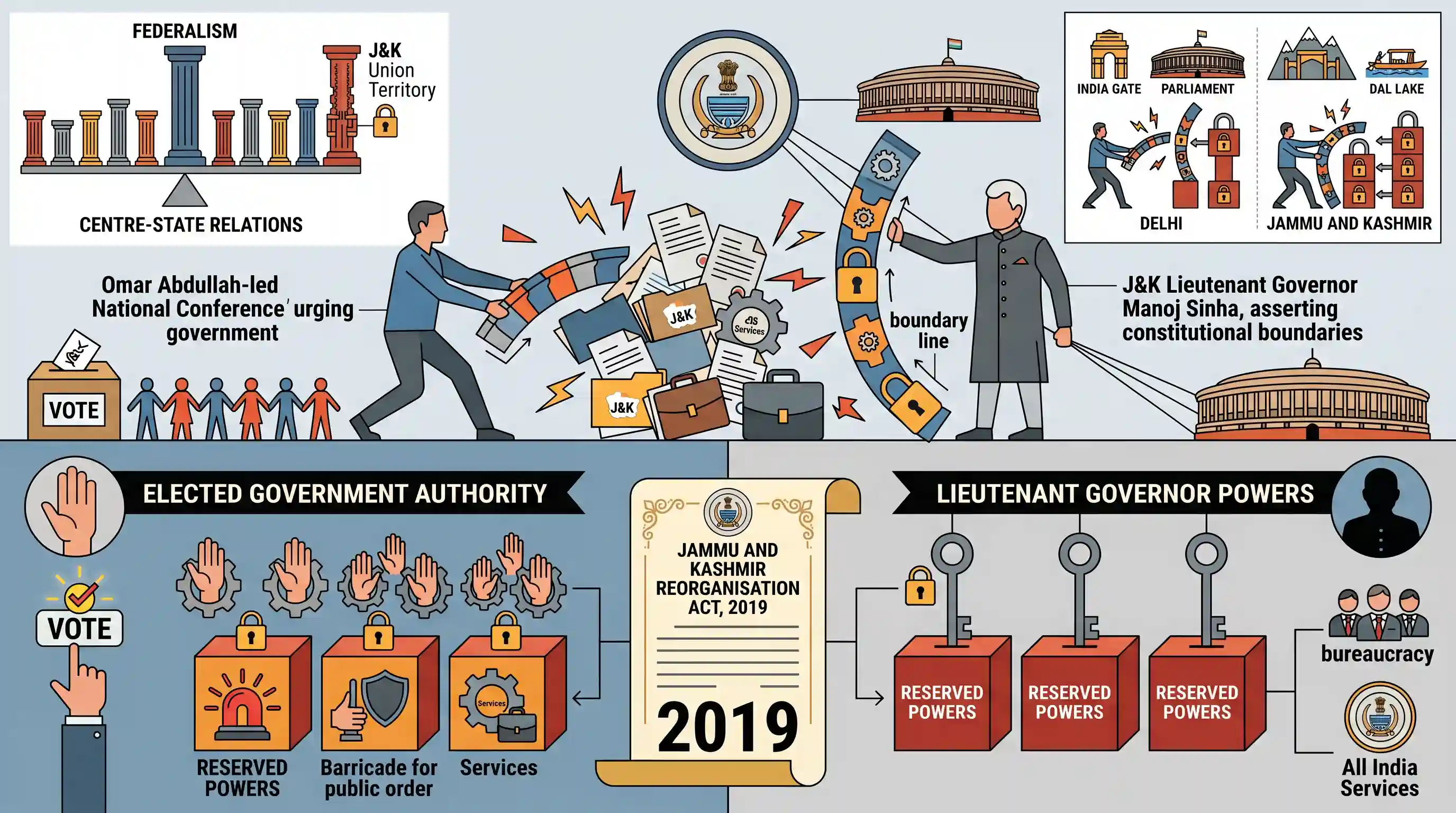
The recent election in J&K has created a new arena for friction between an elected UT government and the Lieutenant Governor. Understanding the division of powers under the J&K Reorganisation Act, 2019, and comparing it with the Delhi governance model is crucial for GS2 Polity questions regarding federalism, devolution of power, and the constitutional role of the LG.
Summary
Amid friction over the transfer of officials, J&K Lieutenant Governor Manoj Sinha asserted he is aware of his constitutional "boundaries," while the Omar Abdullah-led National Conference government urged the Centre to respect its democratic mandate. This incident highlights the emerging administrative tussle in the Union Territory of Jammu & Kashmir between the newly elected legislature and the Lieutenant Governor. Similar to the dynamic in Delhi, the J&K Reorganisation Act, 2019 reserves key powers—including police, public order, and services—for the LG, significantly limiting the elected government's authority and creating structural grounds for federal disputes.
Key Points
- J&K Lieutenant Governor Manoj Sinha commented that he knows his constitutional "boundaries" amid protests from the newly elected government over the transfer of officials.
- The National Conference, led by Chief Minister Omar Abdullah, urged the Centre to respect the democratic mandate given to the elected government.
- Under the J&K Reorganisation Act, 2019, Jammu and Kashmir is a Union Territory with a legislature, but key subjects such as Police, Public Order, and All India Services remain firmly under the Lieutenant Governor's control.
- This administrative tussle over the control of bureaucracy mirrors the ongoing friction seen in Delhi between the elected government and the LG.
- The situation highlights the structural complexities and federal friction inherent in the governance model of Union Territories with legislatures.
Important Terms
Jammu and Kashmir Reorganisation Act, 2019

The 2019 legislation that reconstituted Jammu and Kashmir into two Union Territories (J&K and Ladakh), revoked its special status, and established the current administrative framework for the region.
UPSC context
GS-II (Polity); essential for understanding state reorganization, the unique status of J&K, and shifting power dynamics in Union Territories.
Lieutenant Governor (LG)
The President’s representative and administrative head of a Union Territory. In J&K, the LG holds discretionary powers over subjects including police, public order, and civil services.
UPSC context
GS-II (Polity); tests knowledge of constitutional offices and the executive's role in the federal structure of Union Territories.
Article 239A
A constitutional provision enabling Parliament to create a Legislative Assembly and Council of Ministers for certain Union Territories; it serves as the model for J&K’s current governance structure.
UPSC context
GS-II (Constitution); critical for comparing different Union Territory governance models (Puducherry/J&K vs. Delhi's Article 239AA).
Services
Refers to the administration of civil servants (postings and transfers). In J&K, this is a 'reserved' subject under the LG's jurisdiction, unlike in full-fledged states.
UPSC context
GS-II (Governance); central to disputes over executive control and the separation of powers in a dual-governance system.
Federalism
A constitutional principle where power is shared between central and regional governments. In UTs, it involves 'asymmetric federalism' with varying degrees of local autonomy and central oversight.
UPSC context
GS-II (Polity); foundational concept for analyzing the balance of power and tensions between local mandates and central authority.
Democratic Mandate
The perceived legitimacy and authority granted to a political party to govern based on winning a popular election and representing the collective will of the voters.
UPSC context
GS-II (Polity); relevant to discussions on representative democracy and friction between elected legislatures and central appointees.
Prelims Trap
"Like Delhi, the J&K Legislative Assembly cannot make laws on Public Order, Police, and Land."
J&K's Assembly CAN legislate on "Land". It is only restricted from "Public Order" and "Police". Delhi's Assembly, conversely, is restricted from Police, Public Order, AND Land.
Static Concepts Connected
What are the legislative and executive limitations of the J&K Assembly?
- Police & Public Order: Excluded from the Assembly's legislative purview; strictly reserved for the Union Government.
- Land: Unlike Delhi, the J&K Assembly retains the power to legislate on Land.
- Services Control: Under the 2024 Business Rules amendment, control over All India Services and the Anti-Corruption Bureau rests exclusively with the LG.
What is the 'Triple Chain of Accountability' (GNCTD vs UoI, 2023)?
- The Chain: Civil servants report to Ministers; Ministers are accountable to the Legislature; the Legislature answers to the Electorate.
- Democratic Logic: The Supreme Court ruled that severing bureaucratic control from elected ministers breaks this chain, rendering the democratic mandate ineffective.
Cross-Topic Patterns
Asymmetric Federalism & UTs
The J&K and Delhi governance models highlight 'asymmetric federalism', often linked in Mains to Article 371 provisions and the 6th Schedule's autonomous councils.
Transaction of Business Rules
Amending Transaction of Business Rules to shift executive power to the LG bypasses formal legislative debate, raising Constitutional morality questions for GS2.

Expect a 2026 Prelims multi-statement question contrasting the exact legislative exclusions of J&K (Police, Order) vs Delhi (Police, Order, Land).
Linked PYQs · 3
Linked PYQs · 3
- 2025MainsGS2
Discuss the nature of Jammu and Kashmir Legislative Assembly after the Jammu and Kashmir Reorganization Act, 2019. Briefly describe the powers and functions of the Assembly of the Union Territory of Jammu and Kashmir.
- 2018MainsGS2
Whether the Supreme Court Judgement (July 2018) can settle the political tussle between the Lt. Governor and elected government of Delhi? Examine.
- 2016MainsGS2
Discuss the essentials of the 69th Constitutional Amendment Act and anomalies, if any, that have led to recent reported conflicts between the elected representatives and the institution of the Lieutenant Governor in the administration of Delhi. Do you think that this will give rise to a new trend in the functioning of the Indian federal politics?
