Strait of Hormuz Geopolitical Escalation and Indian Diaspora Security
Source:Indian Express ↗
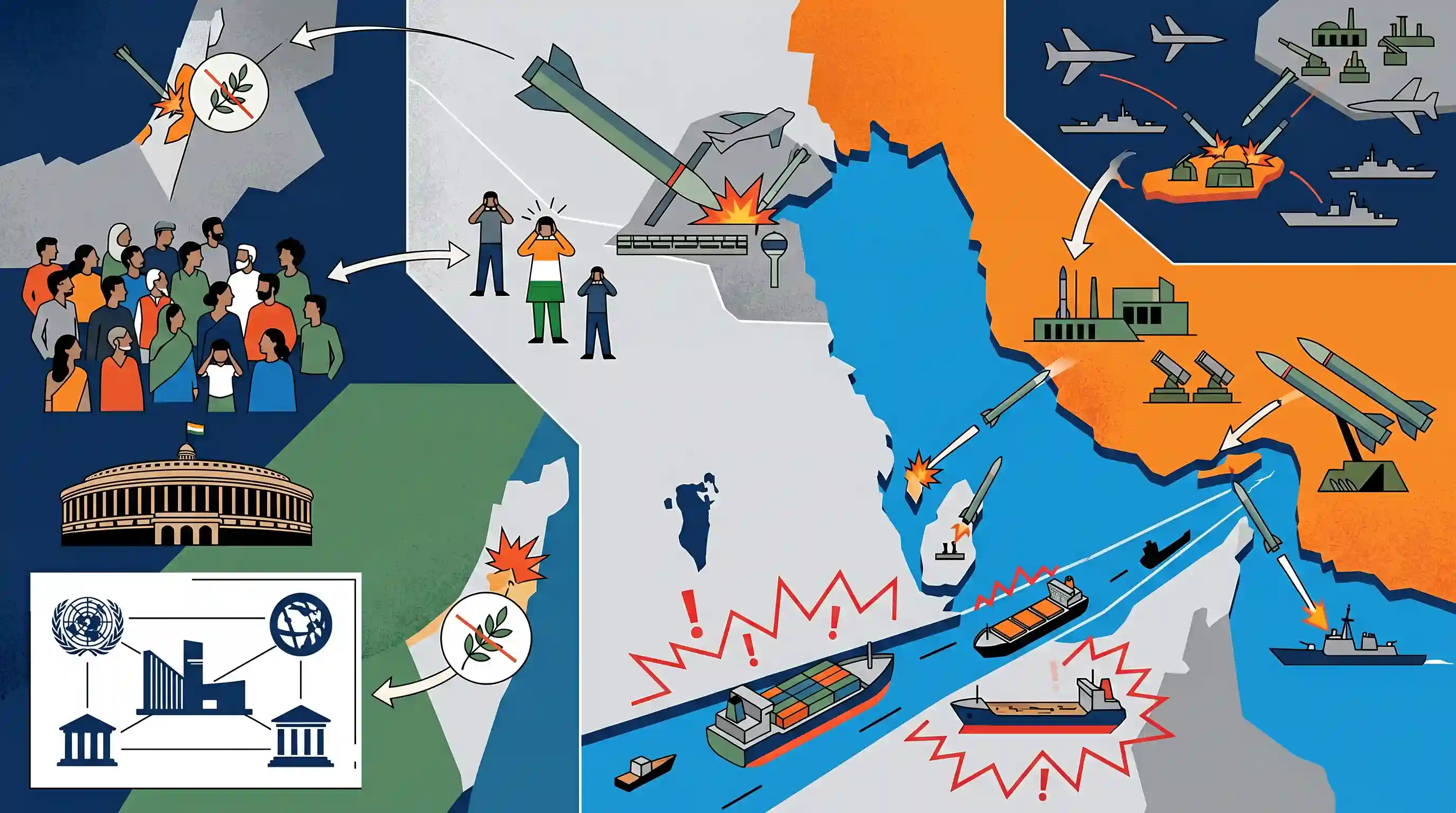
Why It Matters
The conflict's proximity to the Strait of Hormuz—a crucial chokepoint for global oil shipments—poses a direct threat to India's energy security and macroeconomic stability. Furthermore, the death of an Indian national highlights the pressing need for India to calibrate its Middle East diplomacy to ensure the safety and potential evacuation of its massive diaspora during regional escalations.
Summary
An Iranian missile strike on Kuwait airport killed an Indian national, prompting immediate retaliatory strikes by the US on Iran's Qeshm Island near the Strait of Hormuz. The escalation, which involved missile interceptions by Bahraini forces and the US Navy's 5th Fleet, heightens tensions in West Asia and threatens to disrupt fragile ceasefire talks linked to the Israel-Hezbollah conflict. The incident underscores the severe vulnerability of the Indian diaspora in the Gulf region and raises alarm over potential disruptions to global energy supply chains passing through the Strait of Hormuz.
Key Points
- An Iranian missile strike hit Kuwait airport's Terminal 1, resulting in the death of an Indian national.
- The US retaliated by launching military strikes against Iran's Qeshm Island, located in the strategic Strait of Hormuz.
- The US Navy 5th Fleet, headquartered in Bahrain, along with Bahraini forces, was involved in intercepting incoming missiles.
- The direct US-Iran confrontation threatens to derail fragile ceasefire negotiations linked to the broader Israel-Hezbollah conflict in Lebanon.
- The escalating conflict in and around the Strait of Hormuz poses severe risks to global maritime trade and energy security.
Important Terms
Strait of Hormuz

A narrow, strategically vital waterway connecting the Persian Gulf with the Gulf of Oman. It serves as the world's most critical oil chokepoint, handling 20% of global petroleum consumption.
UPSC context
GS Paper 2 & 3; essential for understanding global energy security, maritime trade routes, and India's oil supply vulnerabilities.
US Navy 5th Fleet
A U.S. Navy numbered fleet headquartered in Bahrain. It oversees maritime security in the Persian Gulf, Red Sea, and Arabian Sea, ensuring freedom of navigation through critical chokepoints.
UPSC context
GS Paper 2; relevant to global security architecture, regional stability in West Asia, and protection of international shipping lanes.
Indian Diaspora in the Gulf
The nearly 9 million Indian nationals residing in GCC countries. They are vital to India’s economy through remittances but face security risks during regional geopolitical escalations.
UPSC context
GS Paper 2; specifically covers the 'Indian Diaspora' syllabus topic, focusing on their socio-economic contributions and safety during crises.
Hezbollah
An Iran-backed Shiite militant group and political party based in Lebanon. It is a major regional actor in the 'Axis of Resistance,' frequently engaging in conflict with Israel.
UPSC context
GS Paper 2; crucial for analyzing West Asian geopolitics, non-state actors, and the impact of proxy wars on regional stability.
Qeshm Island
The largest Iranian island in the Persian Gulf, located strategically in the Strait of Hormuz. It houses 'underground missile cities' and serves as a primary platform for Iran's asymmetric naval power.
UPSC context
GS Paper 1 & 2; tests knowledge of strategic geography and military installations impacting global energy transit through maritime bottlenecks.
Prelims Trap
Kuwait shares a land border with both Iraq and Iran.
Kuwait is located at the tip of the Persian Gulf. It shares land borders exclusively with Iraq to the north and Saudi Arabia to the south, not Iran.
Static Concepts Connected
Which water bodies do the major West Asian straits connect?
- Strait of Hormuz: Connects the Persian Gulf to the Gulf of Oman and the broader Arabian Sea. Bordered by Iran and Oman.
- Bab el-Mandeb: Connects the Red Sea to the Gulf of Aden and the Arabian Sea. Bordered by Yemen, Djibouti, and Eritrea.
- Suez Canal: Artificial waterway connecting the Red Sea to the Mediterranean Sea, controlled by Egypt.
How does India currently secure its maritime trade in the volatile Gulf region?
- Operation Sankalp: Launched by the Indian Navy in 2019 to ensure the safe passage of Indian-flagged vessels navigating the Strait of Hormuz amid rising US-Iran tensions.
- IFC-IOR: The IFC-IOR in Gurugram monitors regional shipping traffic, piracy, and maritime security threats, coordinating with partner navies in the Gulf.
Cross-Topic Patterns
Strait of Hormuz + Energy Security
Conflict in this vital chokepoint threatens India's crude imports, directly testing the adequacy of India's Strategic Petroleum Reserves (ISPRL) to handle sudden supply shocks.
Diaspora Evacuations + Remittances
With ~9 million Indians in the Gulf, prolonged conflict necessitates massive evacuation protocols (like the 1990 Kuwait airlift) and threatens India's crucial inward remittance flows.

Expect a 2026 Prelims map question matching West Asian islands (Qeshm, Bahrain, Socotra) to their sovereign states or adjacent water bodies.
Linked PYQs · 3
Linked PYQs · 3
- 2025MainsGS2
"Energy security constitutes the dominant kingpin of India's foreign policy, and is linked with India's overarching influence in Middle Eastern countries.” How would you integrate energy security with India's foreign policy trajectories in the coming years?
- 2018MainsGS2
In what ways would the ongoing US-Iran Nuclear Pact Controversy affect the national interest of India? How should India respond to this situation?
- 2017MainsGS2
The question of India's Energy Security constitutes the most important part of India's economic progress. Analyze India's energy policy cooperation with West Asian countries.
