Unidentified Drone Debris Recovered from Kutch Coastline
Source:Indian Express ↗
Why It Matters
Provides a real-world example of the emerging security challenges involving drones and UAVs in border and coastal regions, highly relevant to GS3 Internal Security and Border Management topics.
Summary
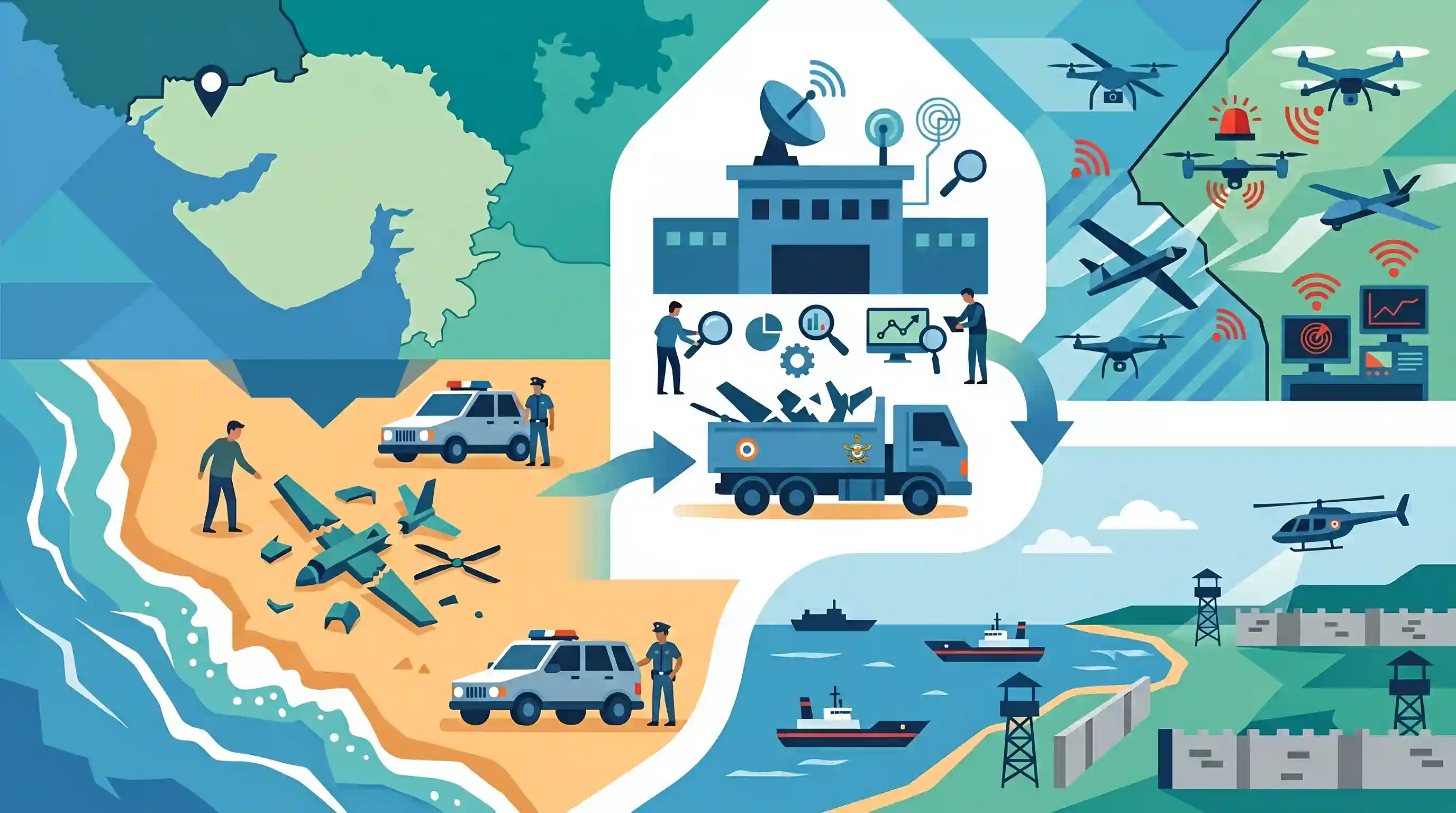
Debris of an unidentified Unmanned Aerial Vehicle (UAV) was found on a beach in Gujarat's Kutch district, near the international land and sea border with Pakistan. Discovered by a passer-by and initially secured by the local police, the drone parts have been sent to the Indian Air Force base in Bhuj for investigation. The incident underscores the emerging internal security threats posed by drones along sensitive maritime and land borders.
Key Points
- Debris from an unmanned aerial vehicle (UAV) was discovered washed ashore on Pingleshwar Mahadev beach in Gujarat's Kutch district.
- The Kutch region shares both land and maritime boundaries with Pakistan, making it a sensitive border area.
- The debris has been transferred to the Indian Air Force (IAF) base in Bhuj for detailed forensic and technical investigation.
- The incident highlights ongoing concerns about the use of drones by adversaries for surveillance, drug smuggling, or ferrying arms across international borders.
Important Terms
Unmanned Aerial Vehicle (UAV)

A remotely piloted or autonomous aircraft used for surveillance, reconnaissance, or payload delivery. In security contexts, they are increasingly used by adversaries for smuggling or asymmetric attacks.
UPSC context
GS III (Internal Security). Tests awareness of emerging technology-based threats like 'drone-terrorism' and cross-border smuggling.
Border Security Force (BSF)
India’s 'First Line of Defence,' this Central Armed Police Force (CAPF) is mandated to guard the international borders with Pakistan and Bangladesh.
UPSC context
GS III (Security Forces & Agencies). Tests understanding of specific organizational mandates for border guarding during peace and war.
Indian Air Force (IAF)
The air arm of the Indian Armed Forces responsible for securing Indian airspace and conducting aerial warfare; it also handles high-tech aerial surveillance and air defense.
UPSC context
GS III (Internal Security/Defense). Tests knowledge of air power's role in national security and technological investigation of aerial threats.
Coastal Security
A multi-layered 3-tier grid involving the Marine Police (shallow waters), Indian Coast Guard (EEZ), and Indian Navy (overall maritime security) to protect India's 7,516 km coastline.
UPSC context
GS III (Security Challenges in Border Areas). Focuses on post-26/11 architectural changes and inter-agency coordination mechanisms.
Border Management
The strategic process of securing a nation's frontiers through physical infrastructure (fencing), technological integration (sensors), and diplomatic measures.
UPSC context
GS III. A core syllabus topic; tests knowledge of terrain-specific challenges (e.g., marshy Kutch) and modernization strategies.
Comprehensive Integrated Border Management System (CIBMS)
A technology-driven border security system utilizing sensors, high-tech cameras, and radars to provide seamless surveillance where physical fencing is unfeasible.
UPSC context
GS III (Internal Security). Tests awareness of technological solutions for securing 'smart' borders against intrusions.
Prelims Trap
"The Indian Coast Guard has exclusive coastal security jurisdiction over India's territorial waters up to 12 nautical miles."
False. India operates a 3-tier coastal security grid. The State Marine Police handles shallow waters up to 12 nautical miles, not the Coast Guard.
Static Concepts Connected
What is India's three-tier coastal security architecture?
- State Marine Police: Responsible for patrolling shallow coastal waters and the immediate shoreline up to 12 nautical miles (Territorial Waters).
- Indian Coast Guard: Secures the intermediate layer, patrolling waters from 12 to 200 nautical miles, covering India's Exclusive Economic Zone (EEZ).
- Indian Navy: Forms the outer ring, patrolling beyond 200 nautical miles and maintaining overall maritime security command.
How do indigenous anti-drone systems neutralize rogue UAVs?
- Soft Kill tech: Neutralizes threats by jamming radio frequency (RF) communications and spoofing GNSS signals to blind or disorient the drone.
- Hard Kill tech: Uses Directed Energy Weapons (DEWs), such as high-powered lasers, to physically destroy the rogue UAV in mid-air.
Cross-Topic Patterns
UAVs + Golden Crescent narco-terrorism
The Kutch border's proximity to the Golden Crescent makes drones the new preferred vector for cross-border narco-terrorism, bypassing traditional physical marshland patrols in the Sir Creek region.
Sir Creek geography + Border disputes
Geographical fluidity in the Rann of Kutch tidal estuary complicates physical border demarcation, making low-flying aerial intrusions harder to map against specific territorial violations.

2026 Prelims could test DRDO's counter-drone technologies (Soft vs Hard kill) paired with India's 3-tier coastal security jurisdictions.
Linked PYQs · 5
Linked PYQs · 5
- 2023MainsGS3
The use of unmanned aerial vehicles (UAVs) by our adversaries across the borders to ferry arms/ammunitions, drugs, etc., is a serious threat to the internal security. Comment on the measures being taken to tackle this threat.
- 2025MainsGS3
Why is maritime security vital to protect India's sea trade? Discuss maritime and coastal security challenges and the way forward.
- 2022MainsGS3
What are the maritime security challenges in India ? Discuss the organisational, technical and procedural initiatives taken to improve the maritime security.
- 2020MainsGS3
Analyze internal security threats and transborder crimes along Myanmar, Bangladesh and Pakistan borders including Line of Control (LoC). Also discuss the role played by various security forces in this regard.
- 2024MainsGS3
India has a long and troubled border with China and Pakistan fraught with contentious issues. Examine the conflicting issues and security challenges along the border. Also give out the development being undertaken in these areas under the Border Area Development Programme (BADP) and Border Infrastructure and Management (BIM) Scheme.
