Post Conflict Power Dynamics in Northern Syria
Source:The Hindu ↗
Why It Matters
The ongoing instability in Syria and the shifting power dynamics involving Kurdish forces, Turkiye, and Israel are crucial for understanding Middle Eastern geopolitics. 'Places in news' like Aleppo are a recurring theme in Prelims, while the broader regional instability affects global energy security and international relations.
Summary
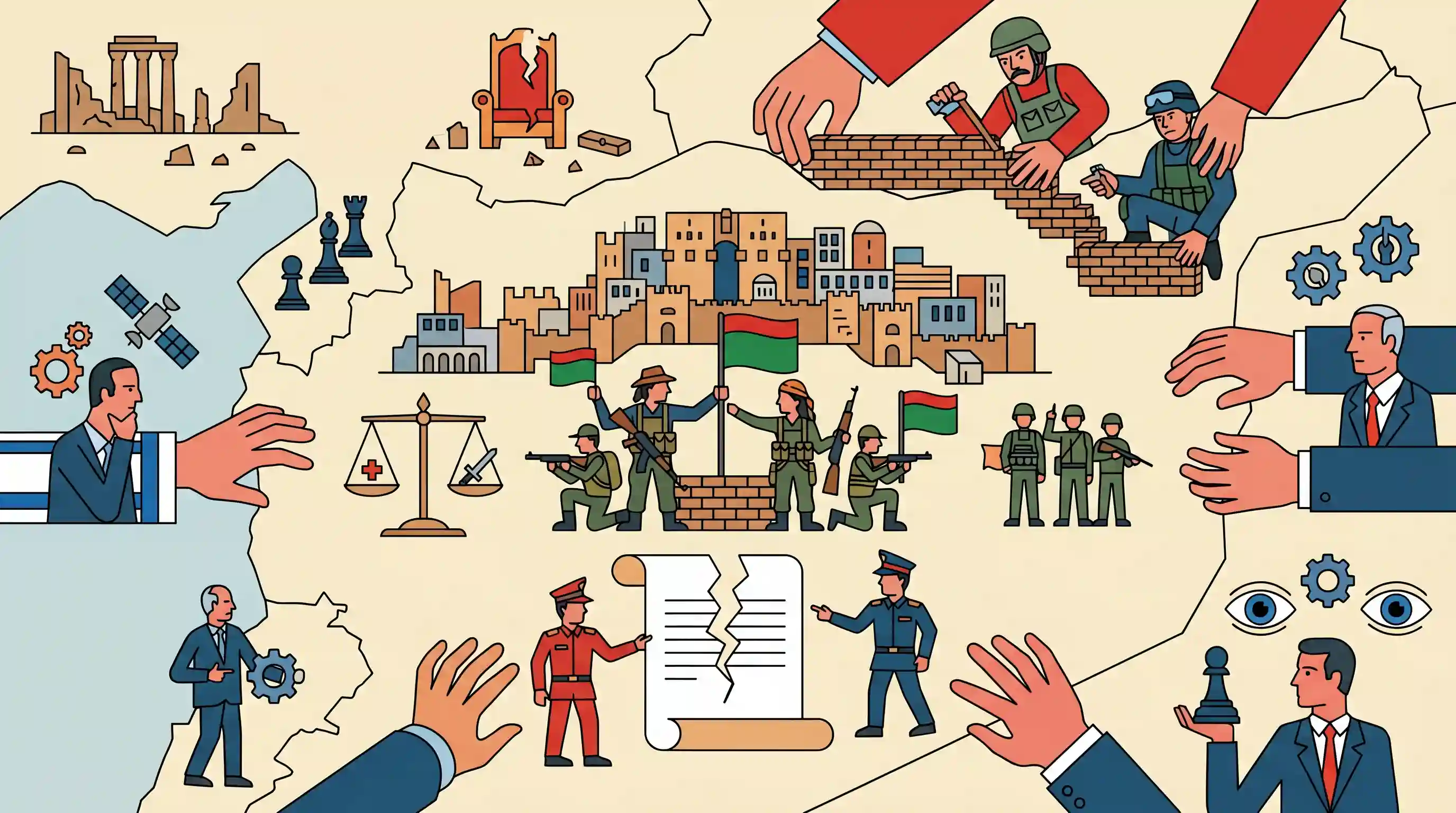
Kurdish fighters belonging to the Syrian Democratic Forces (SDF) have refused to withdraw from the northern Syrian city of Aleppo, despite a truce agreement with the new Syrian government. The development highlights the complex power vacuum left by the ouster of Bashar al-Assad, as Kurdish groups seek to retain their autonomy and integrate their military into the state apparatus on their own terms. Meanwhile, regional powers like Turkiye and Israel continue to maneuver for influence in the volatile post-war landscape, with Ankara particularly concerned about Kurdish territorial gains near its border.
Key Points
- Kurdish fighters from the Syrian Democratic Forces (SDF) remain in Aleppo despite a truce agreement with the new Syrian government forces.
- The SDF, having helped oust President Bashar al-Assad, asserts control over certain northern and northeastern areas of Syria.
- Negotiations continue over the political and military integration of the Kurdish administration into the newly formed Syrian government.
- Neighboring Turkiye continues to oppose Kurdish autonomy near its border, while external actors like Israel also vie for influence in post-Assad Syria.
Important Terms
Syrian Democratic Forces (SDF)

A multi-ethnic, Kurdish-led military alliance in Northern Syria. Primarily known as the key ground partner for the US-led coalition against ISIS, it controls significant territory and seeks regional autonomy.
UPSC context
GS II: West Asia Geopolitics. Tests understanding of non-state actors and their role in regional security and counter-terrorism.
Aleppo
Syria's second-largest city and a historic trade hub. Located near the Turkish border, its strategic position makes it a vital military and political gateway in the Syrian conflict.
UPSC context
GS II: Places in News / Mapping. Significant for understanding the geography of conflicts and the impact of urban control on state stability.
Rojava (Autonomous Administration of North and East Syria)
The de facto autonomous region in Northeast Syria (officially DAANES). It operates a decentralized governance model established by Kurdish groups during the Syrian Civil War, emphasizing ethnic pluralism and self-rule.
UPSC context
GS II: International Relations. Relevant for studying regional autonomy movements and their impact on West Asian borders.
Democratic Confederalism
A political ideology emphasizing grassroots democracy, gender equality, and ecology without the need for a nation-state. It is the guiding framework for the self-governance experiment in Kurdish-led Syrian regions.
UPSC context
GS I/II: Political Ideologies. Analyzes alternative governance models and social movements in conflict-prone multi-ethnic regions.
Power Vacuum
A political condition arising from the collapse of a central authority, leading to a loss of control that various regional powers or militant groups compete to fill.
UPSC context
GS II: International Security. Tests the ability to analyze how state failure impacts regional stability and external intervention.
Kurdistan Workers' Party (PKK)
A Kurdish militant and political organization in Turkey. Its alleged links to Syrian Kurdish forces drive Turkiye's security concerns and military operations in Northern Syria.
UPSC context
GS II: West Asia Geopolitics. Essential for understanding Turkiye’s foreign policy and cross-border security dynamics.
Prelims Trap
"The Kurds are an ethnic group native exclusively to northern Syria."
The Kurds are one of the world's largest stateless nations, spread across a continuous geographic area spanning Turkiye, Iraq, Iran, and Syria.
Static Concepts Connected
Which countries share a land border with Syria?
- North: Turkiye shares the longest land border with Syria, located to the north.
- East and South: Iraq lies to the east and southeast, while Jordan shares the southern border.
- West and Southwest: Lebanon and Israel border the southwest, with the Mediterranean Sea lying directly west.
What characterizes a "stateless nation" in international relations?
- Shared Identity: An ethnic or cultural group possessing a distinct national identity but lacking its own sovereign state, such as the Kurds or Palestinians.
- Geographic Dispersion: The population is typically distributed across multiple existing nation-states, often leading to cross-border conflicts and prolonged struggles for autonomy.
Cross-Topic Patterns
Middle East vacuum and India's energy security
Instability in post-Assad Syria threatens broader West Asian peace, which directly impacts India's vital oil supply chains and diaspora safety in neighboring Gulf states.
Turkiye's complex geopolitical buffering
Ankara’s intervention against Kurdish autonomy in Syria intersects with its NATO membership and its historically fluid, transactional stance towards Russian and US regional interests.

Expect a 'Places in News' match-the-following question pairing ethnic groups (Kurds, Yazidis) to their geographic spread in West Asia.
Linked PYQs · 4
Linked PYQs · 4
- 2018PrelimsGS1
Consider the following pairs: Towns sometimes mentioned in news Country 1. Aleppo Syria 2. Kirkuk Yemen 3. Mosul Palestine 4. Mazar-i-sharif Afghanistan Which of the pairs given above are correctly matched?
- 2025MainsGS2
"Energy security constitutes the dominant kingpin of India's foreign policy, and is linked with India's overarching influence in Middle Eastern countries.” How would you integrate energy security with India's foreign policy trajectories in the coming years?
- 2023PrelimsGS1
Consider the following pairs: Area of conflict mentioned in news Country where it is located 1. Donbas : Syria 2. Kachin : Ethiopia 3. Tigray : North Yemen How many of the above pairs are correctly matched?
- 2015PrelimsGS1
The area known as 'Golan Heights' sometimes appears in the news in the context of the events related to
