Kuno national park set to receive cheetahs from Botswana
Source:The Hindu ↗
Why It Matters
The ongoing Project Cheetah is a prime example of international cooperation for species reintroduction and biodiversity conservation. For UPSC aspirants, understanding the geography of protected areas like Kuno National Park and Gandhi Sagar Wildlife Sanctuary, as well as the historical context of cheetah extinction in India, is highly relevant for both Prelims (Environment/Geography) and Mains (GS-3).
Summary
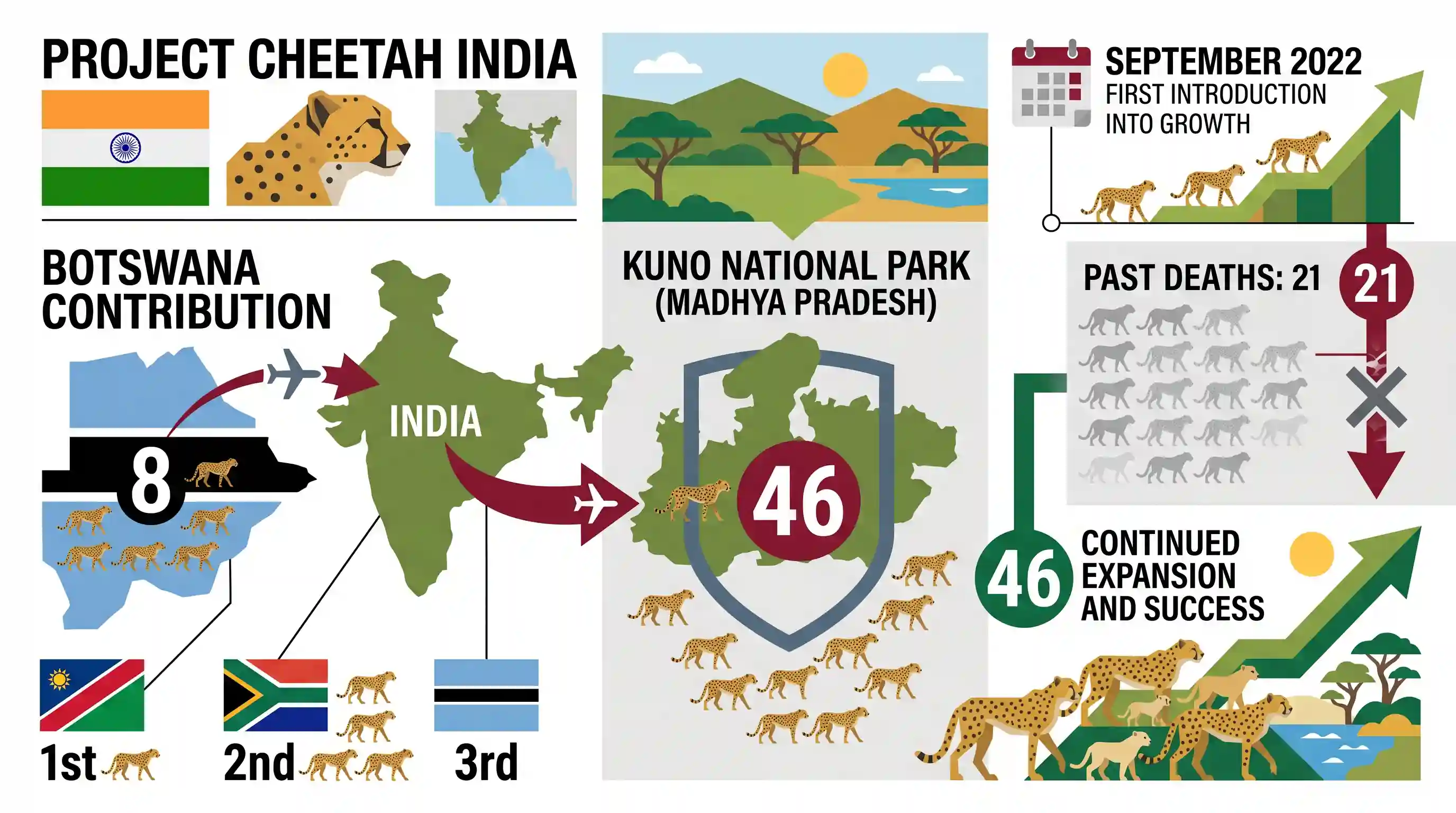
As part of Project Cheetah, India is set to receive eight cheetahs from Botswana, making it the third African nation to contribute to the reintroduction initiative after Namibia and South Africa. The cheetahs will be housed at Madhya Pradesh's Kuno National Park, taking the country's total cheetah population to 46. The project, which began in September 2022, continues to expand its conservation efforts despite the past deaths of 21 cheetahs at Kuno.
Key Points
- Eight cheetahs (six males, two females) are arriving from Botswana to Kuno National Park on February 28.
- Botswana becomes the third African nation to supply cheetahs to India's reintroduction program, following Namibia and South Africa.
- India's current cheetah population stands at 38 (including 27 India-born cubs), with three adults relocated to the Gandhi Sagar Wildlife Sanctuary.
- The newly arriving cheetahs will undergo a mandatory 30-day quarantine period upon arrival at Kuno.
- Project Cheetah, initiated in September 2022, aims to establish a sustainable population of cheetahs, which were declared extinct in India in 1952.
Important Terms
Project Cheetah

India's landmark initiative to reintroduce the cheetah, the world's first inter-continental large wild carnivore translocation project, aimed at restoring grassland and savanna ecosystems.
UPSC context
GS Paper III: Environment & Biodiversity; tests knowledge of species extinction, conservation milestones, and ecosystem restoration strategies.
Kuno National Park
A protected area in Madhya Pradesh's Sheopur district selected as the primary site for cheetah reintroduction due to its grassland-forest mosaic and historical suitability for big cats.
UPSC context
GS Paper III: Protected Areas; requires identifying habitats, river systems (Kuno River), and regional biodiversity corridors.
Species Reintroduction
The intentional release of an organism into its native range where it has been extirpated, aiming to establish a self-sustaining population and restore ecological processes.
UPSC context
GS Paper III: Ecology; tests understanding of IUCN guidelines and the role of apex predators in food web stability.
National Tiger Conservation Authority (NTCA)
A statutory body under the Ministry of Environment, Forest and Climate Change, established under the Wildlife (Protection) Act, 1972, serving as the nodal agency for Project Cheetah.
UPSC context
GS Paper II & III: Governance & Environment; tests knowledge of statutory bodies and executive implementation of conservation laws.
Flagship Species
A species used as a symbol to represent an environmental cause, using its public appeal to attract funding and support for broader habitat conservation efforts.
UPSC context
GS Paper III: Biodiversity; tests ability to differentiate between conservation roles (Flagship, Keystone, and Umbrella species).
Umbrella Species
A species whose conservation requirements encompass the needs of many other species, effectively protecting the entire ecosystem when its own habitat is preserved.
UPSC context
GS Paper III: Ecology; examines the strategic ecological rationale behind large-scale carnivore conservation.
Botswana (Conservation Partnership)
The third African nation to partner with India under Project Cheetah, contributing to genetic diversity and strengthening India-Africa conservation diplomacy and South-South cooperation.
UPSC context
GS Paper II: International Relations; tests knowledge of bilateral environmental pacts and India’s global leadership in wildlife management.
Prelims Trap
"Project Cheetah exclusively sources critically endangered Asiatic Cheetahs from Namibia and South Africa."
India is translocating the African Cheetah (Vulnerable), not the Asiatic Cheetah (Critically Endangered, found only in Iran). Additionally, Botswana is now the third source country, breaking the Namibia/South Africa duopoly.
Static Concepts Connected
How do African and Asiatic Cheetahs differ in conservation status?
- African Cheetah: Listed as Vulnerable by the IUCN. Found widely across Sub-Saharan Africa. Slightly larger in build compared to its Asian counterpart.
- Asiatic Cheetah: Listed as Critically Endangered by the IUCN. Currently restricted to a highly precarious, tiny population in Iran.
What are the key geographical features of Gandhi Sagar Wildlife Sanctuary?
- Hydrology: Located in Madhya Pradesh, it is physically bifurcated by the Chambal River, providing a perennial water source.
- Biome: Features a classic savanna ecosystem with open grasslands and northern tropical dry deciduous forests, making it an ideal secondary habitat for cheetahs.
Cross-Topic Patterns
Carrying Capacity & Metapopulation Strategy
Moving cheetahs to Gandhi Sagar highlights a 'metapopulation' strategy—managing spatially isolated populations as a single entity to prevent inbreeding and avoid exceeding local carrying capacities at Kuno.
Conservation Diplomacy in Sub-Saharan Africa
Wildlife translocation from Namibia, South Africa, and now Botswana serves as a unique soft-power tool, deepening India's bilateral diplomatic and environmental engagements in Sub-Saharan Africa.

Expect a 2026 prelims pairing of Gandhi Sagar WLS ecology (Chambal river, savanna biome) with the African Cheetah's IUCN status.
Linked PYQs · 2
Linked PYQs · 2
- 2017PrelimsGS1
Recently there was a proposal to translocate some of the lions from their natural habitat in Gujarat to which one of the following sites?
- 2020PrelimsGS1
Which one of the following protected areas is well-known for the conservation of a sub-species of the Indian swamp deer (Barasingha) that thrives well on hard ground and is exclusively graminivorous?
