Himachal Pradesh High Court rules on Kullu Dussehra deity protocols
Source:nationpathindia ↗
Why It Matters
Kullu Dussehra is a prominent international cultural festival in Himachal Pradesh, and judicial interventions regarding its management and deity participation hold immense socio-cultural and administrative significance for the state.
Summary
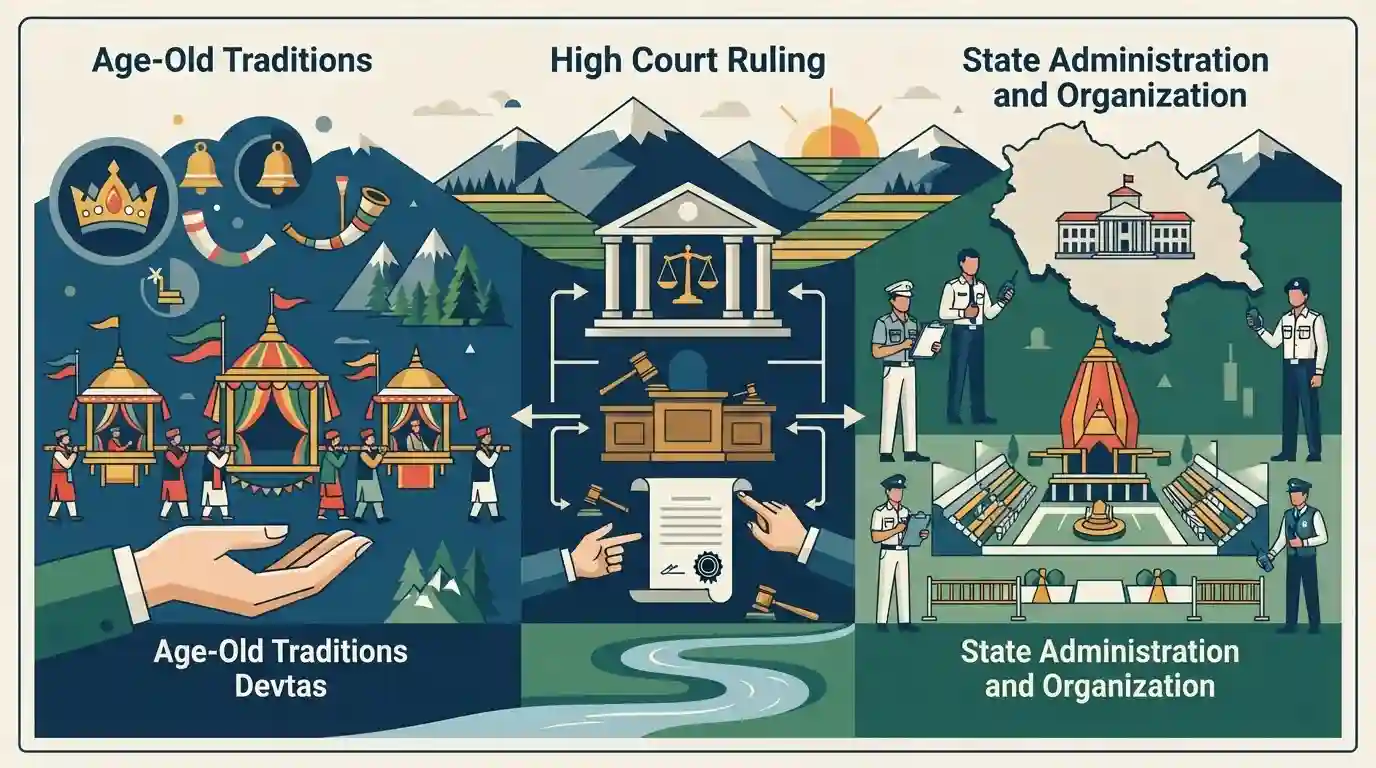
The Himachal Pradesh High Court delivered a landmark ruling regarding the protocol for inviting and organizing local deities (Devtas) for the historic Kullu Dussehra festival, balancing state administration with age-old religious traditions.
Key Points
- The Himachal Pradesh High Court issued a significant ruling concerning the invitation and participation of regional deities (Devtas) in the international Kullu Dussehra festival.
- The court addressed administrative protocols, government facilitation, and traditional autonomy regarding local deities who congregate at Dhalpur maidan.
- Kullu Dussehra is a unique week-long international festival where hundreds of local deities assemble to pay obeisance to Lord Raghunath.
Important Terms
Himachal Pradesh High Court

The highest judicial body in Himachal Pradesh, which recently ruled that only historically recognized deities documented in the Wajib-ul-Arz are entitled to official invitations and VIP facilities at Kullu Dussehra.
UPSC context
HPAS Paper II (Polity & Governance) and HP specific culture; tests judicial interpretation of local religious customs and administrative rights.
Kullu Dussehra
An international festival celebrated in Kullu, Himachal Pradesh, distinguished by the traditional congregation of hundreds of local deities from across the valley.
UPSC context
HPAS Paper I (Himachal Art and Culture); tests knowledge of premier state festivals, traditional deity protocols, and socio-religious heritage.
Wajib-ul-Arz
A historical revenue document recording local customs, rights, and recognized local deities in Himachal Pradesh, used as a legal benchmark for festival participation.
UPSC context
HPAS Paper I & II; important for understanding historical land revenue records and legal standing of traditional local institutions.
Prelims Trap
All local deities of Himachal Pradesh have an absolute constitutional right to state-funded VIP protocol at the Kullu Dussehra festival.
Aspirants might confuse the modern Kullu Dussehra organizing committee guidelines with the ancient religious origin of the festival itself, or mistake newly formed temple committees for historically recognized deities listed in the Wajib-ul-Arz.
Static Concepts Connected
What are the key features and historical significance of Kullu Dussehra in Himachal Pradesh?
- Origin: Started in the 17th century by Raja Jagat Singh, who brought an idol of Lord Raghunath from Ayodhya and placed it on the throne of Kullu.
- Celebration: Unlike rest of India where Dussehra marks the burning of Ravana, in Kullu it begins on Vijayadashami and lasts for a week, marking the gathering of local gods.
- Congregation: Centres around Dhalpur Maidan where hundreds of local deities (Devtas) arrive in elaborate rath yatras to pay obeisance to Lord Raghunath.
- International Status: Granted the status of an International Festival in 1972, attracting tourists and pilgrims worldwide.
Cross-Topic Patterns
Land Revenue Records Meet Cultural Heritage Law
The use of revenue records like Wajib-ul-Arz in judicial rulings connects cultural heritage disputes with land settlement history and British-era revenue administration in Himachal Pradesh.
Secular Administration vs. Traditional Deity Protocols
The state government's financial facilitation for deities during Dussehra highlights the interplay between secular state administration and the management of religious institutions.

HPAS Mains GS1 (Culture of HP) or GS2 (Judiciary/Governance): Expect a question on the legal status of folk traditions vs state administration.
Linked PYQs · 1
Linked PYQs · 1
- 2017HPAS_PRELIMSGS1
'Madho Rai ki Jaleb' is the main attraction of which popular Himachali fair ?
